
Rummy Sequence vs Set: Rules and Examples
Learn the difference between a rummy sequence and set, why sequences are compulsory, and how to arrange all 13 cards for a valid declaration.
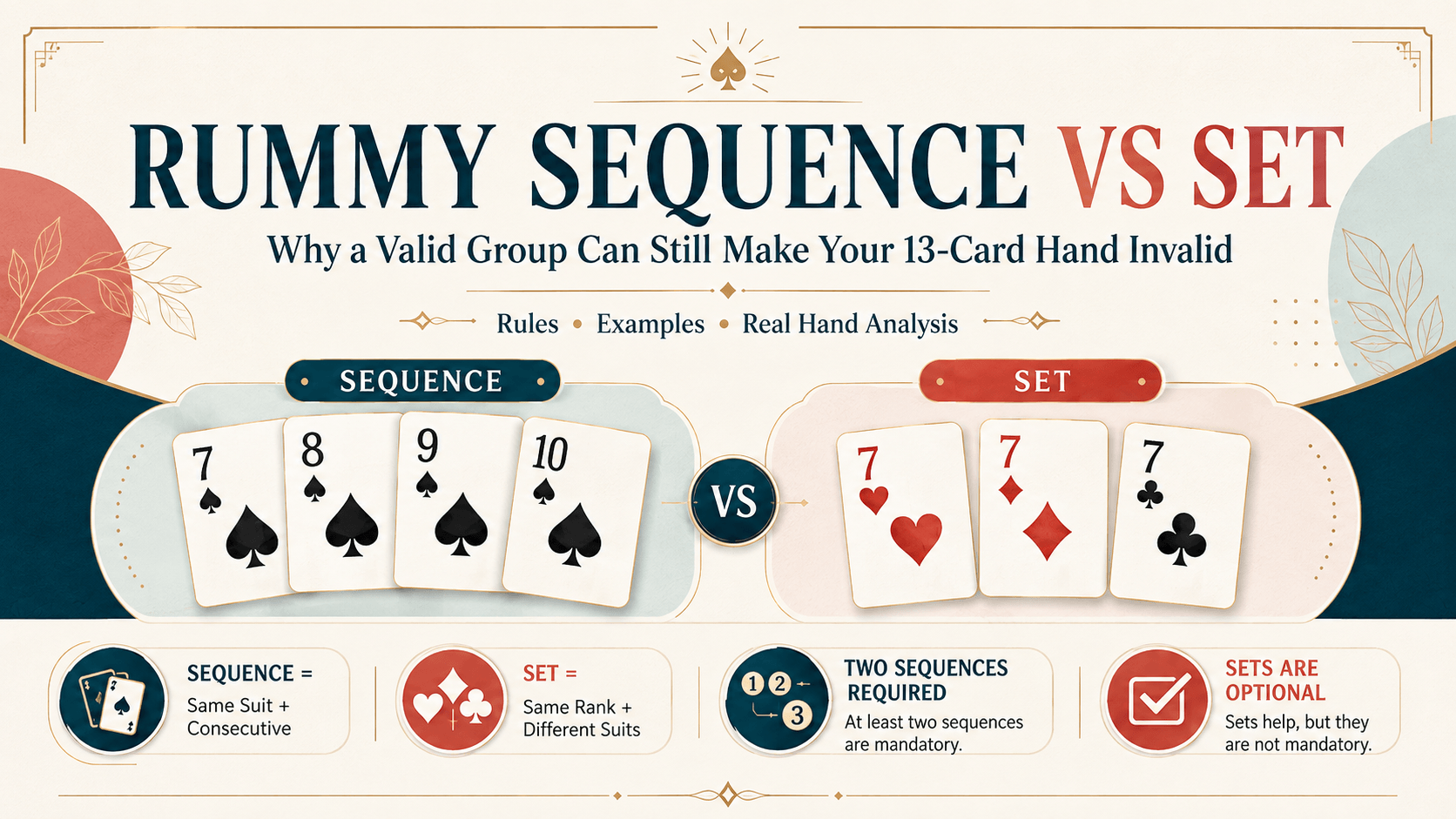
A sequence can be perfectly valid.
A set can also be perfectly valid.
Yet choosing the wrong one can still make your entire 13-card hand invalid.
That sounds contradictory until you stop looking at Rummy as a collection of separate groups and start looking at it as a 13-card allocation problem.
Consider one card:
7♠
It could belong to:
7♠ 8♠ 9♠
as part of a sequence.
Or it could belong to:
7♠ 7♥ 7♦
as part of a set.
Both groups are valid.
But the same 7♠ cannot belong to both groups at the same time.
So the real question is not:
“Is this card part of a sequence or a set?”
The better question is:
“Where should this card go so that the entire 13-card hand works?”
That is where sequence and set strategy actually becomes interesting.
Sequence vs Set: The Basic Difference
Let us clear up the basic rule first.
What Is a Sequence?
A sequence contains at least three consecutive cards of the same suit.
For example:
5♥ 6♥ 7♥
The suit remains the same:
♥ ♥ ♥
And the ranks are consecutive:
5 → 6 → 7
A sequence therefore depends on:
Same Suit + Consecutive Rank
What Is a Set?
A set normally contains three or four cards of the same rank with different suits.
For example:
8♠ 8♥ 8♦
The rank remains the same:
8 = 8 = 8
But the suits are different.
A set therefore depends on:
Same Rank + Different Suits
That is the textbook difference.
But it is not the most important difference.
Sequence and Set Are Not Equal Requirements
In standard 13-card Indian Rummy, a valid declaration normally requires:
- At least two sequences
- At least one pure sequence
- All remaining cards arranged into valid sequences or sets
This creates an important hierarchy.
Sequences are compulsory.
Sets are optional.
You can make a valid hand without a single set.
But you cannot make a standard valid declaration without the required sequences.
This changes the way sequence and set should be compared.
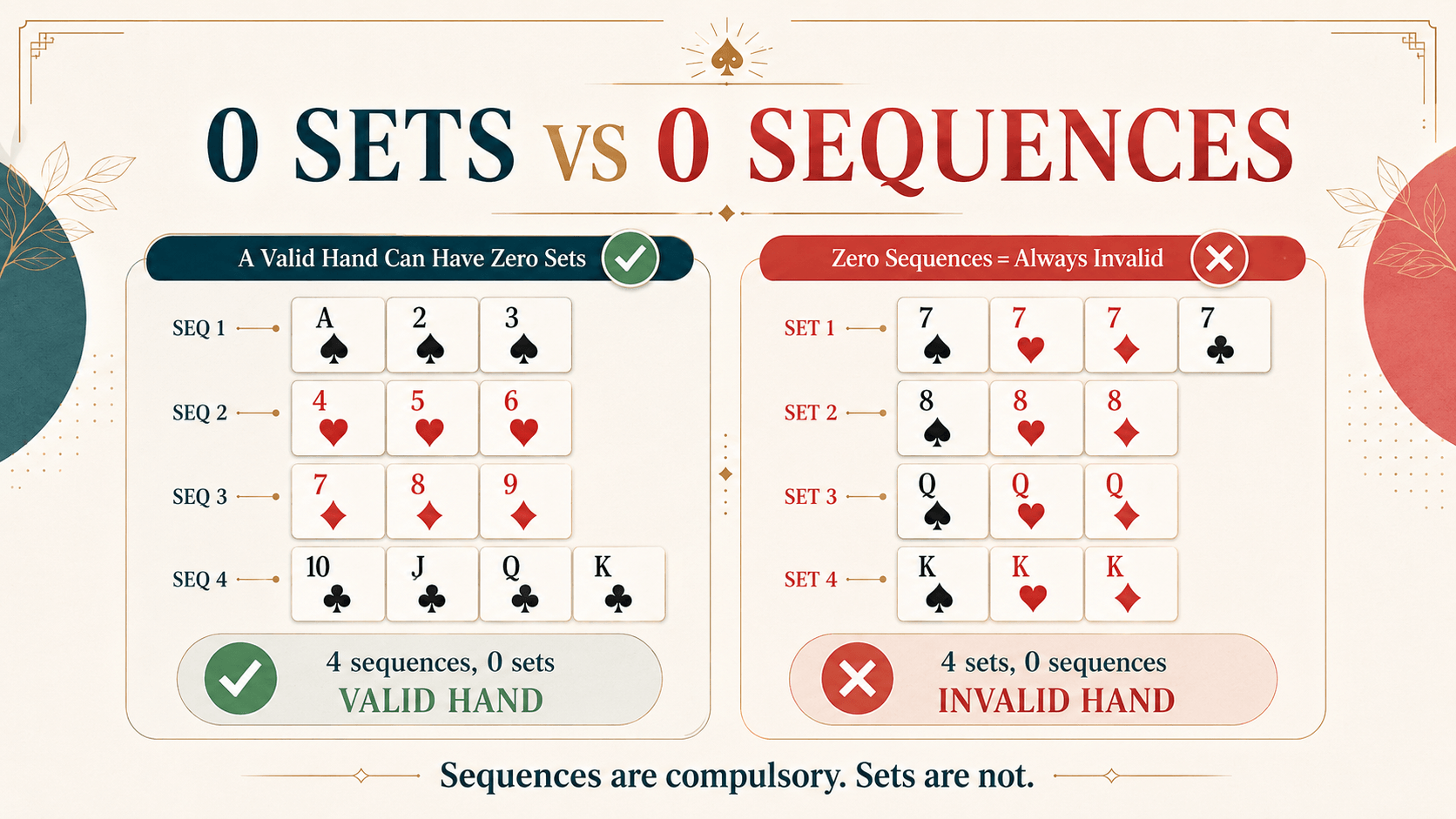
A Valid Rummy Hand Can Have Zero Sets
Consider this hand:
Sequence 1
A♠ 2♠ 3♠
Sequence 2
4♥ 5♥ 6♥
Sequence 3
7♦ 8♦ 9♦
Sequence 4
10♣ J♣ Q♣ K♣
Card count:
3 + 3 + 3 + 4 = 13
There are:
4 sequences
and:
0 sets
Yet every card has a valid place, and the sequence requirements are satisfied.
So sets are clearly not mandatory.
Now Try the Exact Opposite
Imagine this hand:
Set 1
7♠ 7♥ 7♦ 7♣
Set 2
8♠ 8♥ 8♦
Set 3
Q♠ Q♥ Q♦
Set 4
K♠ K♥ K♦
Again:
4 + 3 + 3 + 3 = 13 cards
Every individual group looks valid.
Every card is grouped.
There are no loose cards.
But the hand contains:
0 sequences
So it fails the standard declaration structure.
This leads to one of the most useful principles in 13-card Rummy:
A collection of valid groups does not automatically create a valid hand.
The complete structure matters.
Sequence Solves an Order Problem
A sequence is built around continuity.
Take:
6♣ 7♣ 8♣
Two conditions must remain intact.
Suit
All cards are Clubs.
Rank
6 → 7 → 8
Change the suit:
6♣ 7♦ 8♣
and the sequence fails.
Remove one rank:
6♣ 8♣ 9♣
and it also fails because 7♣ is missing.
So sequence logic can be summarized as:
Fixed Suit + Rank Continuity
Set Solves a Membership Problem
Now look at:
6♣ 6♦ 6♥
There is no consecutive order to maintain.
Instead:
Rank is fixed
6 = 6 = 6
Suit varies
♣ ♦ ♥
The group works because the cards belong to the same rank family.
So set logic is:
Fixed Rank + Suit Diversity
This difference becomes very important when one card can participate in both structures.
The 13-Card Allocation Problem
Now let us use a complete hand rather than isolated examples.
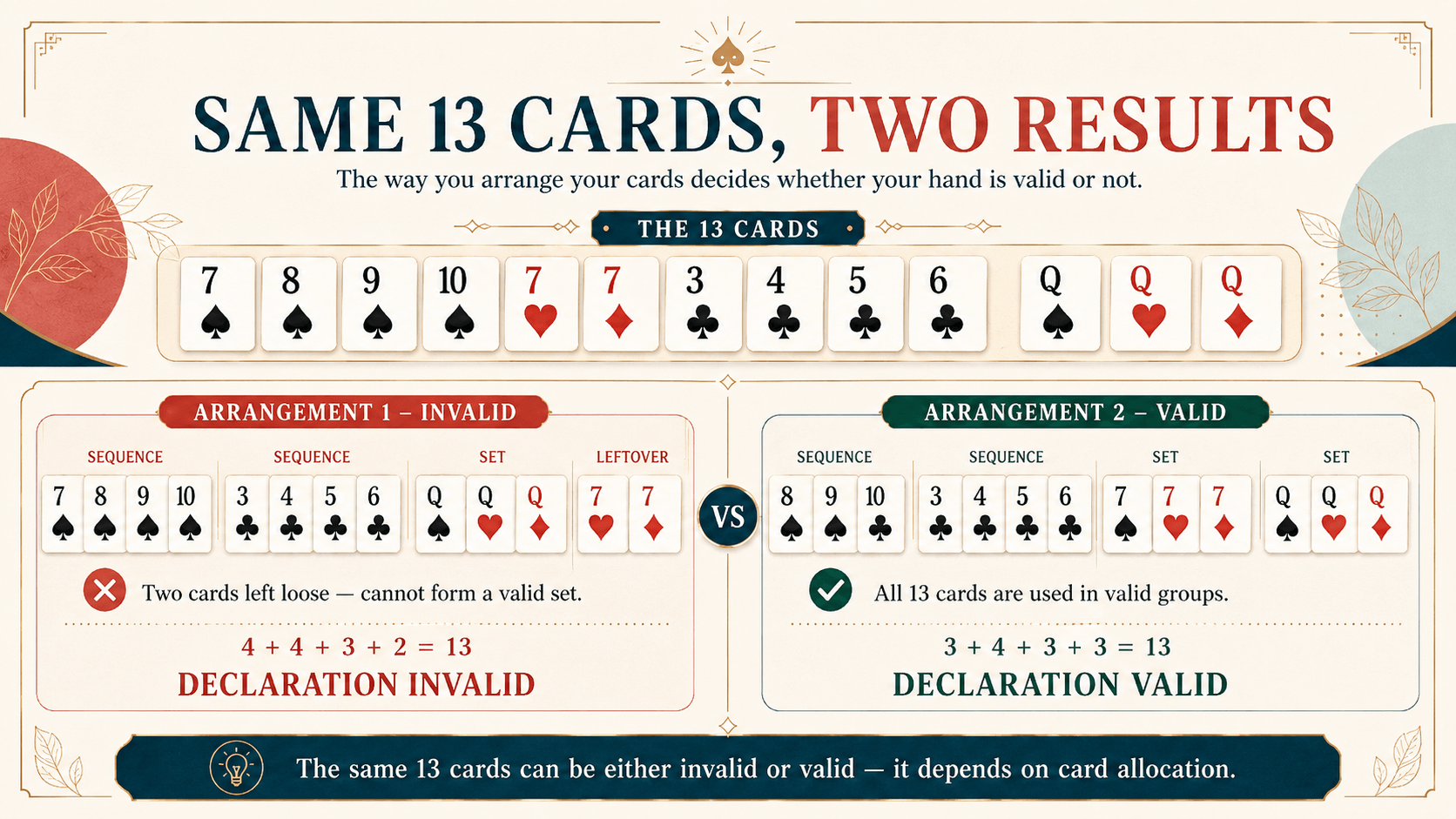
You receive:
7♠ 8♠ 9♠ 10♠
7♥ 7♦
3♣ 4♣ 5♣ 6♣
Q♠ Q♥ Q♦
Count them:
4 + 2 + 4 + 3 = 13
At first glance, this hand looks strong.
And it is.
But the way you arrange it determines whether it is valid.
Arrangement 1
You create:
Sequence
7♠ 8♠ 9♠ 10♠
Sequence
3♣ 4♣ 5♣ 6♣
Set
Q♠ Q♥ Q♦
That uses:
4 + 4 + 3 = 11 cards
The remaining cards are:
7♥ 7♦
Only two cards.
They cannot form a normal set by themselves.
So:
4 + 4 + 3 + 2 = 13
but the final group is invalid.
Declaration: INVALID
Notice something important:
The two sequences are valid.
The Queen set is valid.
Three good groups still do not save the hand.
Do Not Change the Cards — Change the Allocation
Now use the exact same 13 cards.
Take:
7♠
out of:
7♠ 8♠ 9♠ 10♠
What remains?
8♠ 9♠ 10♠
That is still a valid three-card sequence.
Now combine the freed 7♠ with:
7♥ 7♦
and you get:
7♠ 7♥ 7♦
a valid set.
The hand becomes:
Sequence 1
8♠ 9♠ 10♠
Sequence 2
3♣ 4♣ 5♣ 6♣
Set 1
7♠ 7♥ 7♦
Set 2
Q♠ Q♥ Q♦
Now the structure is:
3 + 4 + 3 + 3 = 13
Every card is valid.
Declaration: VALID
No new card was drawn.
No Joker was used.
Nothing was discarded.
Only one thing changed:
Card allocation.
The Best-Looking Group Is Not Always the Best Choice
In Arrangement 1:
7♠ 8♠ 9♠ 10♠
is a strong four-card sequence.
It looks better than:
8♠ 9♠ 10♠
because it contains more cards.
But that extra 7♠ creates a problem elsewhere.
Without it:
7♥ 7♦
remain stranded.
So shortening the four-card sequence to three cards actually improves the overall hand.
This gives us another useful principle:
The strongest individual group is not necessarily the strongest hand.
A good Rummy player does not only optimize groups.
They optimize the entire 13-card structure.
When One Card Can Belong to Both Groups
Suppose you hold:
7♠ 8♠ 9♠
and:
7♥ 7♦
Again, 7♠ could belong to either side.
Should you move it into the set?
Not automatically.
If you remove 7♠ from:
7♠ 8♠ 9♠
you leave:
8♠ 9♠
Those two cards no longer form a sequence.
So you would create:
7♠ 7♥ 7♦
but destroy:
7♠ 8♠ 9♠
You solved one problem and created another.
Compare that with:
7♠ 8♠ 9♠ 10♠
Now removing 7♠ leaves:
8♠ 9♠ 10♠
still valid.
That makes 7♠ much more flexible.
A Card's Value Depends on What Survives After It Moves
This is a much more useful way to think about overlapping combinations.
Do not ask only:
“Can this card create a set?”
Ask:
“What happens to the group I remove it from?”
A move is useful only when the whole hand improves.
For example:
If moving one card:
- creates a new 3-card set,
- and leaves its original sequence valid,
that is often a strong allocation.
But if moving one card:
- creates a set,
- while destroying your only pure sequence,
the move may be disastrous.
Longer Sequences Have Hidden Flexibility
Consider:
7♠ 8♠ 9♠ 10♠
Inside this four-card sequence are two smaller valid sequences:
7♠ 8♠ 9♠
and:
8♠ 9♠ 10♠
That means either end card may sometimes be reassigned while leaving a legal sequence behind.
This is one reason longer natural sequences can offer more structural flexibility.
Now compare that with a three-card sequence:
7♠ 8♠ 9♠
Remove either end card and the sequence collapses to two cards.
So not every card inside a valid sequence has the same degree of flexibility.
Sets Have a Natural Four-Card Ceiling
A normal deck contains four suits:
♠ ♥ ♦ ♣
So the largest natural same-rank set is usually:
K♠ K♥ K♦ K♣
Four cards.
A natural set cannot keep growing the way a sequence can.
Sequences may contain:
3 cards,
4 cards,
5 cards,
or more,
provided they remain consecutive and in the same suit.
That structural difference creates different kinds of flexibility.
The Duplicate-Suit Trap
Indian Rummy may use more than one deck.
So it is possible to receive two physically separate copies of the same card.
For example:
7♠ 7♠ 7♥
All three cards have the same rank.
But that does not automatically make them a valid natural set.
The problem is:
7♠ is duplicated.
A standard natural set expects valid suit diversity.
So a better mental definition is not simply:
Same rank.
It is:
Same rank with a valid suit structure.
This is an easy mistake to make when multiple decks are involved.
What About Jokers?
Jokers can help both structures.
For example:
Impure Sequence
5♥ Joker 7♥
The Joker represents:
6♥
Set
Q♣ Q♦ Joker
The Joker may stand in for another Queen.
But using Jokers does not make sequences and sets interchangeable.
A sequence still follows a rank path.
A set still groups a rank family.
And importantly:
A Joker-supported impure sequence does not remove the requirement for at least one pure sequence in standard 13-card Rummy.
Which Should You Prioritize: Sequence or Set?
The answer depends on the structure you already have.
But there is a useful hierarchy.
Before Your Required Sequences Are Secure
Prioritize:
Pure Sequence
then:
Second Sequence
because those are compulsory structural requirements.
After the Required Sequences Are Secure
Sets become extremely useful for absorbing otherwise disconnected cards.
That gives us a more accurate comparison:
Sequences solve compulsory structure.
Sets often solve leftover structure.
Neither is always “better.”
But they do different jobs.
A Better Decision Framework
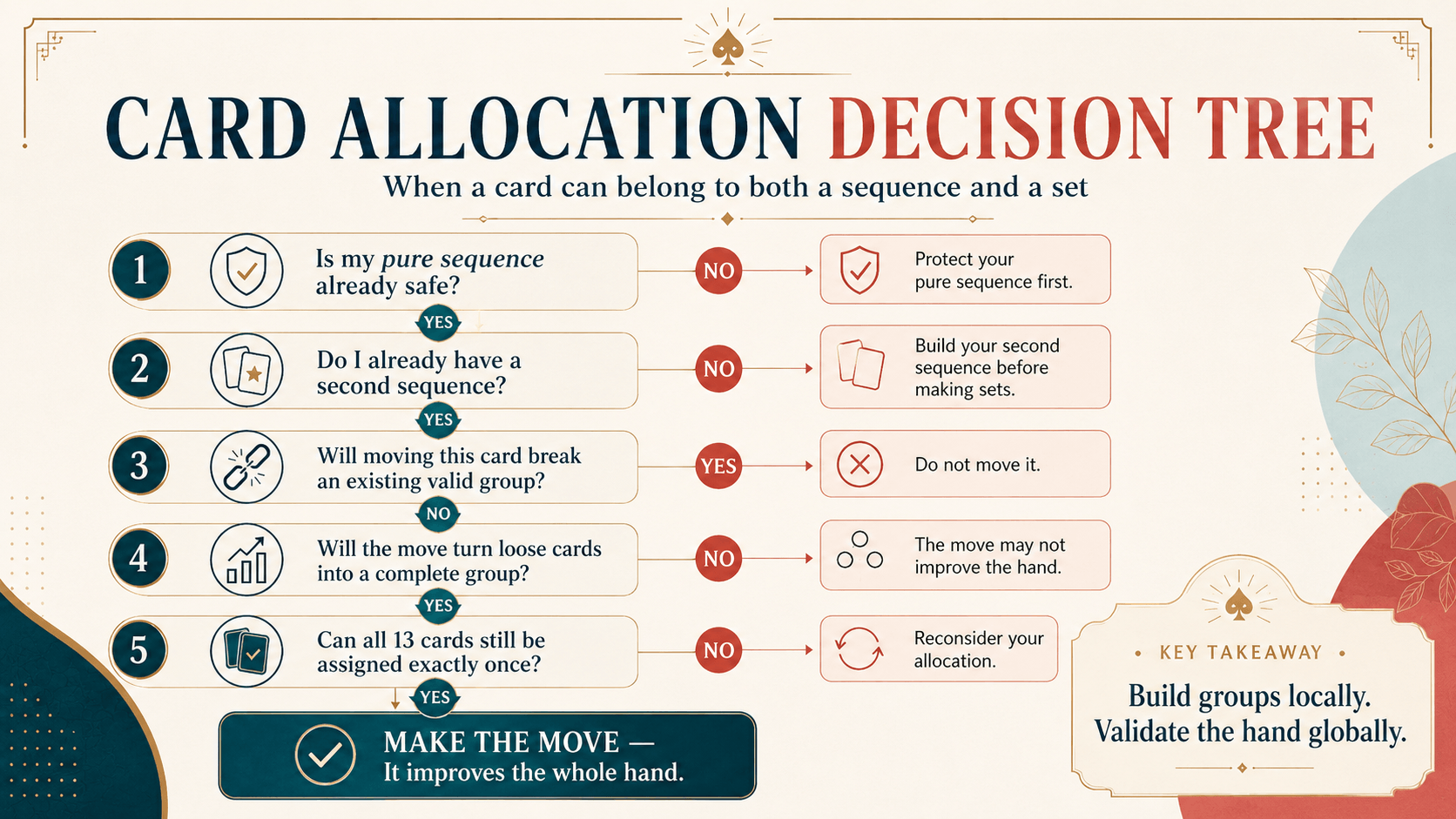
When one card can fit both a sequence and a set, use these five questions.
1. Is My Pure Sequence Already Safe?
If no:
protect or complete it first.
Do not sacrifice the hand's most important compulsory group casually.
2. Do I Already Have a Second Sequence?
If no:
building the second sequence usually deserves higher priority than completing an optional set.
3. Will Moving This Card Break an Existing Valid Group?
If yes:
be careful.
You may simply be moving the problem from one place to another.
4. Will the Move Turn Loose Cards Into a Complete Group?
This is exactly what happened with:
7♥ 7♦
in our earlier example.
Moving 7♠ turned two useless loose cards into:
7♠ 7♥ 7♦
a complete set.
5. Can All 13 Cards Still Be Assigned Exactly Once?
This is the final test.
A beautiful new set is irrelevant if another card becomes stranded somewhere else.
Always finish by validating the complete hand.
Think of Rummy as a Constraint Problem
You do not need mathematical terminology to use this idea.
It simply means:
Every card has to obey rules.
Every group has to obey rules.
And the whole hand has to obey rules.
There are therefore three levels.
Card Level
Where should this card go?
Group Level
Is this sequence or set legal?
Hand Level
Does the complete 13-card structure satisfy the declaration rules?
Many beginner mistakes happen because they stop at Level 2.
They see:
“This set is valid.”
or:
“This sequence is valid.”
An experienced check goes one step further:
“What does this group do to the rest of my hand?”
A 10-Second Sequence-or-Set Check
When you are unsure where a card belongs, run through this quickly:
Is my pure sequence secure?
↓
Do I have another sequence?
↓
Will moving the card break a valid group?
↓
Will it complete loose cards elsewhere?
↓
Can all 13 cards still be grouped?
If the entire structure improves, the move makes sense.
If only one group improves while the hand gets worse, reconsider.
Frequently Asked Questions
What is the main difference between a sequence and a set in Rummy?
A sequence contains consecutive cards of the same suit. A set contains cards of the same rank with a valid combination of different suits.
Which is more important: sequence or set?
Sequences have higher structural importance because a standard 13-card declaration normally requires at least two sequences, including at least one pure sequence.
Sets are useful but not compulsory.
Is a set compulsory in 13-card Rummy?
No.
A hand can be valid with zero sets if the entire hand is arranged into valid sequences and all declaration requirements are satisfied.
Can a Rummy sequence contain more than three cards?
Yes.
A sequence may contain four, five or more consecutive cards of the same suit.
Can a set contain four cards?
Yes.
For example:
K♠ K♥ K♦ K♣
is a complete natural four-card set.
Can a natural set contain five cards?
Normally no.
There are only four suits, so a standard natural same-rank set has a maximum of four differently suited cards.
Can two identical cards be used in the same set?
Duplicate copies of the same rank and suit are not normally valid together in a standard natural set.
For example:
7♠ 7♠ 7♥
is not equivalent to:
7♠ 7♥ 7♦
Can a Joker be used in a set?
Yes, under common rules a Joker can help complete a set.
Can a Joker be used in a sequence?
Yes.
When it replaces a missing card, the result is normally an impure sequence.
Can the same card belong to both a sequence and a set?
A card may be eligible for both, but in the final hand it can only be assigned to one group.
The best assignment is the one that helps all 13 cards form a valid structure.
Final Takeaway
The beginner question is:
“Is this card part of a sequence or a set?”
The better question is:
“Where should this card go so that the whole 13-card hand works?”
The difference is important.
A four-card sequence may look stronger than a three-card sequence.
But shortening it may release one card that completes an entire set.
A set can be perfectly legal.
But four perfect sets still cannot replace the required sequences.
And, as we saw, the exact same 13 cards can produce:
an invalid hand
or:
a valid declaration
without drawing or discarding a single card.
The only difference is how those cards are allocated.
Build groups locally. Validate the hand globally.
That is the principle worth remembering.