
Pure Sequence in Rummy: Rules & Examples
Learn pure sequence rules in 13-card Indian Rummy with valid and invalid examples, Joker and Ace rules, common mistakes, and a quick hand check.
A pure sequence contains at least three consecutive cards of the same suit without a Joker standing in for a missing card. In standard 13-card Indian Rummy, you need at least one pure sequence and a second sequence before declaring. The examples below cover valid runs, Ace positions and the wild-Joker exception used by some tables.
What Exactly Is a Pure Sequence?
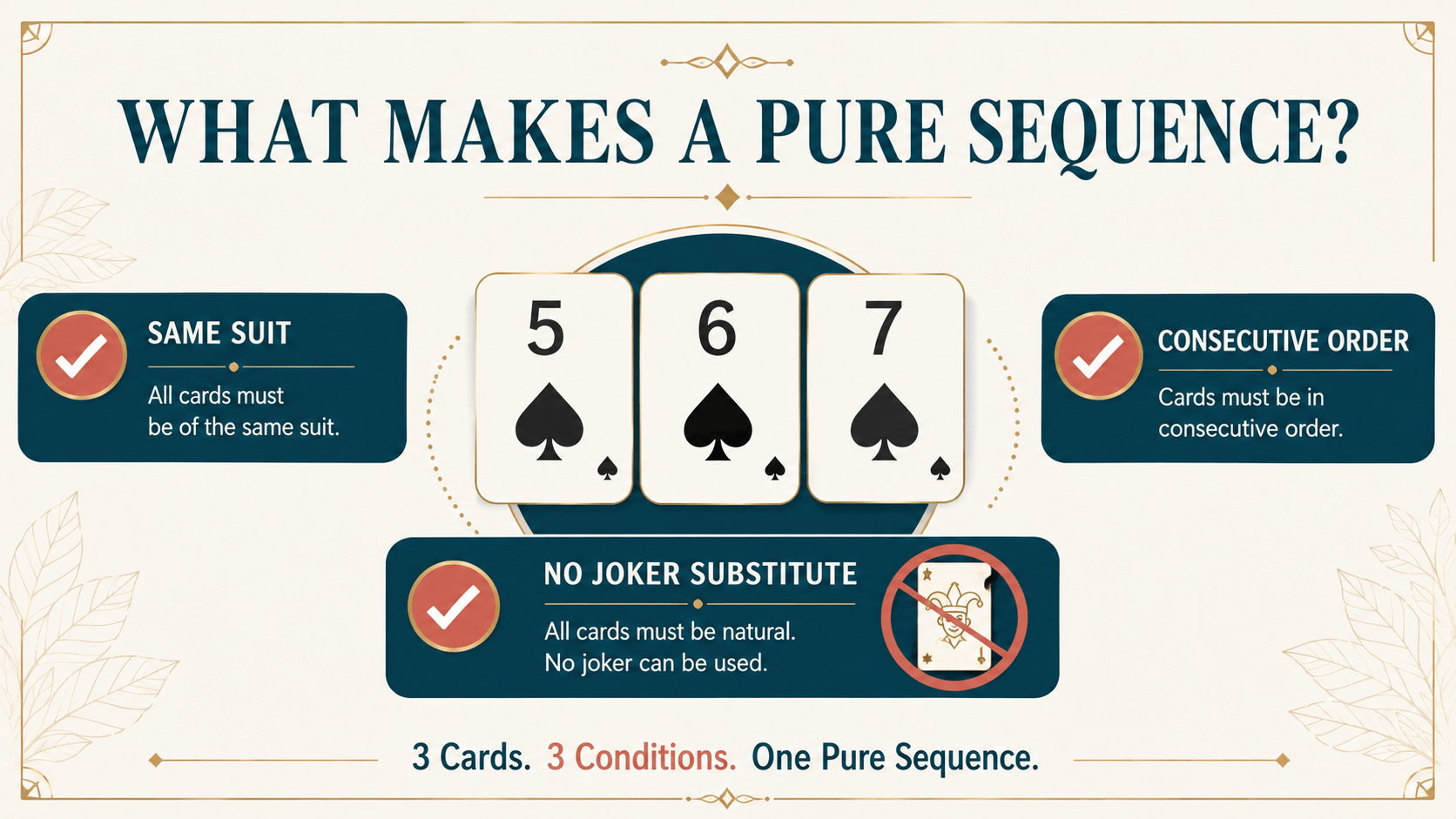
A group must satisfy three conditions:
1. Same Suit
Every card belongs to the same suit.
2. Consecutive Rank
The cards must follow one another naturally.
3. No Joker Is Used as a Substitute
A Joker cannot fill a missing rank if you want the sequence to remain pure.
For example:
5♠ 6♠ 7♠
is pure.
So is:
9♥ 10♥ J♥ Q♥
Both groups use natural cards of one suit in consecutive order.
Why Does the Pure Sequence Matter So Much?
Suppose your hand contains:
8♣ Joker 10♣
Q♠ Q♥ Q♦
4♦ 4♣ 4♥
and several other well-grouped cards.
The hand may look organized.
But if every sequence depends on a Joker and there is no natural sequence, the structure is still incomplete under standard 13-card declaration rules.
This is the key distinction:
Sets organize cards.
Impure sequences solve gaps.
The pure sequence satisfies a compulsory declaration condition.
That is why the pure sequence has more strategic importance than its card count suggests.
A Small Number That Explains the Rule
There is an interesting way to look at pure sequences mathematically.
Assume the common convention where:
A-2-3 is valid
and:
Q-K-A is valid.
For a three-card sequence in one suit, there are 12 possible natural rank windows:
A-2-3
2-3-4
3-4-5
4-5-6
5-6-7
6-7-8
7-8-9
8-9-10
9-10-J
10-J-Q
J-Q-K
Q-K-A
Multiply those 12 patterns × 4 suits and you get:
48 possible three-card pure-sequence patterns
in a standard 52-card deck.
That does not include longer sequences such as:
4♥ 5♥ 6♥ 7♥
or:
9♣ 10♣ J♣ Q♣ K♣
So the pure-sequence rule is restrictive, but players still have many possible natural structures available.
The real challenge is recognizing which one your current hand can realistically build.
Valid Pure Sequence Examples
Example 1
3♣ 4♣ 5♣
Same suit. Consecutive. No substitute.
Valid.
Example 2
8♦ 9♦ 10♦ J♦
Four-card sequences are perfectly valid.
A pure sequence does not have to contain exactly three cards.
Example 3
A♥ 2♥ 3♥
The Ace is being used at the low end.
Valid under common Indian Rummy rules.
Example 4
Q♠ K♠ A♠
The Ace is being used at the high end.
Also commonly valid.
What Does NOT Count?
Understanding the failures is more useful than memorizing definitions.
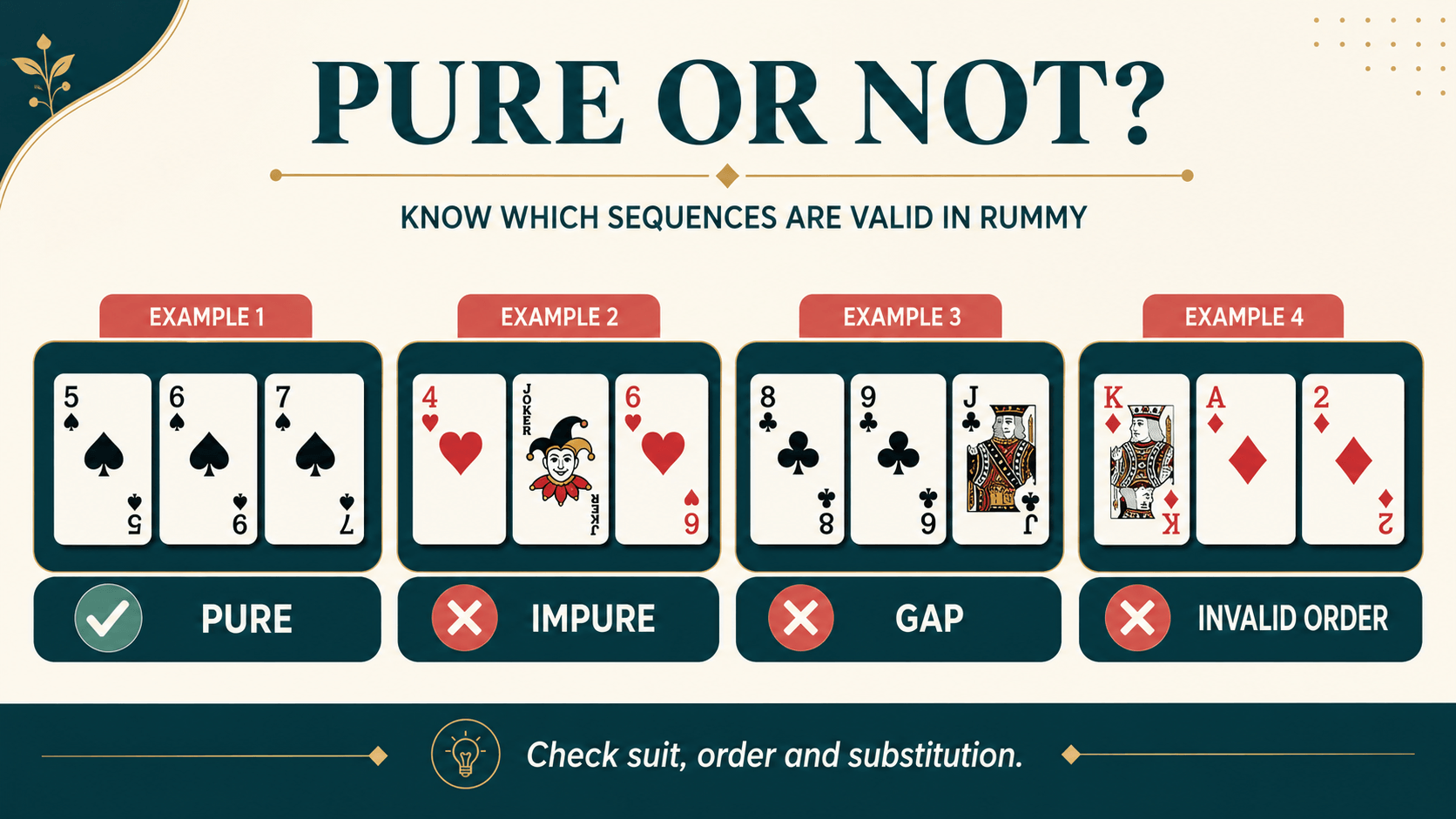
5♠ 6♥ 7♠
The values are consecutive.
But the suits are different.
Not a sequence.
4♥ Joker 6♥
The Joker represents the missing 5♥.
The order works, but the missing card is being substituted.
Impure sequence, not pure.
8♣ 9♣ J♣
The suit matches.
But 10♣ is missing.
Not a valid sequence.
K♦ A♦ 2♦
The cards may look connected because the Ace can be high or low.
But the Ace does not normally “wrap around” from King to 2.
K-A-2 is not a standard valid sequence.
The Joker Rule Is More Subtle Than It Looks
You will often read:
“A pure sequence cannot contain a Joker.”
That is useful for beginners, but it is slightly incomplete.
The more precise rule is:
A Joker cannot be used as a substitute for a missing card in a pure sequence.
Why does that wording matter?
Because in some 13-card rule sets, a card selected as the wild Joker rank can still appear naturally in a pure sequence when it is being used at its printed rank and suit.
Imagine the wild Joker rank is 7.
You hold:
5♦ 6♦ 7♦
The 7♦ happens to belong to the selected Joker rank.
But here it is not replacing another card.
It is simply acting as the natural 7♦ between 6♦ and the next rank.
Some rule sets therefore continue to treat this as a pure sequence.
This is one of those details where the exact table rules matter.
Practical rule:
If a wild-Joker card naturally belongs in the run, check the game's rule panel rather than assuming automatically.
Pure Sequence vs Impure Sequence
The difference is not the presence of a special-looking card.
The difference is substitution.
Pure
6♣ 7♣ 8♣
Every rank is naturally present.
Impure
6♣ Joker 8♣
The Joker stands in for 7♣.
Both may be useful sequences.
But they do not perform the same role when validating a standard 13-card declaration.
Should You Always Build the Pure Sequence First?
This advice appears everywhere:
“Always make the pure sequence first.”
It is useful, but too absolute.
A better expert rule is:
Protect strong natural runs early.
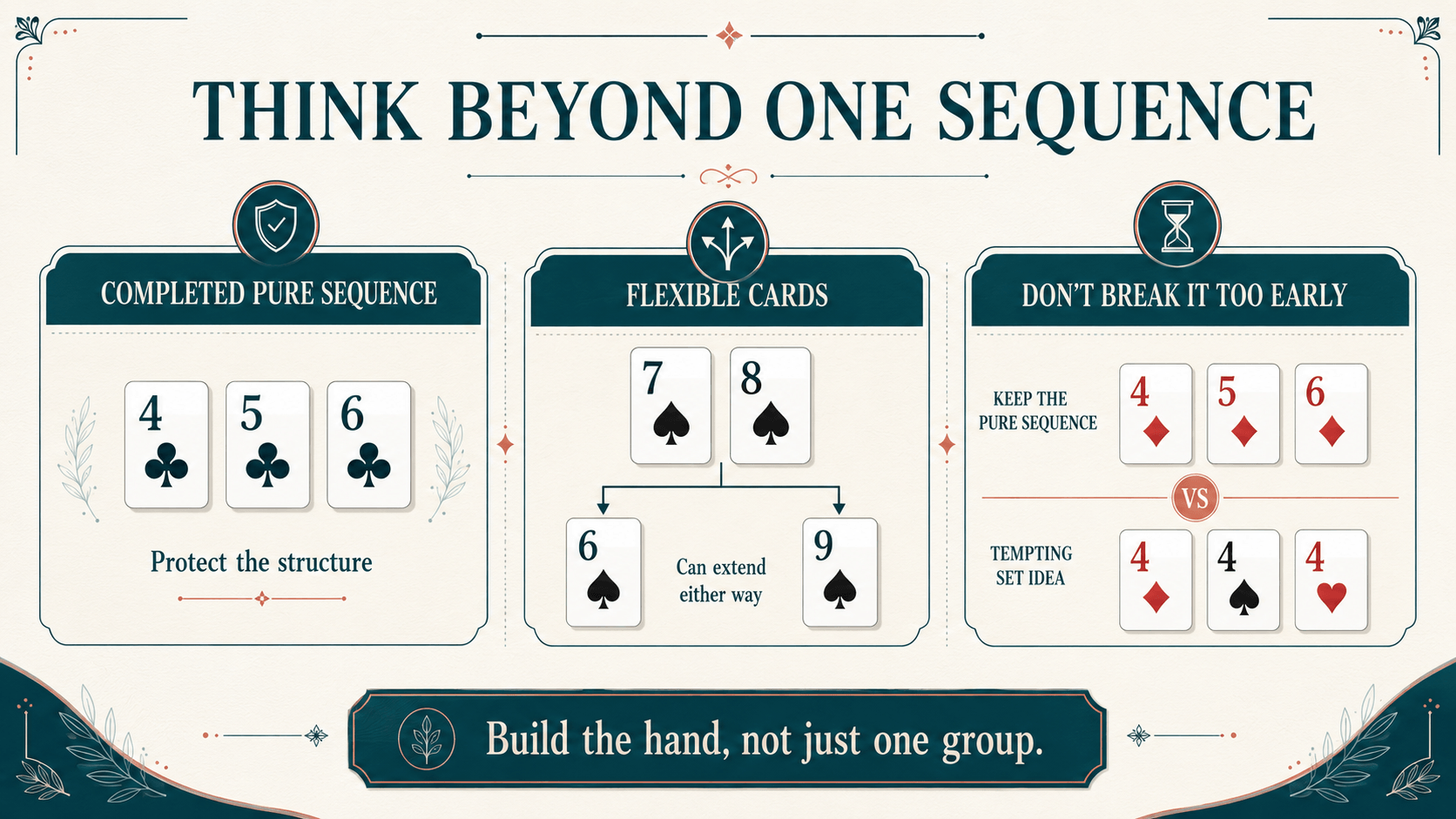
If you already hold:
6♥ 7♥ 8♥
there is little reason to disturb it.
It has already solved one of the most important structural requirements.
But imagine you only have:
Q♣ K♣
while several other cards in your hand form flexible middle-rank connections.
Waiting indefinitely for A♣ or J♣ may not always be the best decision.
The goal is not to become emotionally attached to the first possible pure sequence.
The goal is to identify the most realistic natural run available in the hand.
Why Middle Cards Are Often More Flexible
Consider:
7♠ 8♠
This pair can become:
6♠ 7♠ 8♠
or:
7♠ 8♠ 9♠
Now compare it with:
Q♠ K♠
Its natural options are more limited:
J♠ Q♠ K♠
or:
Q♠ K♠ A♠
Both pairs are useful.
But middle-rank connected cards often provide more directions for development.
That does not mean you should automatically discard high connected cards.
It means card flexibility matters alongside card value.
Do Not Break a Completed Pure Sequence Without a Reason
Once you have:
4♦ 5♦ 6♦
you have already satisfied a major condition.
Breaking 4♦ away because it could join a set of fours may create unnecessary work.
For example:
4♦ 5♦ 6♦
Pure Sequence
plus:
4♠ 4♥
Potential Set
A beginner may be tempted to move 4♦ into the set.
But now the pure sequence disappears.
Unless another pure sequence is already secure, that trade can weaken the structure of the entire hand.
A useful hierarchy is:
Completed Pure Sequence > Attractive Incomplete Set
when the pure-sequence requirement has not been satisfied elsewhere.
Longer Pure Sequence or Two Smaller Groups?
Suppose you hold:
4♣ 5♣ 6♣ 7♣ 8♣
That is a valid five-card pure sequence.
But should you always keep all five together?
Not necessarily.
Depending on the rest of the hand, you may eventually be able to use:
4♣ 5♣ 6♣
as one sequence,
while:
7♣ 8♣
becomes the beginning of another possible structure.
The important principle is:
Do not optimize one beautiful group at the expense of the entire 13-card hand.
Rummy is a whole-hand problem.
Five Common Pure Sequence Mistakes
1. Looking Only at Card Numbers
A sequence requires the same suit.
5♠ 6♥ 7♠ does not qualify.
2. Treating Every Joker Combination as Pure
If a Joker substitutes for a missing card, the sequence is impure.
3. Forgetting the Ace Boundary
A can commonly work in:
A-2-3
and:
Q-K-A
but not:
K-A-2.
4. Breaking a Finished Pure Sequence Too Easily
A potential set may look attractive, but destroying your only pure sequence can create a bigger problem.
5. Waiting Forever for One Specific Card
A possible sequence is not the same as a completed sequence.
If your hand develops in another direction, be willing to reorganize.
A 10-Second Pure Sequence Check
Before making a declaration, look at your proposed pure sequence and ask:
Same suit?
Consecutive ranks?
At least three cards?
No Joker replacing a missing rank?
If the answer is yes to all four, you probably have the natural sequence you need.
Then check the rest of the hand.
Because a pure sequence alone does not make a valid declaration.
Frequently Asked Questions
What is a pure sequence in Rummy?
A pure sequence consists of three or more consecutive cards of the same suit without a Joker being used to substitute for a missing card.
Is a pure sequence compulsory in 13-card Indian Rummy?
Under standard 13-card rules, at least one pure sequence is generally required for a valid declaration.
What is the minimum number of cards in a pure sequence?
Three.
Can a pure sequence contain four or five cards?
Yes. There is no requirement that a pure sequence contain exactly three cards.
Can Ace be used in a pure sequence?
Common rules allow Ace in sequences such as A-2-3 and Q-K-A of the same suit.
Is K-A-2 a pure sequence?
No. The Ace does not normally wrap from King back to 2.
Can a Joker ever appear in a pure sequence?
A Joker cannot replace a missing card in a pure sequence. Some rules allow a selected wild-Joker card to appear naturally at its original rank and suit, so check the specific table rules.
Can I have more than one pure sequence?
Yes. The requirement is normally at least one, not exactly one.
Final Takeaway
A pure sequence is easy to define but easy to misunderstand.
The most useful way to think about it is:
It is the natural backbone of a 13-card Rummy hand.
The minimum version uses just three cards — roughly 23% of the hand — yet without it, an otherwise well-arranged hand may fail the standard declaration test.
So do not simply ask:
“Can these cards form a sequence?”
Ask:
“Is this sequence natural, stable, and helping the structure of my whole hand?”
That is the difference between memorizing a rule and actually understanding it.
Continue Learning
Read next:
- Rummy Rules Explained: Complete 13-Card Indian Rummy Guide
- What Is the Role of Jokers in Indian Rummy?
- Valid Declaration in Rummy: Rules, Examples & Invalid Declarations
- Rummy Sequence and Set: Difference, Rules & Examples