
Joker in Indian Rummy: Printed vs Wild Joker Rules
Learn how printed and wild Jokers work in Indian Rummy, where they can complete impure sequences and sets, and when to move or save a Joker.
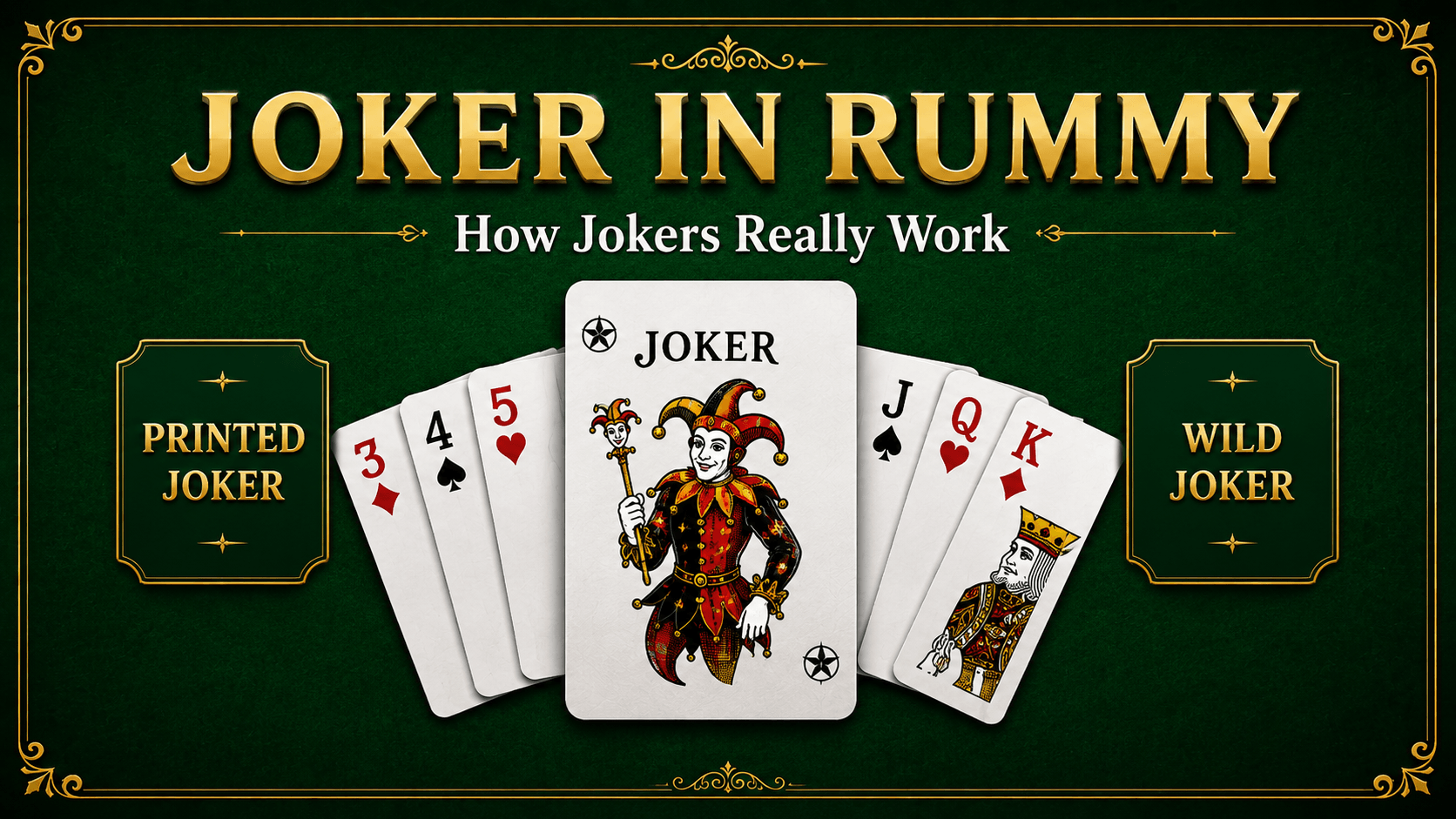
Printed and wild Jokers can replace missing cards in impure sequences and sets. They help complete a hand, but a Joker used as a substitute cannot satisfy the pure-sequence requirement. Check the rules for the table you are playing, especially when a wild-rank card appears at its natural rank and suit.
What Is a Joker in Rummy?
A Joker is a special card that can usually substitute for another card when forming certain valid combinations.
For example:
8♥ 9♥ Joker J♥
The Joker can represent the missing 10♥.
This creates an impure sequence.
Jokers give players more flexibility, but how and when you use them still matters.
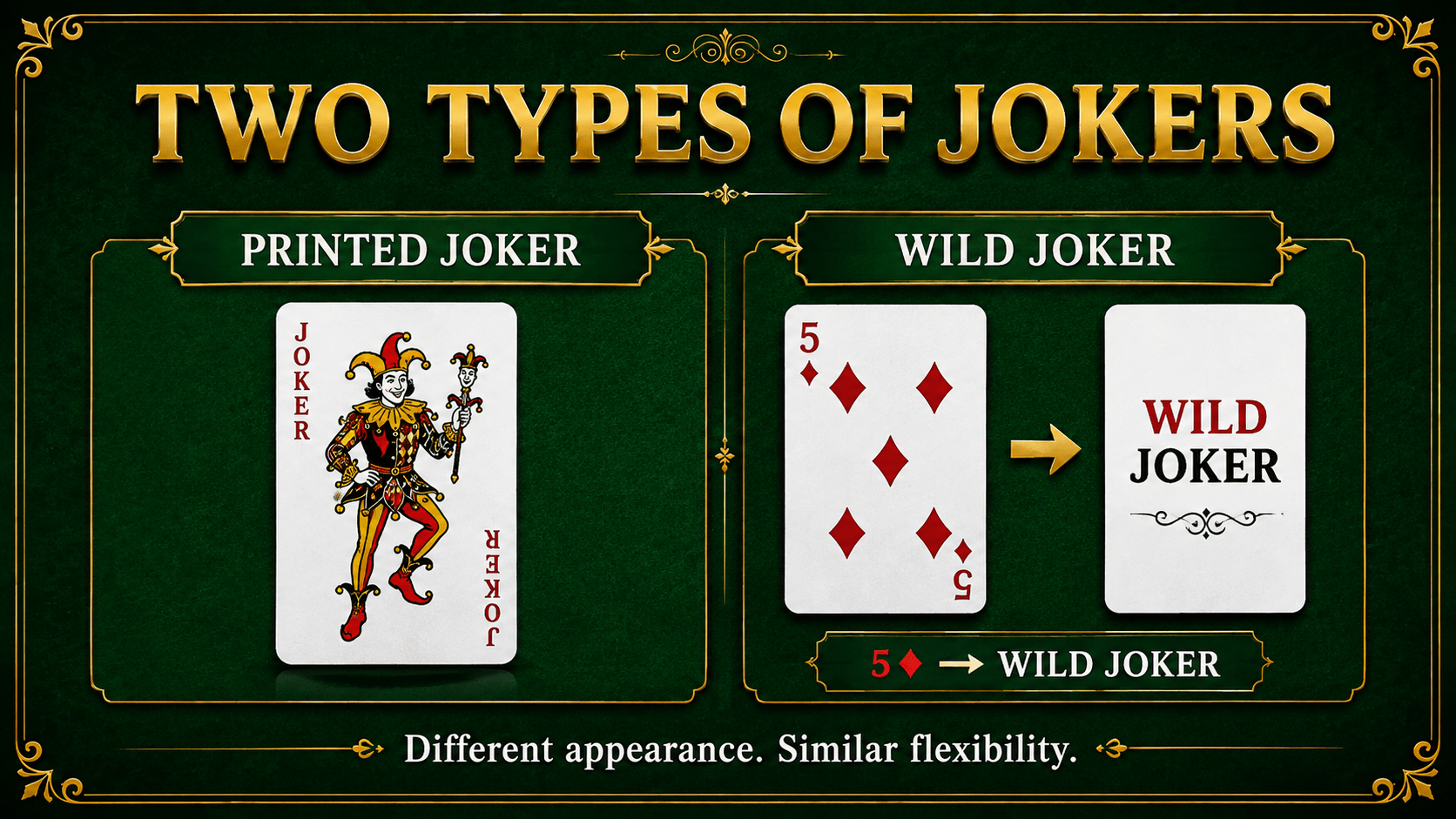
Two Types of Jokers
Indian Rummy commonly uses two types of Jokers:
1. Printed Joker
A printed Joker is the familiar Joker card already included in the deck.
It has no normal suit or rank.
It can generally be used as a substitute in an impure sequence or set.
2. Wild Joker
A wild Joker is created when a card rank is selected for the round. Natural use of that rank and unusual selections may be handled differently across platforms, so check the displayed table rules.
For example, if 5♦ is selected as the Joker card, cards of that rank may act as wild Jokers according to the rules of the game.
The important idea is simple:
Printed Joker = special Joker card
Wild Joker = selected card rank
How Does a Joker Complete a Sequence?
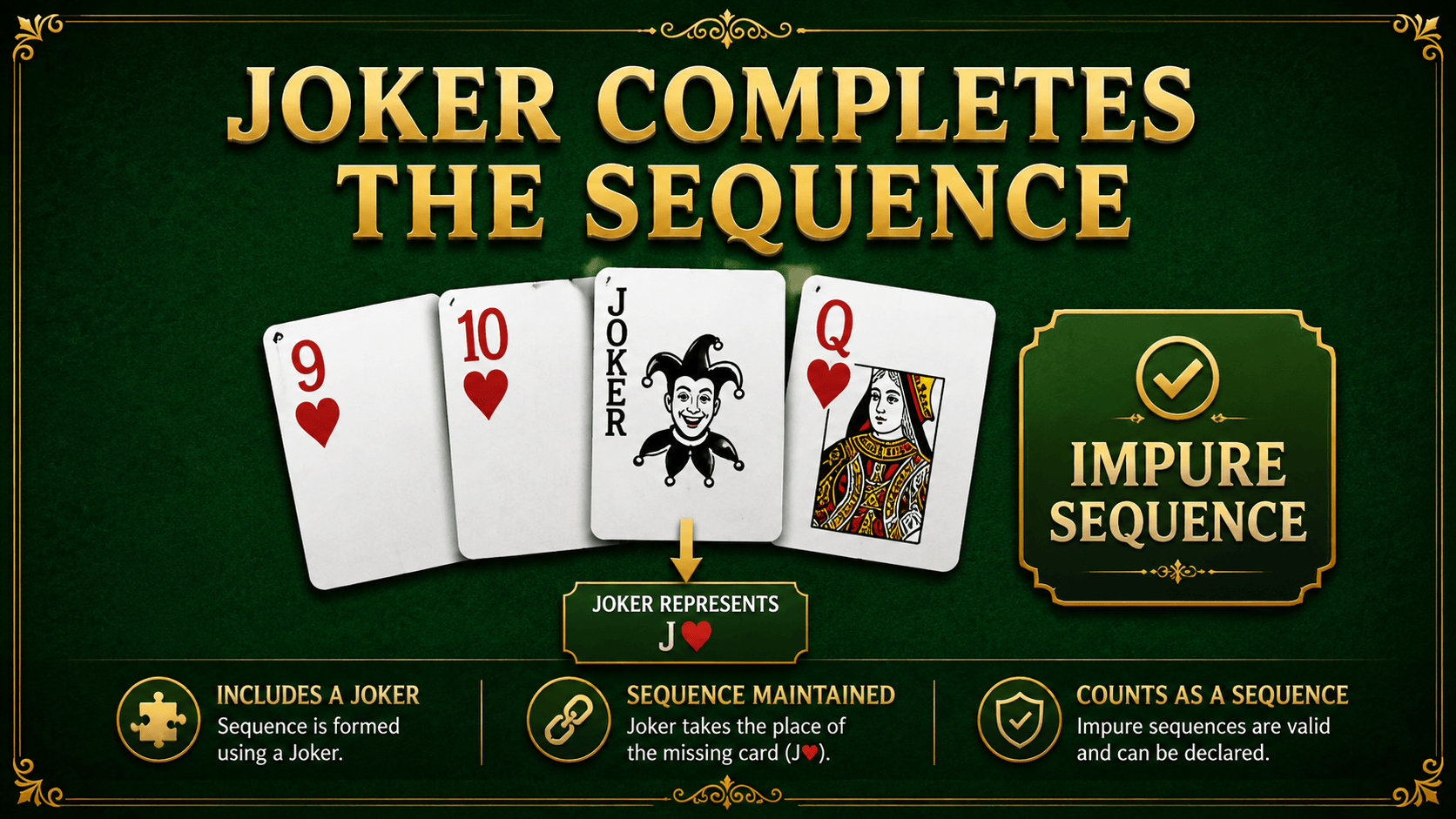
A Joker is commonly used to fill a missing card in a sequence.
For example:
9♣ 10♣ Joker Q♣
The missing card is J♣.
The Joker can take that position and create:
9♣ 10♣ J♣ Q♣
Because a Joker is being used as a substitute, this is called an impure sequence.
What Is an Impure Sequence?
An impure sequence contains consecutive cards of the same suit but uses a Joker to replace one or more missing cards.
Example:
6♠ 7♠ Joker 9♠
The Joker represents 8♠.
This is different from:
6♠ 7♠ 8♠
which is a pure sequence.
A simple way to remember it is:
No substitute Joker = Pure Sequence
Substitute Joker used = Impure Sequence
Can a Joker Be Used in a Set?
Yes. A Joker can also help complete a set.
For example:
K♠ K♥ Joker
The Joker can act as another King according to the rules of the game.
This can help when you have two matching ranks but cannot find the third card naturally.
Another example:
7♣ 7♦ Joker
The Joker can help complete the set.
Can a Joker Be Used in a Pure Sequence?
A Joker being used as a substitute cannot normally create a pure sequence.
For example:
4♠ Joker 6♠
If the Joker is representing 5♠, the group is not pure.
It is an impure sequence.
This is important because a standard 13-card Rummy declaration normally requires at least one pure sequence.
That is why beginners should not focus only on Jokers.
Why Is a Pure Sequence Still Important?
Imagine your hand contains:
7♥ Joker 9♥
Q♣ Q♦ Joker
4♠ Joker 6♠
You have several useful combinations, but none of them is a pure sequence if every Joker is replacing a missing card.
Your hand may still not be ready for a valid declaration.
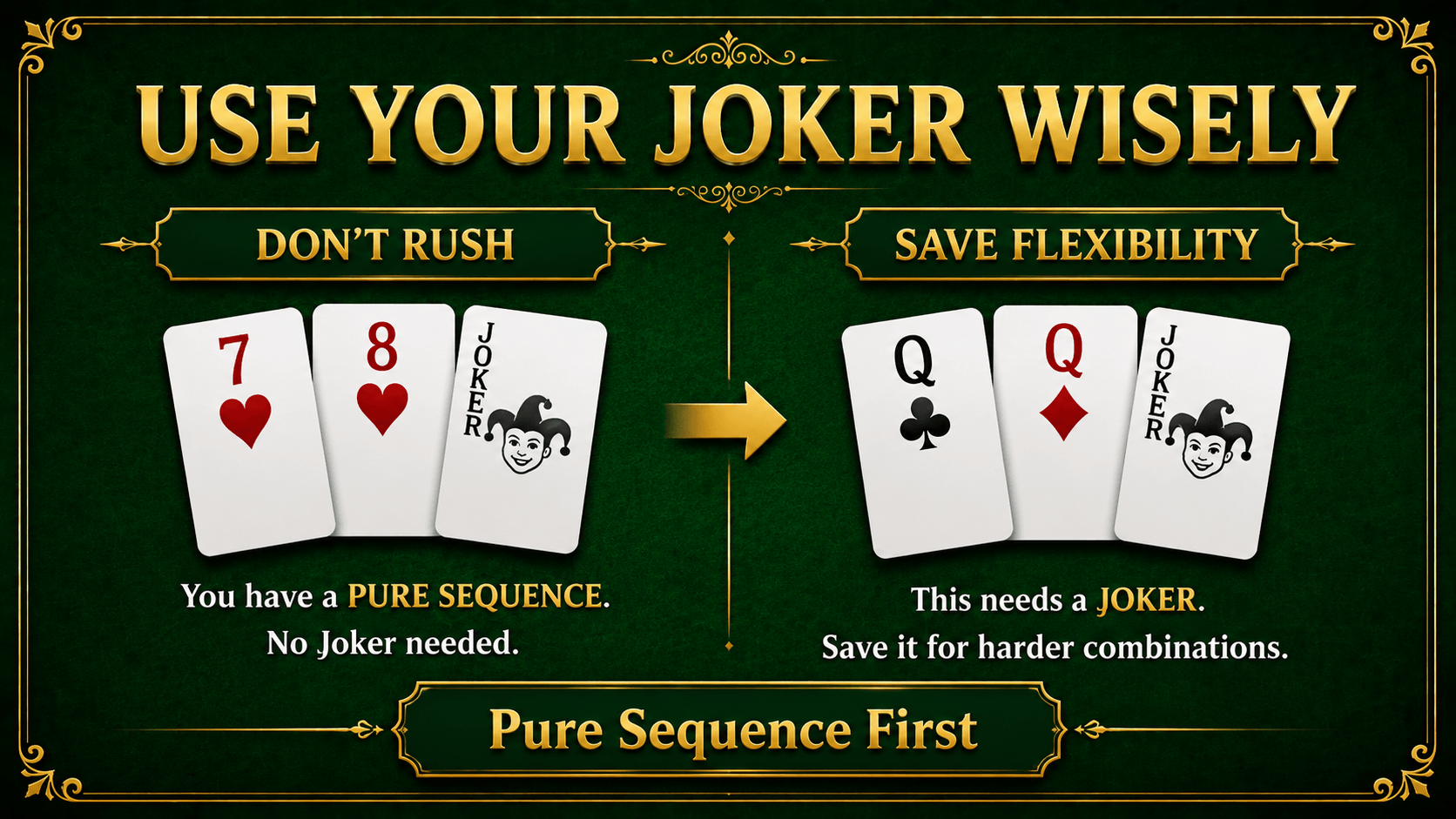
A good priority is:
Pure Sequence First
Then use Jokers to complete the harder parts of the hand.
When Should You Use a Joker?
Jokers are most useful when they solve a difficult gap.
Suppose you have:
6♥ 7♥
and a Joker.
You could use the Joker as 8♥ immediately.
But if 8♥ is still easy to obtain, the Joker may be more valuable in another incomplete group.
For example:
Q♣ Q♦ Joker
may be harder to complete naturally.
This is why it is often better to think before placing a Joker.
A four-question Joker decision method
1. Is the pure sequence protected?
If not, focus on natural consecutive cards. A Joker may solve another group while leaving the essential declaration structure unfinished.
2. Which group is hardest to complete naturally?
A suited pair such as 6♥-7♥ can accept 5♥ or 8♥. A pair of Queens may have fewer useful natural cards remaining, so the Joker may create more value there.
3. Can the Joker support more than one plan?
Keep it visually separate until you compare all candidate groups. Locking it into the first position can hide a better use.
4. Would a natural draw free the Joker?
If 10♣ completes 8♣-9♣-Joker, rebuild the sequence naturally and consider moving the Joker elsewhere.
This is not a fixed formula. It helps compare flexibility instead of spending a Joker automatically. Test it in the free 13 Card Rummy practice game.
Simple Joker Strategy for Beginners
A good beginner approach is:
1. Find Your Pure Sequence
Do this before depending heavily on Jokers.
2. Identify Difficult Groups
Look for combinations that are missing one important card.
3. Use Jokers Where They Save the Most Work
Do not waste them on combinations that can easily be completed naturally.
4. Keep Your Hand Flexible
A Joker can sometimes fit into several possible groups.
Do not lock it into one position too early.
3 Common Joker Mistakes
1. Using a Joker Too Early
You may later find a better place for it.
2. Forgetting the Pure Sequence
Several Joker combinations do not automatically make the hand valid.
3. Using a Joker in an Easy Natural Sequence
If a missing card is easy to complete naturally, saving the Joker may give you more options later.
Frequently Asked Questions
What is a printed Joker?
A printed Joker is the special Joker card included in a standard deck.
What is a wild Joker?
A wild Joker is created when a particular card rank is selected for the round.
Can a Joker complete a sequence?
Yes. A Joker can normally help complete an impure sequence.
Can a Joker complete a set?
Yes. Jokers can generally be used to complete valid sets.
Can a Joker replace a pure sequence?
No. A common valid declaration still requires at least one pure sequence formed without a substitute Joker.
Should I use a Joker immediately?
Not always. It is often better to see where the Joker provides the most value.
Final Summary
The role of a Joker in Rummy is simple:
It helps complete difficult combinations.
A Joker can:
- Complete an impure sequence
- Help form a set
- Replace a missing card
- Give your hand more flexibility
But the basic priority remains:
Pure Sequence → Second Sequence → Use Jokers → Complete Remaining Groups
Once you understand that order, Jokers become much easier to use effectively.
Continue Learning
Read next: