
13 Card Rummy Rules: Complete Indian Guide
Learn the essential rules of 13-card Indian Rummy, including pure sequences, sets, Jokers, valid declarations, scoring, and common mistakes.
In 13-card Indian Rummy, draw and discard cards until all thirteen fit into valid sequences or sets. A standard declaration requires at least two sequences, including one pure sequence formed without a Joker substitute. The examples below explain how to build and check those groups.
Quick Answer: What Are the Basic Rules of Rummy?
To make a valid hand in 13-card Rummy:
- Each player receives 13 cards.
- Players draw and discard one card on each turn.
- Cards must be arranged into valid sequences and sets.
- At least two sequences are normally required.
- At least one of those sequences must be a pure sequence.
- Jokers can help complete certain combinations.
- A player declares after arranging all 13 cards correctly.
The most important rule for beginners is simple:
Build a pure sequence as early as possible.
Without one, even a hand containing several good combinations may not qualify as a valid declaration.
What Is 13-Card Indian Rummy?
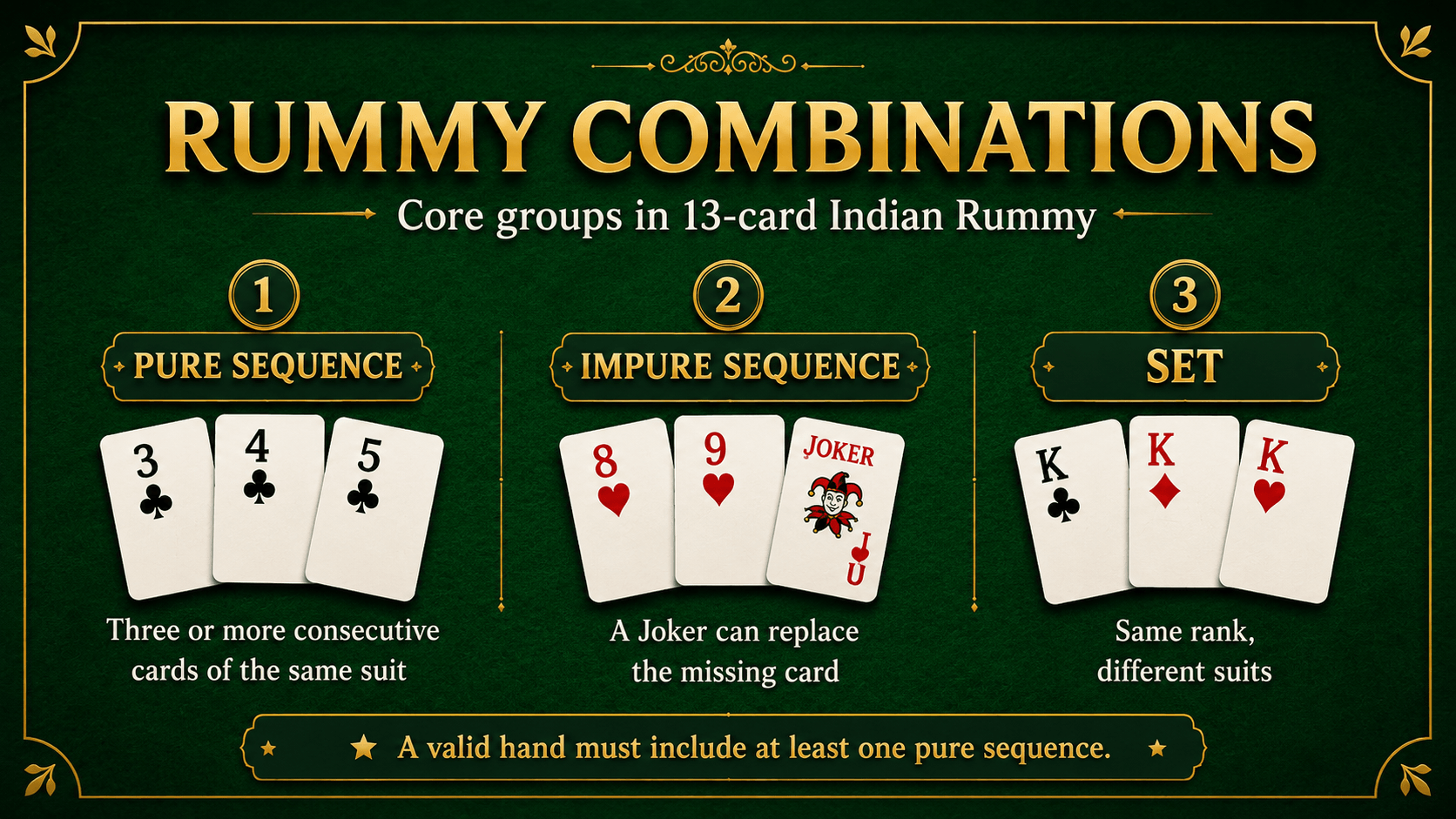
13-card Indian Rummy is a card-matching game in which players organize their cards into meaningful combinations.
The main combinations are:
- Pure Sequence
- Impure Sequence
- Set
Players usually receive 13 cards from one or more standard decks, depending on the number of participants and the specific game format.
During each turn, a player generally:
- Picks one card.
- Organizes the hand.
- Discards one unwanted card.
This continues until a player forms a valid combination with all cards and makes a declaration.
What Is a Sequence in Rummy?
A sequence is a group of three or more consecutive cards of the same suit.
For example:
5♥ 6♥ 7♥
This is a valid sequence because:
- all three cards belong to the same suit;
- the card values are consecutive.
Another example:
10♠ J♠ Q♠ K♠
This is also a valid sequence.
However:
5♥ 6♣ 7♥
is not a valid sequence because the cards do not belong to the same suit.
Sequences are one of the most important parts of a valid Rummy hand.
What Is a Pure Sequence?
A pure sequence contains three or more consecutive cards of the same suit without using a Joker as a substitute for a missing card.
Examples:
3♣ 4♣ 5♣
and
9♦ 10♦ J♦ Q♦
are both pure sequences.
A pure sequence is especially important because a standard valid declaration normally requires at least one.
Pure Sequence Example
Suppose you have:
7♠ 8♠ 9♠
The cards are consecutive, all belong to Spades, and no substitute Joker is being used.
That makes it a pure sequence.
Can a Joker Be Used in a Pure Sequence?
A Joker generally cannot replace a missing card inside a pure sequence.
For example:
4♥ Joker 6♥
would not normally count as a pure sequence if the Joker is replacing the 5♥.
It may form an impure sequence, but not a pure one.
There is one important detail: if a card that naturally belongs in the sequence has also been selected as the wild Joker rank, it may still be treated according to the rules of the particular game.
Because exact Joker handling can vary slightly by format or platform, always check the game rules before playing.
What Is an Impure Sequence?
An impure sequence is a sequence in which a Joker is used to replace a missing card.
For example:
8♣ 9♣ Joker J♣
Here, the Joker represents the missing 10♣.
The cards can therefore form an impure sequence.
Another example:
Q♦ K♦ Joker
If the Joker is being used as the A♦, the combination may be treated as an impure sequence.
Impure sequences are useful, but they do not replace the requirement for a pure sequence.
What Is a Set in Rummy?
A set is a group of cards with the same rank but different suits.
For example:
8♠ 8♥ 8♣
is a valid set.
Another example is:
K♠ K♦ K♣ K♥
All cards have the same rank but belong to different suits.
A group such as:
8♠ 8♠ 8♥
would generally not form a valid standard set because it contains duplicate cards of the same suit.
Sequence vs Set: What Is the Difference?
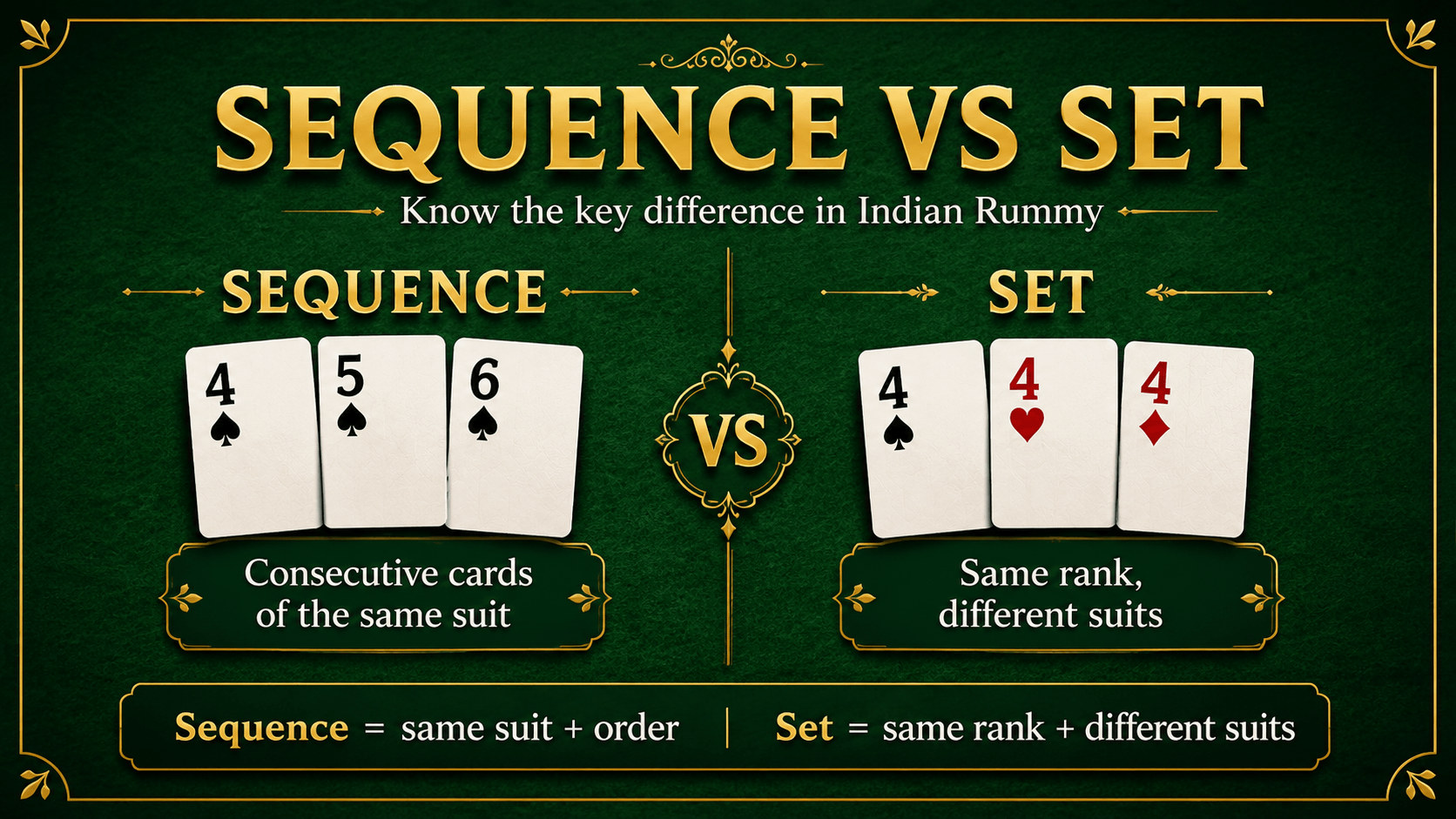
This is one of the most common questions among new Rummy players.
The difference is simple.
Sequence
Cards have:
- consecutive values;
- the same suit.
Example:
4♠ 5♠ 6♠
Set
Cards have:
- the same value;
- different suits.
Example:
4♠ 4♥ 4♦
Remember:
Sequence = same suit, consecutive cards.
Set = same rank, different suits.
What Is the Role of Jokers in Rummy?
Jokers are useful because they can help complete combinations when an important card is missing.
There are commonly two types of Jokers.
Printed Joker
The standard Joker card included in a deck is known as a printed Joker.
It can usually substitute for a missing card in an allowed combination.
Wild Joker
At the beginning of a game, one card rank may be randomly selected as the wild Joker.
For example, if 6♦ is selected, cards of rank 6 may function as Jokers according to the game rules.
Jokers are especially useful for:
- completing impure sequences;
- completing sets;
- reducing the number of unmatched cards in your hand.
However, relying too heavily on Jokers without first creating a pure sequence is a common beginner mistake.
What Is a Valid Declaration in Rummy?
A declaration happens when a player believes all 13 cards have been arranged correctly.
A standard valid declaration normally contains:
- at least two sequences;
- at least one pure sequence;
- all remaining cards organized into valid sequences or sets.
Here is a simple example.
Example Hand
4♠ 5♠ 6♠
Pure Sequence
8♥ 9♥ Joker J♥
Impure Sequence
K♣ K♦ K♥
Set
2♠ 2♥ 2♦
Set
Together, these combinations use all 13 cards correctly.
This type of hand can form a valid declaration, depending on the exact rules of the game being played.
What Is an Invalid Declaration?
A declaration may be considered invalid when one or more cards are not arranged according to the rules.
Common causes include:
- no pure sequence;
- only one sequence;
- an invalid set;
- unrelated cards left outside a sequence or set;
- incorrect use of a Joker;
- duplicate suit cards used incorrectly in a set.
Because an invalid declaration can end a round badly for the player, checking your hand carefully before declaring is important.
How Does the Ace Work in Rummy?
An Ace can commonly be used at either end of certain sequences.
Examples may include:
A♠ 2♠ 3♠
and
Q♠ K♠ A♠
However, an Ace normally cannot be used to create a wraparound sequence such as:
K♠ A♠ 2♠
That is generally not considered a valid standard sequence.
How Are Cards Scored in Rummy?
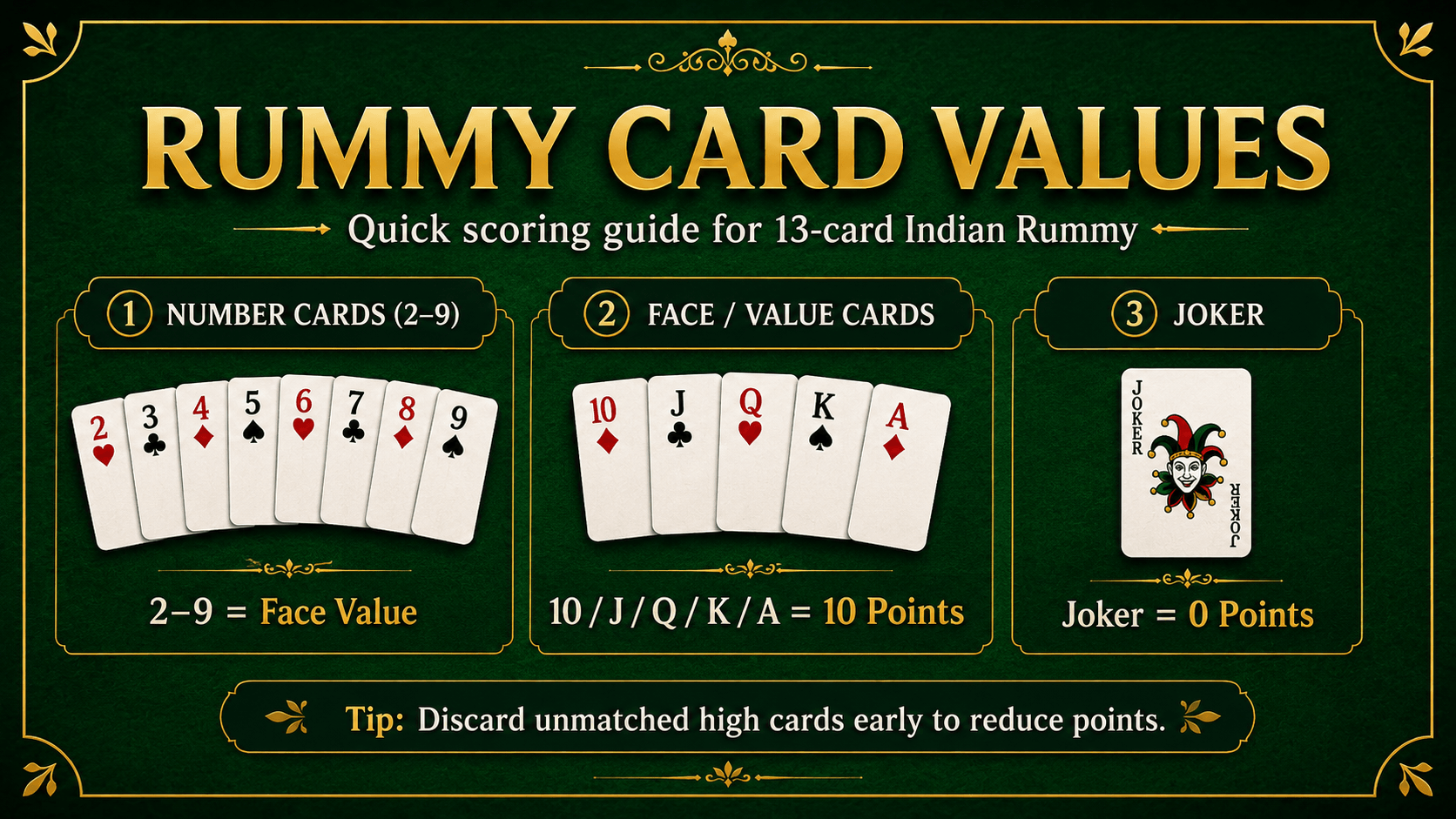
Rummy scoring is generally based on the value of cards that remain unmatched when a round ends.
Common card values are:
- Number cards: face value
- Jacks: 10 points
- Queens: 10 points
- Kings: 10 points
- Aces: commonly 10 points
- Jokers: generally 0 points
For example:
7♣ = 7 points
K♦ = 10 points
A♥ = 10 points
This is why experienced players often avoid holding several unmatched high-value cards for too long.
How Does a Turn Work in Rummy?
A basic turn normally has two main actions.
Step 1: Draw a Card
The player picks one card from either:
- the closed deck; or
- the available discard pile, depending on the game rules.
The hand temporarily contains 14 cards.
Step 2: Discard a Card
The player then selects one card to discard.
The hand returns to 13 cards.
This draw-and-discard cycle continues as players improve their combinations.
7 Common Rummy Mistakes Beginners Should Avoid
Understanding the rules is easier when you also know what not to do.
1. Ignoring the Pure Sequence
The pure sequence should usually be your first priority.
Without it, your declaration may fail even if the rest of the hand looks strong.
2. Holding High Cards for Too Long
Kings, Queens, Jacks and Aces can add significant points when unmatched.
If they are not helping your combinations, consider your options carefully.
3. Using Jokers Too Early
A Joker is valuable.
Using one for a combination that could easily be completed naturally may reduce your flexibility later.
4. Forgetting the Discarded Cards
Watching the discard pile can help you understand which cards have already appeared.
5. Making an Invalid Set
Remember that a standard set normally uses the same rank across different suits.
6. Declaring Too Quickly
Before declaring, check every group again.
One incorrect combination can invalidate the hand.
7. Focusing Only on Your Own Cards
Rummy also involves observation.
The cards opponents pick and discard may provide useful clues about the combinations they are building.
Simple Rummy Strategy for Beginners
If you are just starting, use this simple approach:
First: Look for a pure sequence.
Second: Identify cards that can form another sequence.
Third: Use Jokers to complete difficult combinations.
Fourth: Reduce unrelated high-value cards.
Fifth: Review your entire hand before making a declaration.
You do not need complicated strategies when learning the game.
Start by making valid combinations consistently.
Speed and deeper strategy can come later.
Rummy Rules Example for a Complete 13-Card Hand
Consider these 13 cards:
3♥ 4♥ 5♥
8♣ 9♣ 10♣
Q♠ Q♥ Q♦
6♠ 6♦ Joker
A♣
At first glance, much of the hand looks organized.
However, the final A♣ remains unmatched.
That means the hand is not yet fully arranged.
The player still needs to incorporate the Ace into a valid sequence or set before declaring.
This is why checking all 13 cards matters.
A hand can look almost complete while still containing one invalid card.
Frequently Asked Questions About Rummy Rules
How many cards are dealt in Indian Rummy?
Players normally receive 13 cards in standard 13-card Indian Rummy.
How many sequences are required in Rummy?
A standard valid declaration normally requires at least two sequences.
Is a pure sequence compulsory?
Yes, a valid declaration generally requires at least one pure sequence.
Can I make two pure sequences?
Yes. A hand can contain more than one pure sequence.
Can a Joker be used in every sequence?
No. A Joker can generally help create an impure sequence, but it cannot normally substitute for a missing card in a pure sequence.
Can I make a hand using only sets?
No. Standard Rummy normally requires sequences, including at least one pure sequence.
Can Ace come before 2?
Yes. A sequence such as A-2-3 of the same suit is commonly valid.
Can Ace come after King?
Yes. Q-K-A of the same suit is also commonly accepted.
Is K-A-2 a valid Rummy sequence?
No. Standard Rummy rules generally do not allow a wraparound sequence such as K-A-2.
Final Thoughts
Learning Rummy becomes much easier once you remember three basic ideas:
Build a pure sequence.
Create at least one more valid sequence.
Arrange every remaining card into a valid sequence or set.
Jokers can make this process easier, but they should be used carefully.
For beginners, the best approach is to focus on understanding sequences, sets and valid declarations before moving on to more advanced strategies.
Once these fundamentals become familiar, reading and arranging a 13-card hand becomes much faster.