
Valid Declaration in Rummy: 13-Card Checklist
Use this 13-card Rummy declaration checklist to verify the pure sequence, second sequence, sets, Jokers and all 13 cards before you declare.
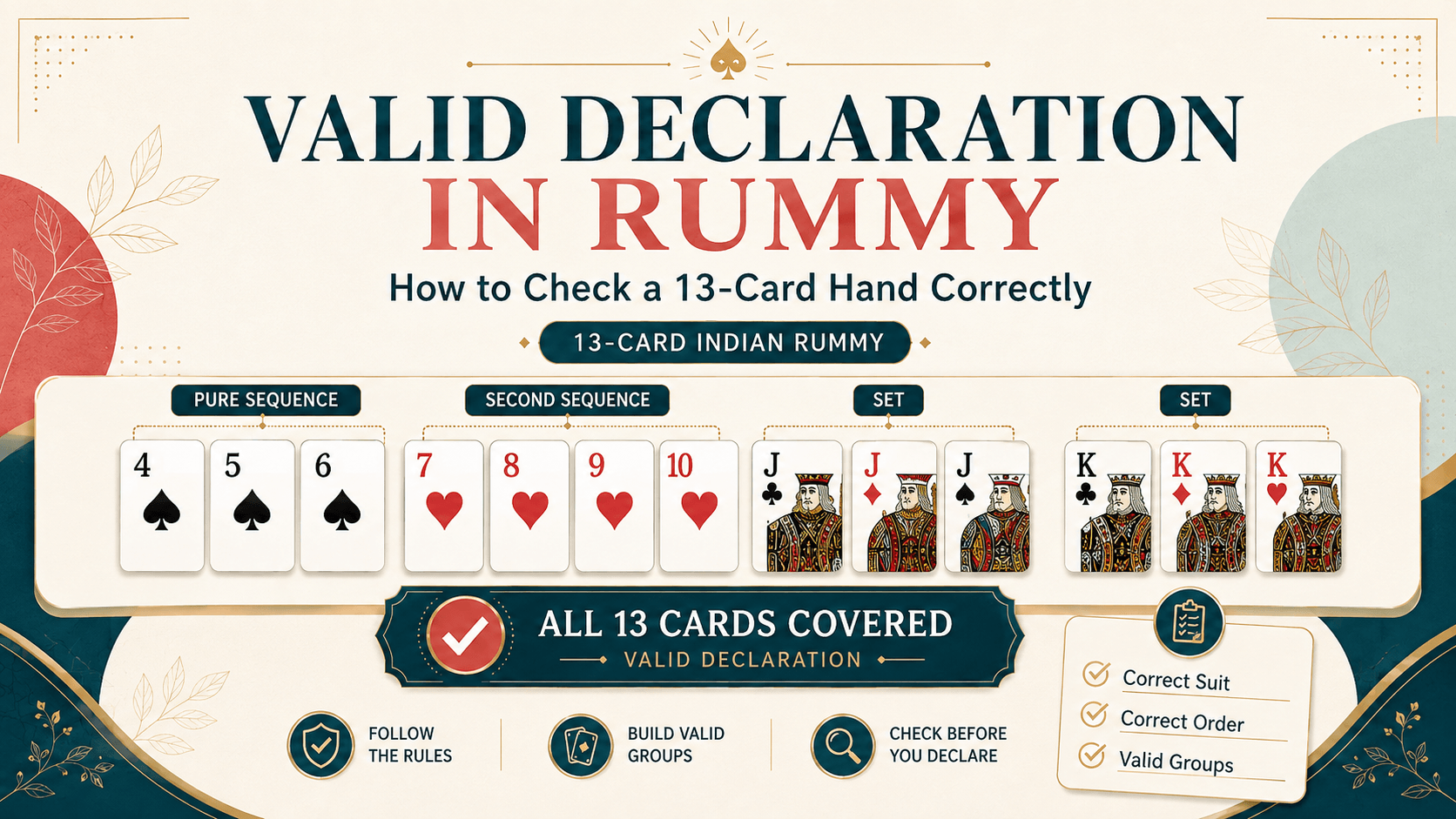
A Rummy declaration is not simply the moment when your cards “look complete.”
It is a validation test for all 13 cards.
That distinction matters.
A player can have:
- a pure sequence,
- a good set,
- several Jokers,
- and cards that appear neatly grouped,
and still make an invalid declaration.
Under standard 13-card Indian Rummy rules, a valid declaration normally requires:
- At least two sequences
- At least one pure sequence
- Every remaining card arranged into a valid sequence or set
In other words, declaration is not about your best group.
It is about whether the entire hand passes the rules at the same time.
Why a declaration needs two sequences
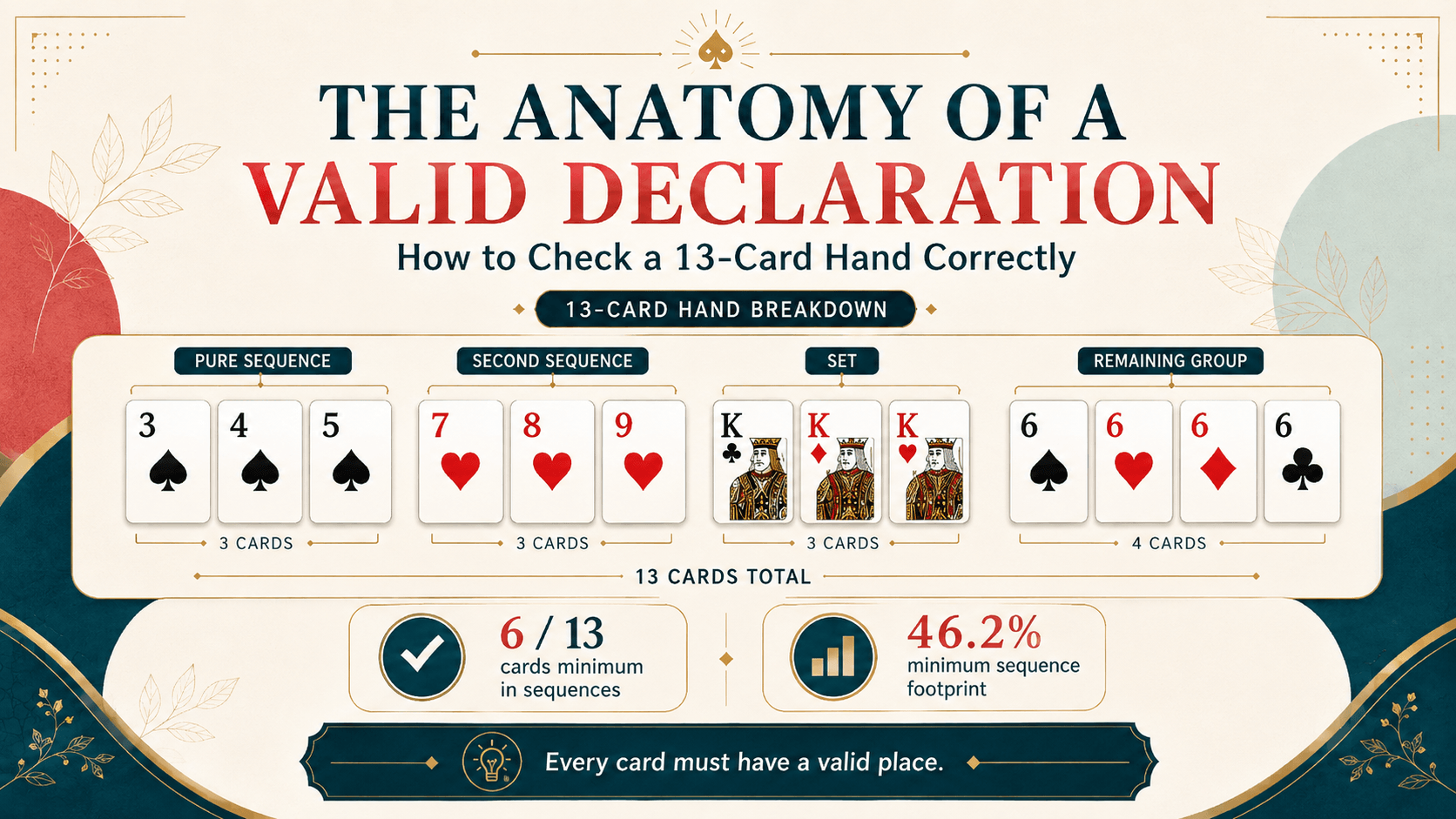
There is a useful numerical way to understand a Rummy declaration.
A sequence must normally contain at least 3 cards.
A valid declaration needs at least 2 sequences.
So the minimum number of cards that must belong to sequences is:
3 + 3 = 6 cards
Out of a 13-card hand:
6 ÷ 13 = 46.15%
So even in the smallest possible sequence structure, about:
Two sequences require at least six cards in total.
And because one of those sequences must be pure, at least:
3 ÷ 13 = 23.1%
of the hand must form a natural pure sequence.
That is why Rummy is structurally more dependent on sequences than many beginners realize.
Sets are useful.
Jokers are useful.
But they cannot replace the two-sequence requirement.
Four checks before you declare
Instead of staring at all 13 cards at once, check the hand through four gates.
This is much more reliable.
Gate 1: Do You Have a Pure Sequence?
Start here.
Example:
4♣ 5♣ 6♣
Same suit.
Correct order.
No Joker replacing a missing card.
Gate 1 passed.
If you do not have a pure sequence, there is little point checking the rest of the hand first.
A beautiful collection of sets does not fix this problem.
Gate 2: Do You Have a Second Sequence?
Now look for another valid sequence.
It can normally be:
Pure
or:
Impure
For example:
8♥ 9♥ Joker J♥
If the Joker represents 10♥, this can serve as an impure second sequence.
So:
Pure Sequence + Impure Sequence
can satisfy the minimum sequence structure.
You do not need two pure sequences.
But you do need two sequences in total.
Gate 3: Is Every Remaining Group Legal?
This is where many declarations fail.
Suppose your first six cards are perfect:
3♠ 4♠ 5♠
and:
8♥ 9♥ 10♥
Now the remaining seven cards still matter.
They cannot simply be “close enough.”
They must form valid:
- Sequences
- Sets
For example:
K♠ K♥ K♦
is a set.
But:
K♠ K♠ K♥
is not a normal valid set because the same suit card has been duplicated.
That detail becomes especially relevant in games using multiple decks. Public Rummy rules specifically warn that duplicate cards of the same suit cannot simply be repeated inside a normal set.
Gate 4: Are All 13 Cards Accounted For?
This sounds obvious.
It is also one of the easiest mistakes to make.
Imagine the hand is:
3♠ 4♠ 5♠
8♥ 9♥ 10♥
K♣ K♦ K♥
6♠ 6♥ 6♦
and:
A♣
The first 12 cards look excellent.
But the A♣ is standing alone.
That one unmatched card means the hand is not complete.
A declaration is a 13-card test, not a “most of my cards are correct” test.
One ungrouped card still makes a declaration invalid
This is another useful way to see the problem.
If 12 of 13 cards are perfectly arranged:
12 ÷ 13 = 92.3%
of the hand is correct.
It still does not produce a valid declaration.
Why?
Because Rummy declaration works more like a logical test than a percentage score.
It is effectively:
All required conditions = TRUE
not:
Most conditions = TRUE
That is why declaration errors can feel harsh.
The hand may be almost perfect, but “almost valid” is still invalid.
Valid Declaration Example
Consider:
Pure Sequence
3♠ 4♠ 5♠
Second Sequence
7♥ 8♥ 9♥
Set
Q♣ Q♦ Q♥
Set
6♣ 6♦ 6♥ 6♠
Card count:
3 + 3 + 3 + 4 = 13
Now run the four-gate test.
Pure sequence?
Yes.
Second sequence?
Yes.
Remaining groups valid?
Yes.
All 13 cards used?
Yes.
Valid Declaration ✓
A 3 + 3 + 3 + 4 arrangement is a particularly easy structure for beginners to visually audit because the whole hand splits neatly into four groups.
It is not the only possible valid structure.
But it is a useful teaching model.
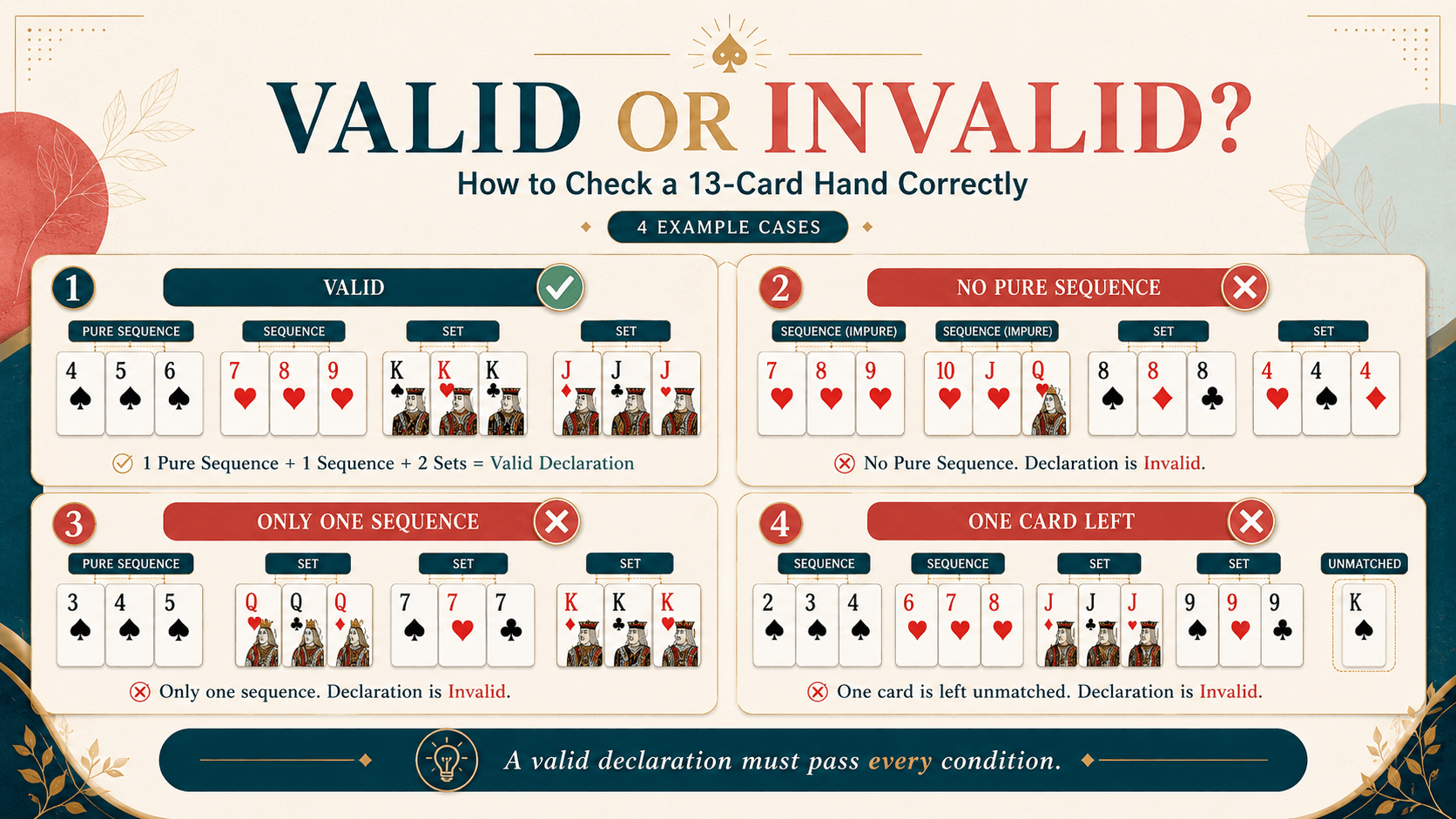
Invalid Declaration #1: No Pure Sequence
Suppose the hand contains:
4♠ Joker 6♠
and:
9♥ Joker J♥
along with valid sets.
Both sequence-like groups rely on Jokers.
So you may have two sequences, but no pure one.
That fails the first gate.
Invalid Declaration ✕
This is one of the most common structural errors in 13-card Rummy.
Public Rummy rule guides consistently identify the pure sequence as compulsory.
Invalid Declaration #2: Only One Sequence
Now consider:
4♥ 5♥ 6♥
Pure Sequence
8♠ 8♥ 8♦
Set
Q♠ Q♥ Q♦
Set
3♣ 3♦ 3♥ 3♠
Set
Every group individually looks legal.
But there is only one sequence.
You need at least two.
Invalid Declaration ✕
This is a good example of why checking groups one by one is not enough.
Each group can be valid while the whole hand structure is invalid.
Invalid Declaration #3: A Broken Set
Imagine:
7♠ 7♠ 7♥
You have three sevens.
But two are identical 7♠ cards from different decks.
That does not normally form a standard valid set.
A valid set requires the same rank across different suits, subject to the specific Joker rules of the game.
So a single bad set can destroy an otherwise valid declaration.
Invalid Declaration #4: The “Looks Consecutive” Trap
Consider:
9♣ 10♣ Q♣
The cards are all Clubs.
But J♣ is missing.
Without a valid Joker substitution:
Not a Sequence
Visual similarity is not enough.
The ranks must actually be consecutive.
Invalid Declaration #5: K-A-2
Ace creates another common mistake.
Under commonly used Indian Rummy rules, Ace can usually appear as:
A-2-3
or:
Q-K-A
But not:
K-A-2
Ace can sit at either end of the rank structure.
It does not normally wrap around the deck.
So:
K♠ A♠ 2♠
is not a standard valid sequence.
The Biggest Declaration Mistake Is Not a Rule Mistake
From a playing perspective, the most interesting mistake is not forgetting what a sequence is.
It is declaring before re-validating the hand after the last move.
Your hand may have been valid-looking one turn ago.
Then you:
- pick a card,
- move a card between groups,
- repurpose a Joker,
- break a set,
- discard something,
and suddenly one old group no longer works.
This is why the last few seconds before declaration matter.
A useful habit is:
Never validate the hand from memory.
Validate the cards that are actually on the table right now.
The “Do Not Touch” Rule
Once you have a completed pure sequence, treat it as protected unless you have a clear structural reason to break it.
Example:
5♦ 6♦ 7♦
Pure Sequence
You then draw another:
5♣
and already hold:
5♥ 5♠
It may be tempting to move 5♦ into:
5♦ 5♣ 5♥ 5♠
That makes a beautiful four-card set.
But if 5♦ was part of your only pure sequence, you have just solved one problem and created a larger one.
This is one of the reasons experienced hand management is not just about maximizing individual groups.
You protect compulsory structures first.
Declaration Is a Dependency System
A useful expert way to think about the hand is:
Pure Sequence
      ↓
Second Sequence
      ↓
Remaining Legal Groups
      ↓
All 13 Cards Covered
      ↓
DECLARE
Each stage depends on the previous conditions still being valid.
This is why declaration should be checked top-down, not randomly.
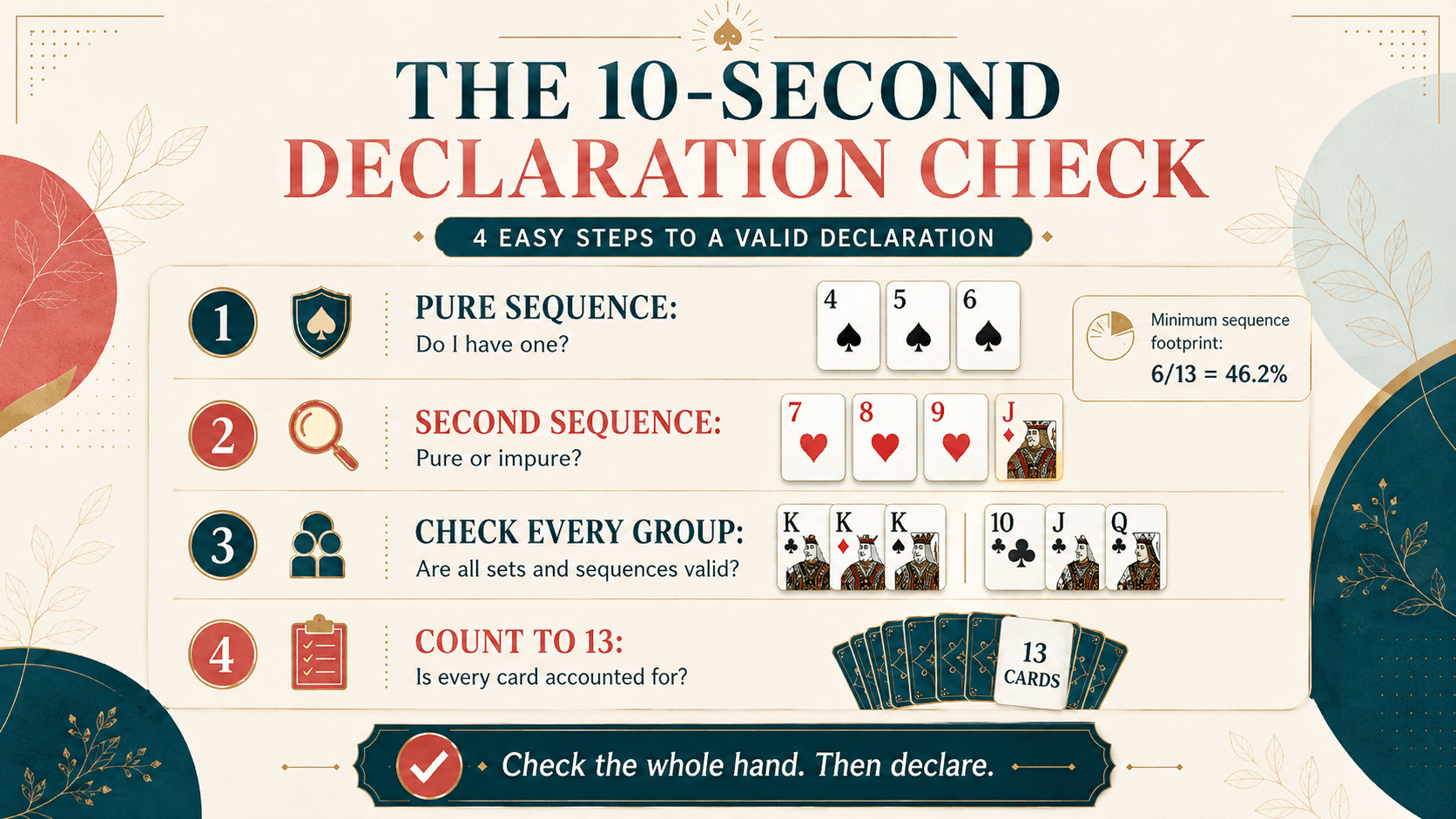
Count the Cards Before You Click
This sounds almost too simple to mention.
It works.
Before declaring:
3 + 3 + 3 + 4 = 13
or whatever your grouping structure is.
Count it.
Digital interfaces usually help organize groups, but a quick card count can expose:
- one forgotten card,
- a duplicated card,
- a broken group,
- an accidental rearrangement.
The fastest check is often not another strategy decision.
It is basic arithmetic.
A Practical Declaration Checklist
Before pressing Declare, ask:
Pure Sequence
Do I have at least one natural sequence?
Sequence Count
Do I have at least two sequences overall?
Group Validity
Are the remaining cards in legal sequences or sets?
Joker Use
Is every Joker being used in a permitted way?
Card Count
Are all 13 cards included?
If all five answers are yes, then declaration becomes a much safer decision.
Frequently Asked Questions
What is a valid declaration in Rummy?
A valid declaration is a 13-card hand in which the required sequences and all remaining groups satisfy the rules.
How many sequences are required?
Standard 13-card Indian Rummy normally requires at least two sequences.
How many pure sequences are required?
At least one of those sequences must normally be pure.
Can both sequences be pure?
Yes.
The second sequence can be pure or impure.
Can I declare with one pure sequence and three sets?
No.
One pure sequence satisfies the pure requirement, but you still need a second sequence.
Can one unmatched card remain?
No.
All 13 cards must be part of valid groups before a standard declaration.
Can a Joker be used in the second sequence?
Yes, the second sequence may normally be impure and use a Joker.
Can I make more than two sequences?
Yes.
Two is the minimum, not the maximum.
A hand with three or even more valid sequences can be declared if the complete 13-card structure satisfies the rules.
What is the easiest way to avoid a wrong declaration?
Check the hand in this order:
Pure Sequence → Second Sequence → Remaining Groups → Count All 13 Cards
This is faster and more reliable than looking at the hand randomly.
Final Takeaway
A valid declaration is not about having good cards.
It is about satisfying a set of dependencies.
At minimum, almost half the hand — 6 of 13 cards, or roughly 46.2% — must already belong to sequences.
At least one of those sequences must be pure.
And all 13 of 13 cards must have a valid place.
The most useful declaration habit is therefore not:
“Does my hand look finished?”
It is:
“Can I prove that every condition is satisfied?”
Once you start thinking that way, declaration errors become much easier to spot.