
13 Card Rummy Points Calculation: 3 Worked Examples
Learn 13 card rummy points calculation with card values, a four-step method, three complete worked hands, and the common 80-point cap.
To score an unfinished Rummy hand, first check the required sequences. Which cards can be excluded from the penalty depends on those requirements; grouping cards into a set does not automatically protect them. Then add the card values required by your table’s rules.
Important: Indian rummy tables and apps can apply different rules for drops, invalid declarations, scoring caps, and special variants. The examples below use common 13-card Indian rummy conventions. Always check the rules shown at your own table before you play.
Quick answer: how are rummy points calculated?
In a commonly used points system, number cards from 2 to 10 carry their face value. Jacks, Queens, Kings, and Aces carry 10 points each. Printed Jokers and wild Jokers normally carry zero points when used correctly. Cards inside valid sequences and sets are protected; the remaining unmatched cards make up the hand score.
- 2 to 10: face value
- J, Q, K and A: 10 points each
- Printed or wild Joker: normally 0 points
- Winner: normally 0 points
- Losing hand: total of cards not covered by valid groups, subject to the table's rules
A common maximum loss is 80 points, even when the raw value of an ungrouped hand is higher. That cap is a table rule, not a reason to stop doing the arithmetic: calculate the raw total first, then apply the cap shown by the game.
The four-step calculation method
- Check the pure sequence first. A valid declaration normally needs at least one sequence made without a Joker.
- Validate every other group. Confirm the second sequence and any sets before treating their cards as protected.
- Separate unmatched cards. Do not count a card merely because it is physically placed near a sequence or set; the group must be valid.
- Add the values and apply the table rule. Total the unmatched cards, then check whether an 80-point cap or an invalid-declaration rule applies.
If sequences and sets still feel similar, review our Rummy sequence vs set examples before calculating a hand.
Worked hand 1: three valid groups and four unmatched cards
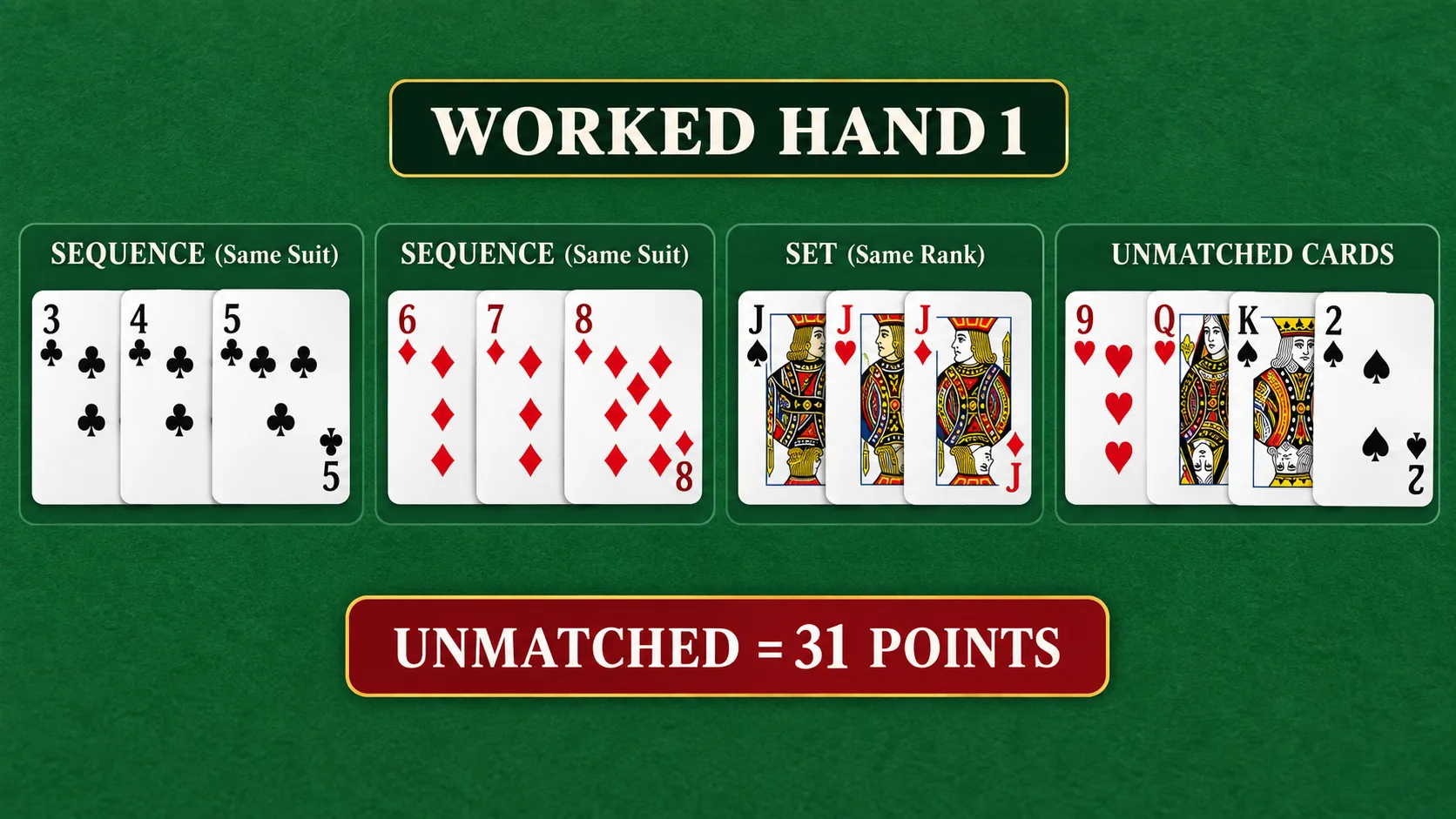
Cards: 3♣ 4♣ 5♣ / 6♦ 7♦ 8♦ / J♠ J♥ J♦ / 9♥ Q♥ K♠ 2♠
- 3♣-4♣-5♣ is a pure sequence.
- 6♦-7♦-8♦ is a second pure sequence.
- J♠-J♥-J♦ is a valid set because the three Jacks have different suits.
- 9♥, Q♥, K♠ and 2♠ are unmatched.
Calculation: 9 + 10 + 10 + 2 = 31 points.
The useful lesson is that high cards inside a valid set do not add to the penalty. The three Jacks are worth 10 each as individual cards, but their valid set protects them from the unmatched-card total.
Worked hand 2: an Ace in a valid sequence
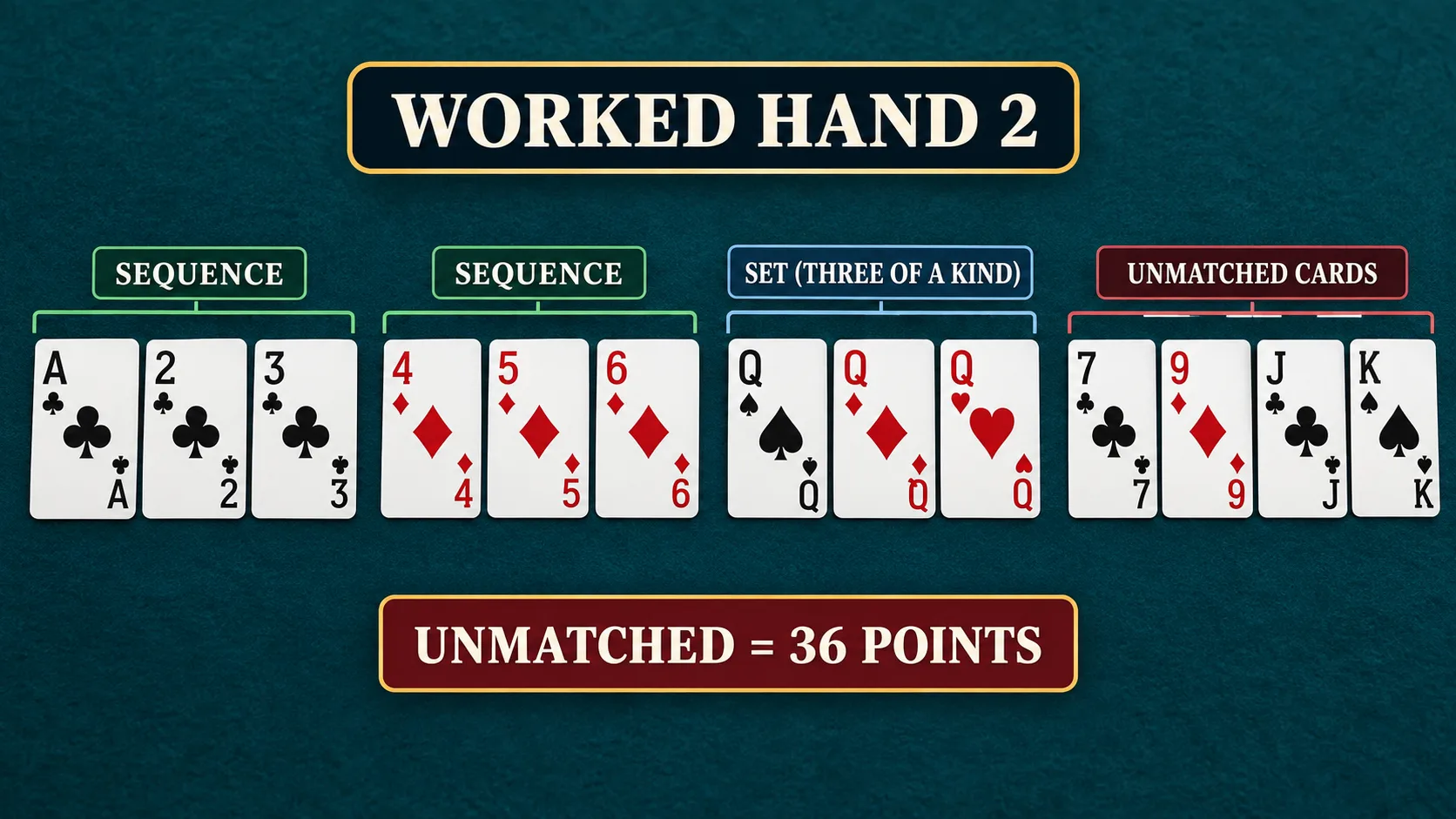
Cards: A♣ 2♣ 3♣ / 4♦ 5♦ 6♦ / Q♠ Q♦ Q♥ / 7♣ 9♦ J♣ K♠
- A♣-2♣-3♣ is a pure sequence.
- 4♦-5♦-6♦ is another pure sequence.
- Q♠-Q♦-Q♥ is a valid set.
- 7♣, 9♦, J♣ and K♠ are unmatched.
Calculation: 7 + 9 + 10 + 10 = 36 points.
An Ace is commonly worth 10 points when unmatched, but here it sits inside a valid sequence, so it contributes zero to the penalty. Do not add card values until you have finished validating every group.
Worked hand 3: raw score 90, commonly capped at 80
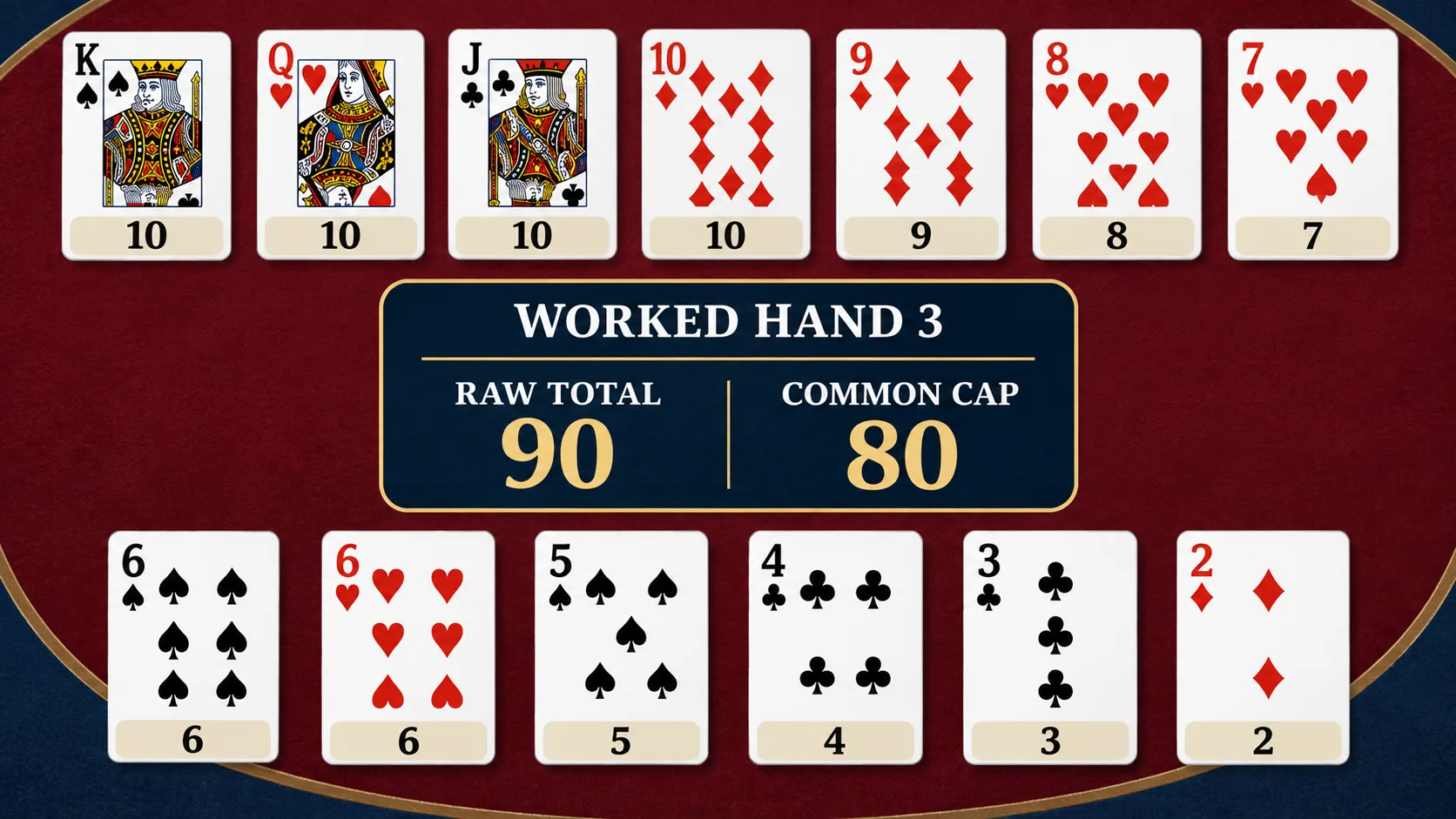
Cards: K♠ Q♥ J♣ 10♦ 9♦ 8♥ 7♥ 6♠ 6♥ 5♠ 4♣ 3♣ 2♦
Assume none of these cards has been arranged into a valid sequence or set. The raw calculation is:
10 + 10 + 10 + 10 + 9 + 8 + 7 + 6 + 6 + 5 + 4 + 3 + 2 = 90 points.
If the table uses the common maximum-loss rule, the displayed penalty becomes 80 points. Notice the distinction: the cards still add up to 90, but the scoring rule limits the recorded loss. If your result differs, check the exact cap and declaration rules inside that game.
What happens without a pure sequence?
A hand can contain attractive sets and still fail declaration requirements. In common Indian rummy rules, a valid declaration needs at least two sequences, and at least one of them must be pure. If the required pure sequence is missing, the platform may treat the declaration as invalid and calculate the penalty under its invalid-declaration rules.
This is why scoring should begin with structure, not addition. Use the valid declaration checklist to confirm the hand before counting points, and read the pure sequence guide if Jokers are involved.
Common calculation mistakes
Counting every card in the hand
Only cards outside valid groups normally count toward the penalty. Cards in protected sequences and sets are excluded.
Treating Aces as one point
That rule belongs to some other rummy variants. In the common Indian 13-card scoring system used in this guide, an unmatched Ace carries 10 points.
Calling any three same-rank cards a set
A valid set uses the same rank in different suits. A repeated suit can make the group invalid, depending on the decks and table rules.
Using a Joker in the pure sequence
A pure sequence is made without substituting a Joker. A sequence that uses a Joker as a replacement is usually impure.
Confusing raw points with the final penalty
The cards may total more than 80, but a table that applies an 80-point cap will display 80. Drops and invalid declarations can also follow separate fixed penalties.
A 20-second checklist after each hand
- Do I have a pure sequence?
- Do I have the required second sequence?
- Are all sets made with different suits?
- Which cards are genuinely unmatched?
- Did I count A, J, Q and K as 10 each?
- Does this table apply an 80-point cap or a special declaration penalty?
For a hands-on check, open the free 13-card Rummy practice table and practise arranging cards before you calculate them. You can also review the full 13 Card Rummy rules guide.
Frequently asked questions
How many points is an Ace in 13 card rummy?
In common Indian 13-card rummy scoring, an unmatched Ace is worth 10 points. An Ace inside a valid sequence does not add to the unmatched-card penalty.
Do Jokers carry points?
Printed Jokers and declared wild Jokers normally carry zero points. They still need to be used according to the table's sequence and set rules.
Why did the game show 80 when my cards added up to more?
Many 13-card rummy tables cap the maximum loss at 80 points. Your raw card total can be higher, but the recorded penalty is limited by that rule.
How many points does the winner receive?
The winner normally receives zero penalty points. The other players' scores are calculated from their unmatched cards and the applicable table rules.
Are drop points the same as unmatched-card points?
No. A first drop or middle drop may use a fixed penalty instead of the full unmatched-card calculation. The exact amounts depend on the table, so check the displayed rules before joining.
Play responsibly. This educational guide is for adults aged 18 and above. Rules, eligibility and availability can vary by location and platform.