
Indian Rummy Game: Rules, How to Play & Card Examples
Learn Indian Rummy game rules with card examples: pure sequences, Jokers, scoring and a complete 13-card hand. Follow each turn and check your declaration.
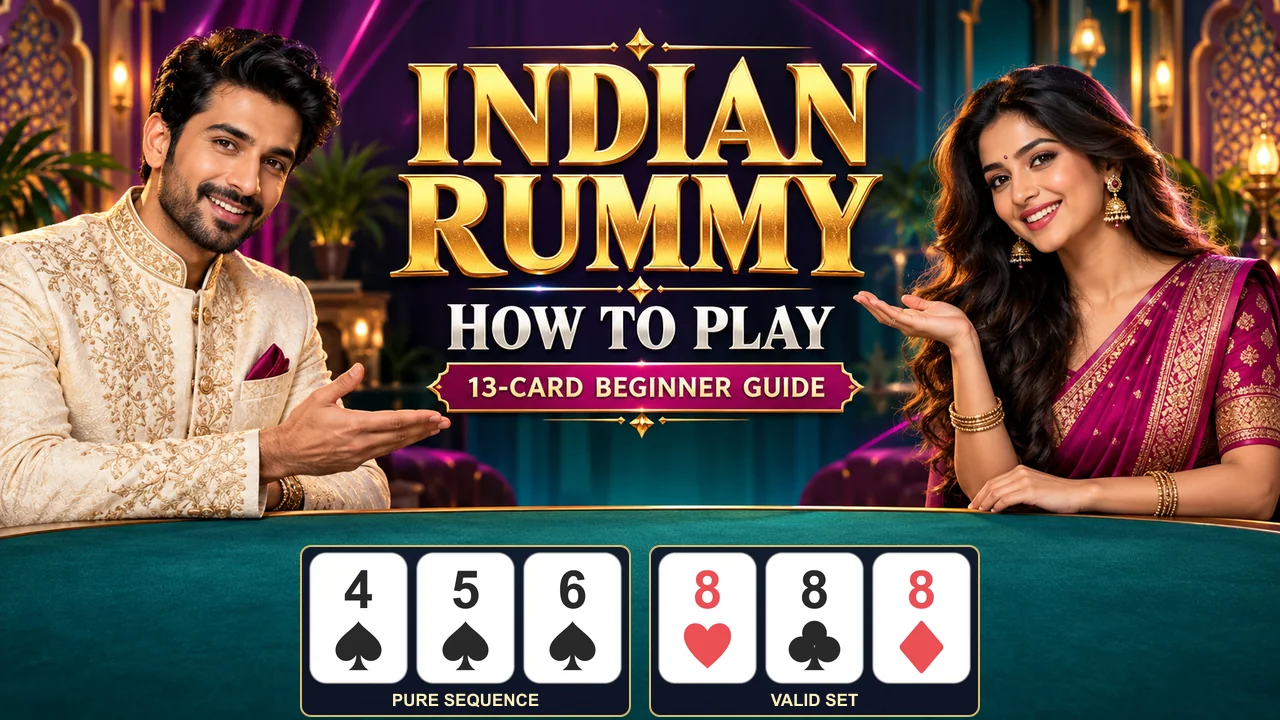
Indian Rummy is a 13-card game in which players draw and discard cards to build sequences and sets. To make a valid declaration, you must arrange all 13 cards into valid groups, including at least two sequences. At least one of those sequences must be pure: no Joker can substitute for a missing card in it.
This guide explains the commonly played 13-card version, with card examples and a complete winning hand. Deck size, drop penalties and some Joker rules vary between tables, so check the rules of the game you join.
Indian Rummy rules at a glance
| Question | Quick answer |
|---|---|
| How many cards does each player get? | 13 cards. |
| How many people can play? | Commonly 2–6 players. |
| What happens on a turn? | Draw one card, arrange your hand, then discard one card. |
| What do you need to declare? | All 13 cards grouped correctly, with at least two sequences and at least one pure sequence. |
| Are sets compulsory? | No. The remaining cards can form additional sequences or valid sets. |
| Are Jokers compulsory? | No. A hand can be valid without using a Joker. |
What counts as a sequence or a set?
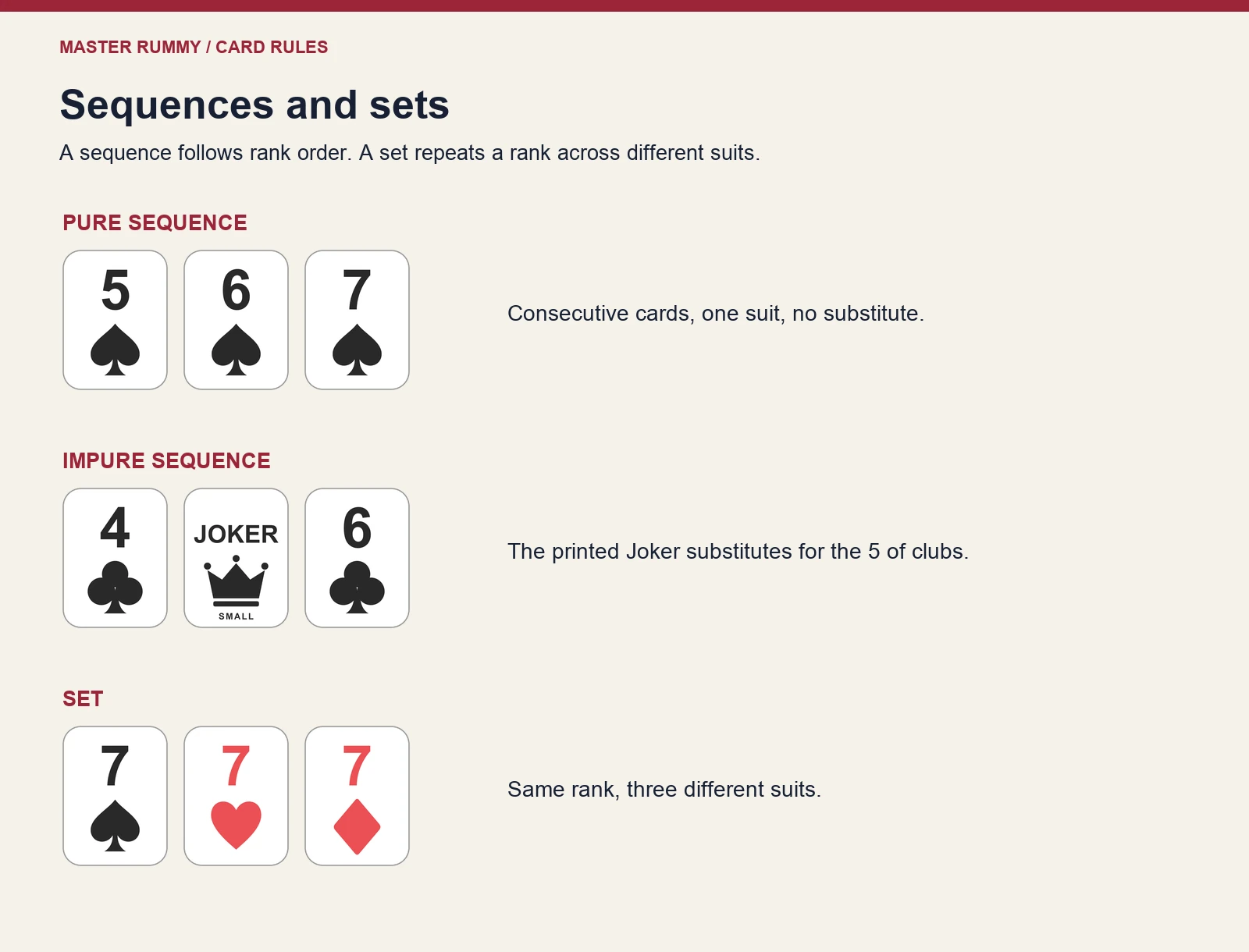
The difference is simple: a sequence follows consecutive ranks in one suit; a set uses the same rank in different suits. Every group needs at least three cards.
Pure sequence
A pure sequence is a run of at least three consecutive cards of the same suit, without a Joker replacing a card. For example, 5♠–6♠–7♠ is pure. So is 10♥–J♥–Q♥–K♥. A sequence can contain more than three cards.
By contrast, 5♠–6♥–7♠ is not a sequence because the suits differ. And 5♠–7♠–8♠ is not consecutive: the 6♠ is missing. For more examples, see our pure sequence guide.
Impure sequence
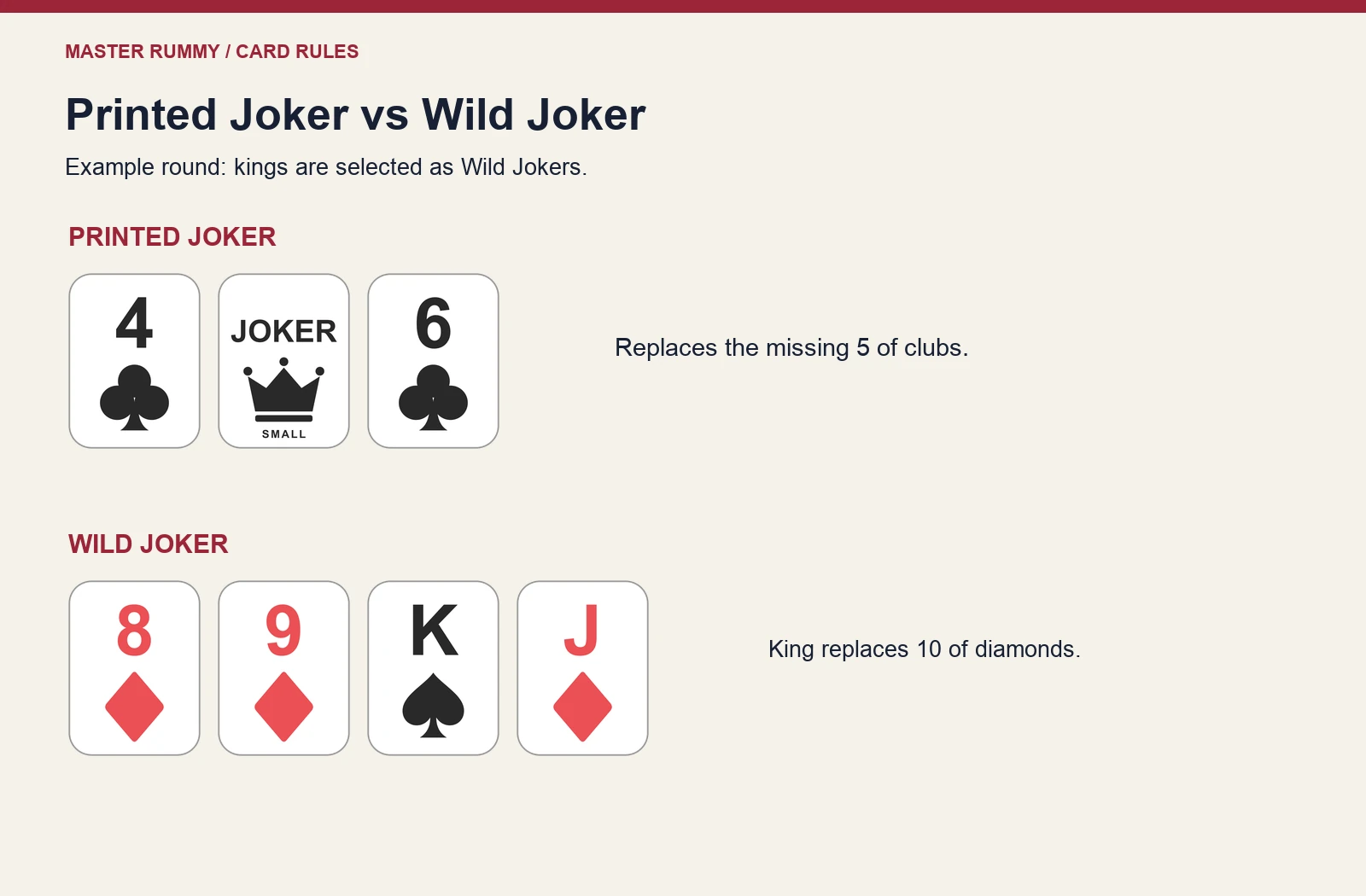
An impure sequence uses a Joker to fill a missing rank. In 4♣–Printed Joker–6♣, the Joker stands for 5♣. The cards represented by the group are still consecutive and belong to one suit.
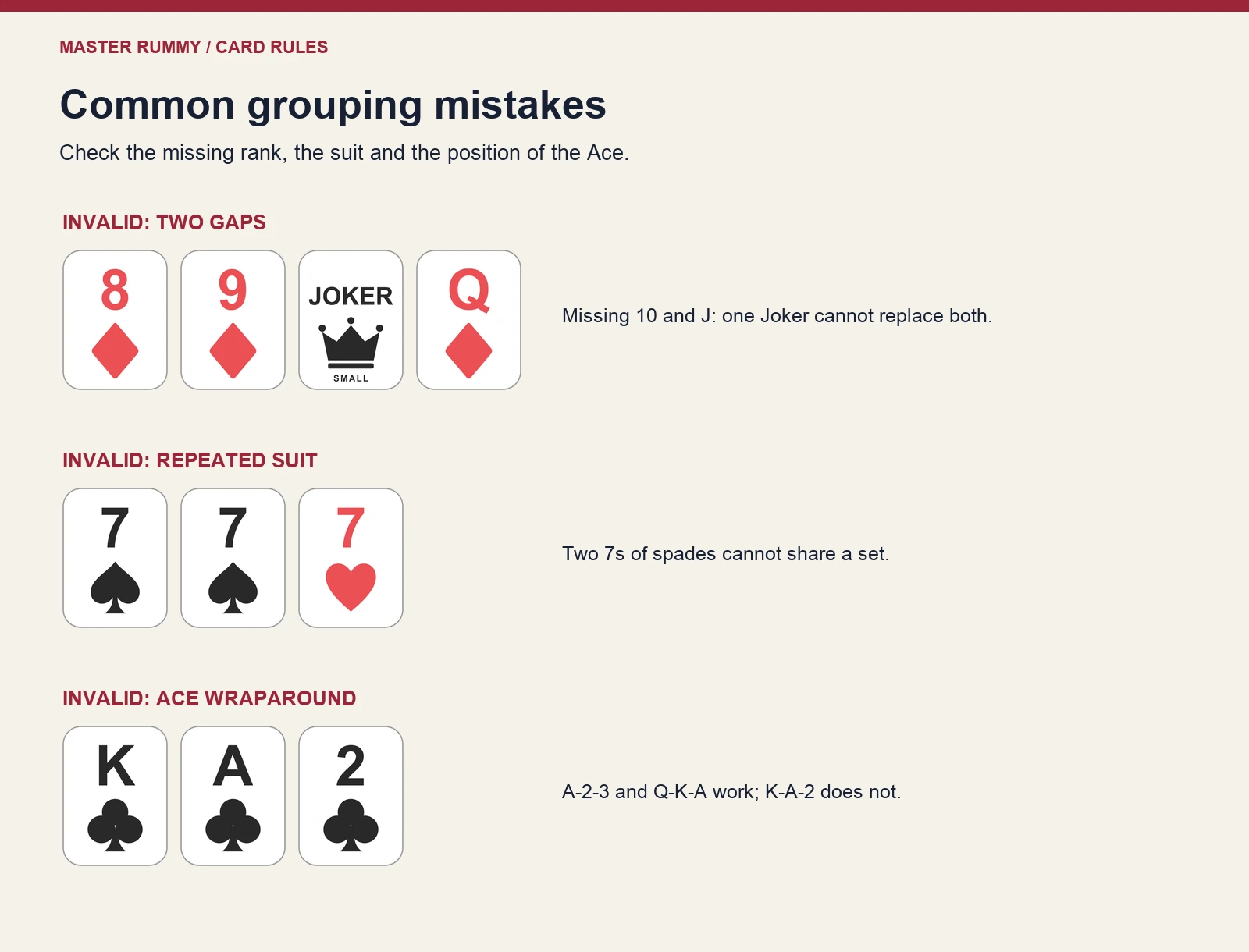
A Joker fills one position, not several. The group 8♦–9♦–Joker–Q♦ is invalid because both 10♦ and J♦ are missing. Replace Q♦ with J♦ and the group works: the Joker now fills only the 10♦ position.
Set
A set contains three or four cards of the same rank, from different suits. 7♠–7♥–7♦ is a valid set. Adding 7♣ produces a four-card set.
Two copies of 7♠ cannot belong to the same set, even when the game uses two decks. A Joker may complete a set under the table's rules, but a set never counts as one of your two required sequences.
How do printed and wild Jokers work?
A printed Joker is the dedicated Joker card included in a deck. A wild Joker is an ordinary card whose rank has been selected to act as a substitute for that round. If a king is selected, all kings act as wild Jokers.
For example, with kings wild, 8♦–9♦–K♠–J♦ is an impure sequence. K♠ substitutes for 10♦; its printed suit does not determine the suit of the sequence.
A Joker used as a substitute cannot make a sequence pure. Some rule sets allow a wild-rank card to remain natural when it occupies its own printed rank and suit. For example, if sixes are wild, 5♠–6♠–7♠ may still count as pure under those rules. Check that convention before relying on it. Our printed and wild Joker guide explains the distinction in more detail.
How to play Indian Rummy, step by step
1. Deal the cards and identify the wild rank
Each player receives 13 cards. A common setup uses two standard decks with printed Jokers. The exact number of decks and printed Jokers depends on the table. A card is selected to identify the wild Joker rank.
The remaining face-down cards form the closed draw pile. A face-up card starts the open discard pile. Keep the wild-rank indicator separate from the cards you can pick up.
2. Sort your hand
Look for complete sequences first, then cards that could form one. Holding 5♠ and 6♠ gives you two possible ends to work toward: 4♠ or 7♠. Holding 5♠ and 7♠ leaves one internal gap: 6♠.
Keep track of your pure sequence separately. Three matching sevens can be useful, but they do not solve the pure-sequence requirement.
3. Draw one card
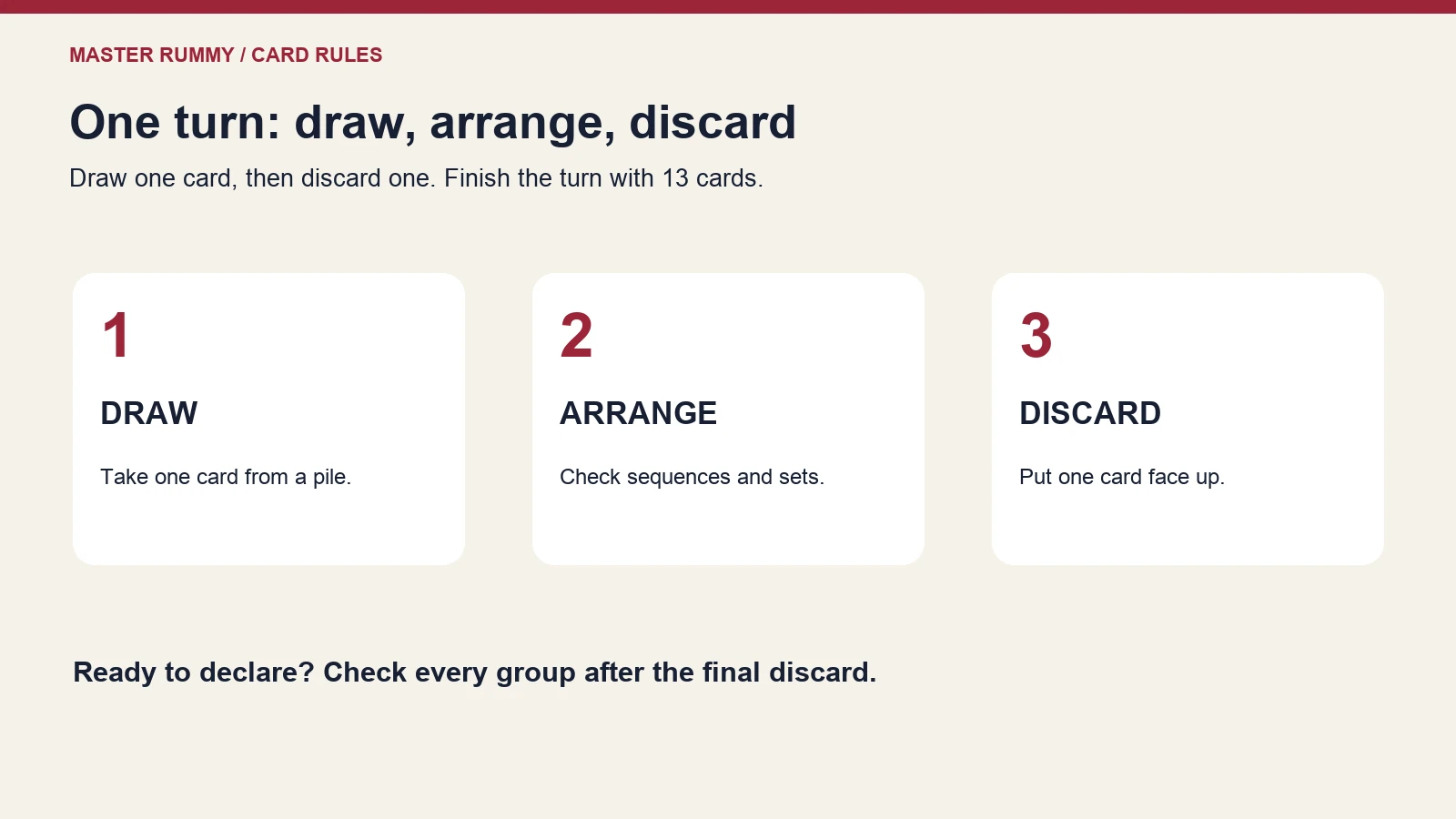
On your turn, take one card from the closed pile or the available top card of the open pile, subject to the table's pickup restrictions. You temporarily hold 14 cards.
Choose a face-up card when it improves a specific group. Picking up a card simply because it has a low point value can leave you with fewer useful connections.
4. Rearrange and discard
After drawing, check whether the new card changes your best grouping. Then discard one card face up, returning your hand to 13 cards. A card that looked unhelpful earlier may become useful after a draw, so reassess before discarding.
5. Declare only after checking every group
Once your hand meets the requirements, make the final discard and follow the table's declaration procedure. Count the cards, verify both sequences and check the remaining groups. A nearly complete hand is still incomplete.
A complete 13-card winning hand
Here is one valid arrangement. For this example, kings are the selected wild rank, although the hand uses only a printed Joker as a substitute.
| Group | Cards | Why it works |
|---|---|---|
| Pure sequence: 3 cards | 4♠–5♠–6♠ | Consecutive ranks in spades, without a substitute. |
| Second sequence: 4 cards | 9♥–10♥–J♥–Q♥ | Another pure sequence; the second sequence does not have to use a Joker. |
| Set: 3 cards | 2♣–2♦–2♠ | Three twos in different suits. |
| Impure sequence: 3 cards | 7♣–Printed Joker–9♣ | The Joker represents 8♣. |
The count is 3 + 4 + 3 + 3 = 13. There are at least two sequences, one is pure, and no card is left outside a valid group. This grouping is an example, not a mandatory pattern: other group lengths can work if all requirements are met.
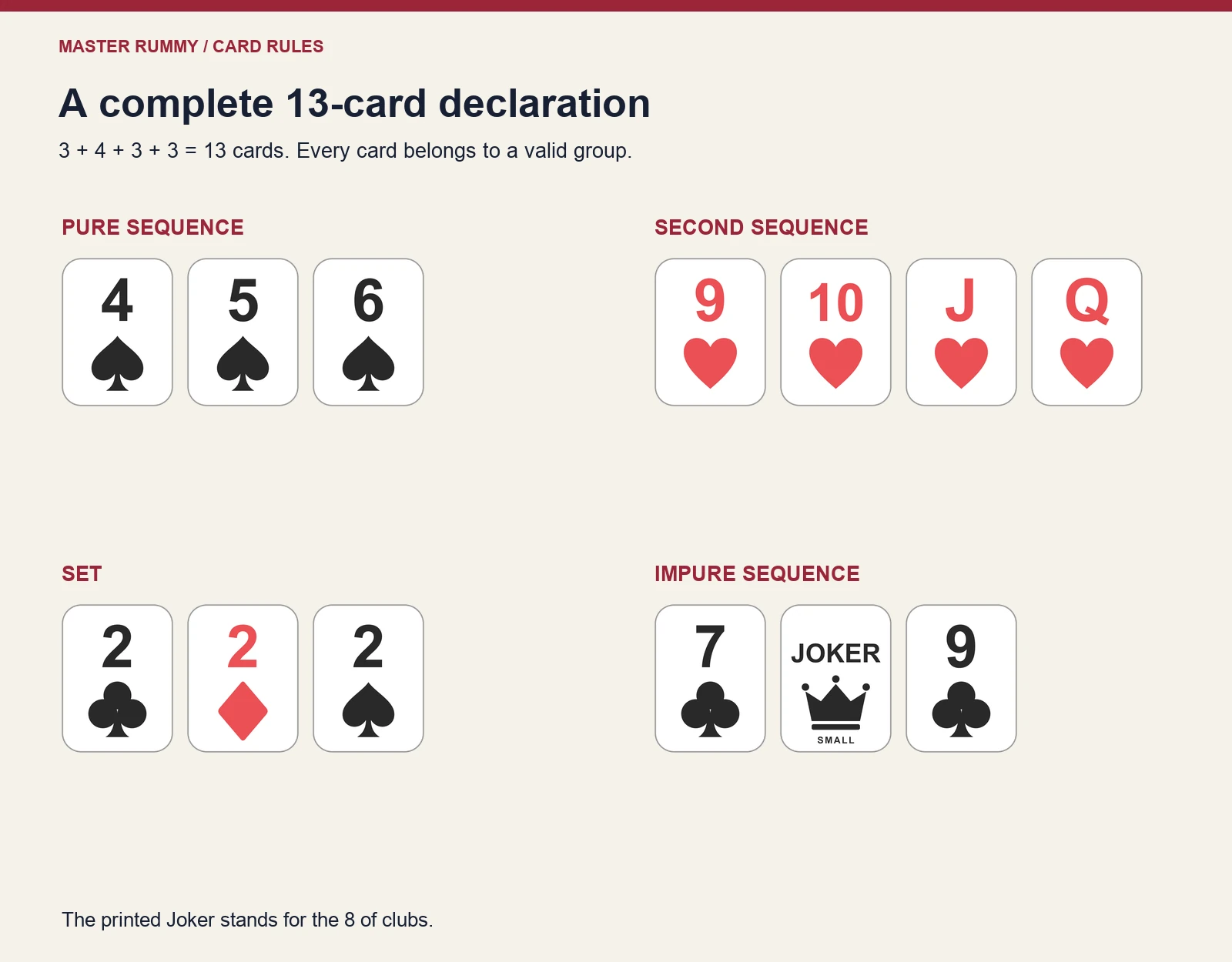
To see how a draw can finish this hand, imagine holding the same cards except that J♥ is missing and you have an extra 8♣. Drawing J♥ completes the heart sequence. Discarding 8♣ leaves the valid 13-card arrangement shown above.
How are points counted?
Card values and the rules for counting an unfinished hand are separate questions. First identify which cards carry points; then apply the scoring rules for the table.
| Card | Common penalty value |
|---|---|
| 2 through 10 | The printed number. |
| J, Q, K and A | 10 points each. |
| Printed and wild Jokers | 0 points. |
In a common points-rummy system, the winner receives zero penalty points. When the compulsory sequences are present, cards outside valid groups contribute to the losing hand's penalty. For example, an unmatched K and 8 contribute 18 points under that calculation.
Do not assume every completed group is protected when the compulsory sequences are missing. Tables can apply different counting rules at that stage. An 80-point cap and 20/40-point drop penalties are common conventions, but they are not universal rules for every Indian Rummy format. Read the table's scoring and drop rules before starting. See worked Rummy points calculations for examples.
Common mistakes to check before declaring
- Only one sequence: a pure sequence plus several sets still lacks the required second sequence.
- A gap hidden by a Joker: name the exact card each Joker represents; one substitute cannot fill two gaps.
- Duplicate suits in a set: two identical cards from different decks are still the same rank and suit.
- Ace wraparound: A–2–3 and Q–K–A can work in one suit; K–A–2 cannot.
- A spare card: every card must belong to a valid group, and each physical card can be used only once.
Beginner tips that follow from the rules
Work toward a pure sequence early. Extra sets and Jokers cannot replace it. Once you have one, look at what is needed for your second sequence rather than building unrelated pairs.
Judge high cards by their connections. An isolated K carries more penalty risk than a low card, but Q♥–K♥ is also a useful connection. Discarding every high card automatically can break a promising sequence.
Recheck Joker placement after a draw. If you draw the natural card a Joker was replacing, that Joker may help complete a different group. Check the entire hand before deciding what to discard.
Practise identifying valid groups before worrying about speed. Recognising why a declaration works is more useful than memorising a single winning layout. For more explanations, browse the Rummy guides library and practise checking each group before declaring.
Indian Rummy FAQs
Is Indian Rummy the same as 13-card Rummy?
Indian Rummy commonly refers to the 13-card version explained here. Rummy is a wider family of games, so confirm the card count and declaration rules when a table uses a different variant.
Can I declare with two pure sequences?
Yes. The requirement is at least two sequences, with at least one pure. Both can be pure, provided the rest of your cards also form valid groups.
Can I win without a set or a Joker?
Yes. Neither is compulsory. A hand made entirely of valid natural sequences can satisfy the declaration rules.
Can Ace be high and low?
Yes, in the common rules used here. A♣–2♣–3♣ and Q♣–K♣–A♣ are valid. K♣–A♣–2♣ is not: the sequence cannot wrap around the Ace.
Can I use the same card in two groups?
No. You can rearrange your hand while playing, but a physical card belongs to only one group in the final declaration.
What is the difference between Points, Pool and Deals Rummy?
These formats share the basic grouping rules but organise scoring differently. Points Rummy resolves individual deals through points. Pool Rummy tracks scores toward an elimination threshold. Deals Rummy runs over a fixed number of deals. Check each format's scoring rules rather than carrying one table's penalties into another. Our Points, Pool and Deals comparison covers those differences.
Rules references
For comparison with a published operator rule set, consult RummyCircle's Rummy rules and its points-system explanation. These describe that operator's conventions; the rules shown at your own table take precedence.