
Rummy Strategy: Better Draw and Discard Decisions
Work through Rummy decisions using your sequences, possible connections, unmatched points and the cards opponents reveal.
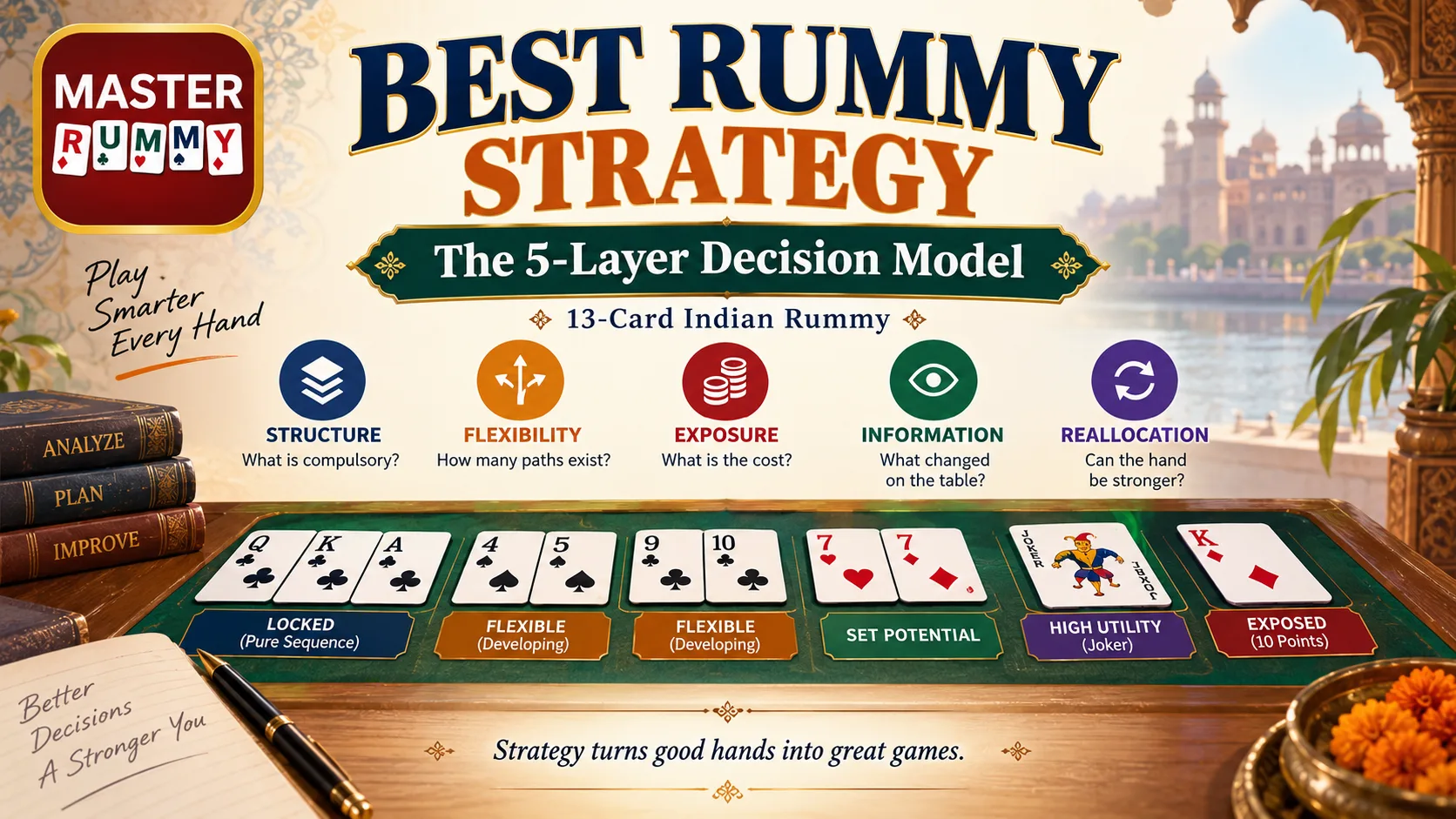
Quick Answer: What Is the Best Rummy Strategy?
There is no single move that works for every Rummy hand.
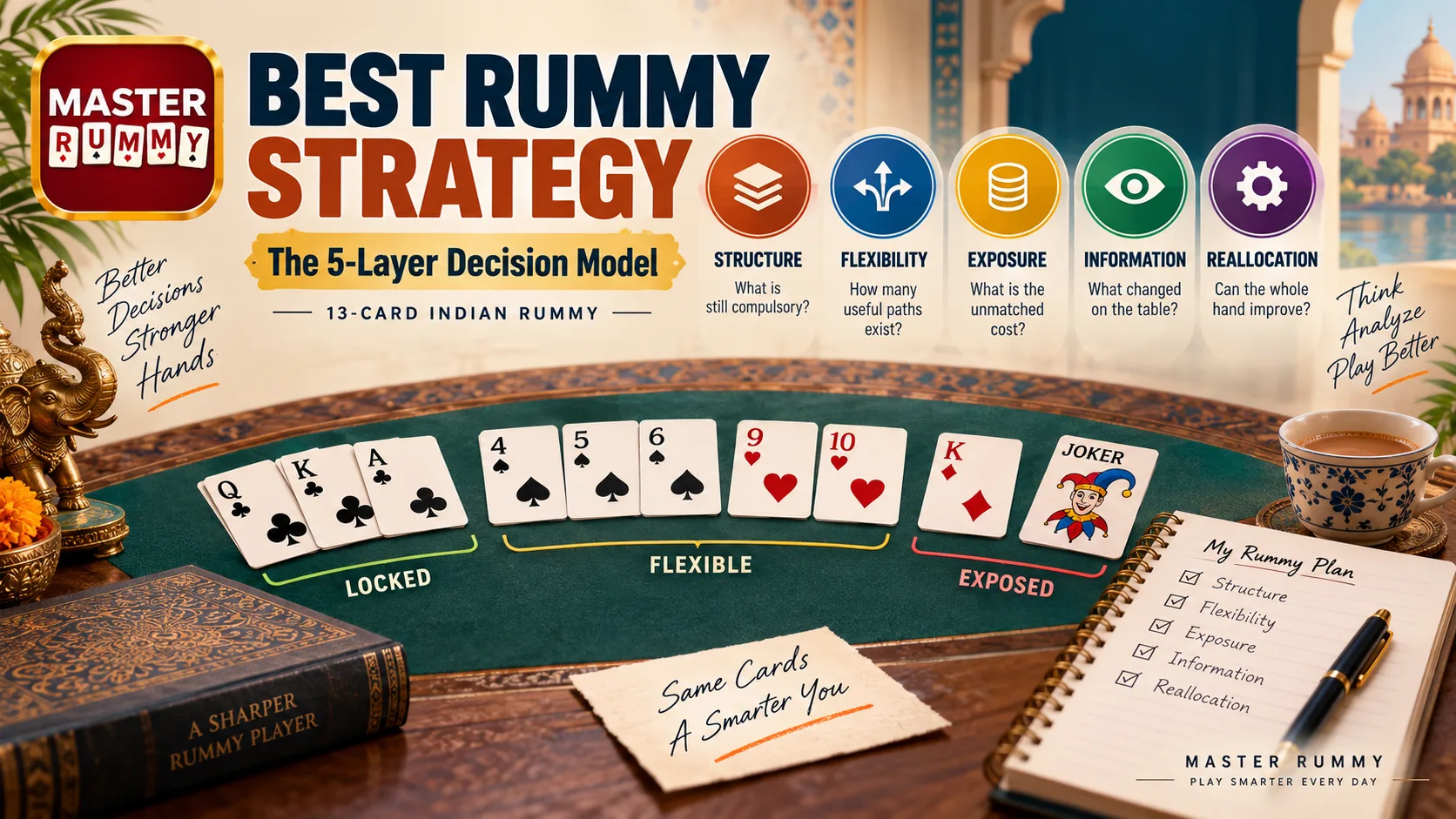
A better strategy is to evaluate the hand in layers:
Structure → Flexibility → Exposure → Information → Reallocation
In standard 13-card Indian Rummy, the first priority is usually to protect the compulsory hand structure: at least two sequences, including at least one pure sequence. After that, the best decision depends on how flexible your remaining cards are, how many points are exposed, what the table has revealed, and whether the same cards can be rearranged more efficiently.
That is the idea behind the 5-Layer Rummy Decision Model used in this guide.
It is not a promise to win every hand.
It is a repeatable way to make better decisions with the cards you actually receive.
Note: Rummy rules can vary between formats and platforms. The examples below use common 13-card Indian Rummy concepts.
Why Most “Best Rummy Strategy” Lists Are Incomplete
Search for Rummy strategy and you will often find advice such as:
Make a pure sequence first.
Discard high cards.
Use Jokers wisely.
Watch your opponent.
All of these can be useful.
The problem begins when two pieces of advice conflict.
Imagine you hold:
Q♣ K♣
and:
K♦
Which King should be discarded first?
A simple “discard high cards” rule cannot answer that.
Q♣ K♣ already have two natural sequence directions:
J♣ Q♣ K♣
or:
Q♣ K♣ A♣
K♦ may have no meaningful connection at all.
Both Kings carry the same card value.
Their strategic value is completely different.
This is why the best Rummy strategy should not be a list of isolated tricks.
It should be a system for comparing competing decisions.
Five things to check in your hand
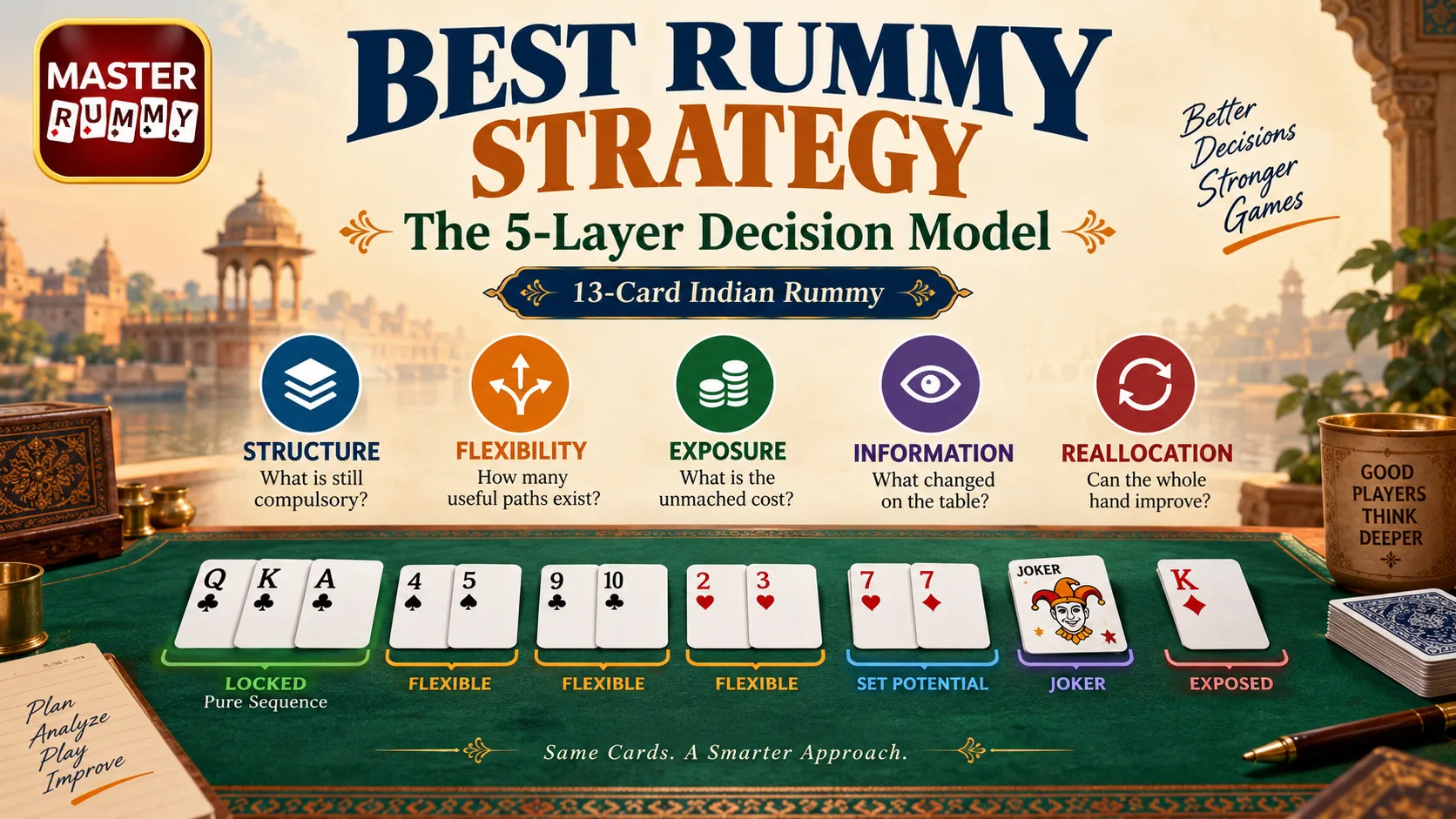
For every important decision, look at five layers:
Layer 1 — Structure
What compulsory part of the hand is still missing?
Layer 2 — Flexibility
How many useful ways can the card or group develop?
Layer 3 — Exposure
What is the cost of keeping cards that remain unmatched?
Layer 4 — Information
What has changed based on recent picks and discards?
Layer 5 — Reallocation
Can the same cards be arranged into a stronger overall hand?
The order matters.
A hand with no pure sequence should not be evaluated in exactly the same way as a hand that already has both required sequences.
The problem changes as the hand changes.
Layer 1: Protect Structure Before Optimizing Everything Else
A standard 13-card Indian Rummy declaration commonly requires at least:
two sequences
with:
at least one pure sequence
and all remaining cards arranged into valid groups.
This creates an important mathematical observation.
A sequence normally needs at least three cards.
So the minimum space occupied by two sequences is:
3 + 3 = 6 cards
Out of 13 cards:
6 ÷ 13 = 46.2%
That means at least roughly:
At least six cards must belong to sequences
in the minimum two-sequence structure.
And the smallest pure sequence occupies:
3 ÷ 13 = 23.1%
of the complete hand.
These percentages do not create a strategy by themselves.
But they show why sequences deserve more structural priority than optional groups such as sets.
The rules themselves make sequences a large part of the hand architecture. Current published 13-card Indian Rummy rules similarly require at least two sequences, including a pure sequence.
“Pure Sequence First” Is a Priority, Not a Permanent Strategy
Beginners are often told:
Make the pure sequence first.
That is sensible until the pure sequence is complete.
Suppose you already hold:
Q♣ K♣ A♣
Your pure sequence problem is solved.
Continuing to treat the pure sequence as the number-one problem makes little sense.
The next question becomes:
Where is my second sequence most likely to come from?
And once that is solved:
How do I efficiently organize the remaining cards?
Good strategy is therefore dynamic.
Priority changes as requirements are completed.
Layer 2: Measure Flexibility, Not Just Card Rank
Consider these two pairs.
Pair A
7♠ 8♠
A single:
6♠
creates:
6♠ 7♠ 8♠
A single:
9♠
creates:
7♠ 8♠ 9♠
So this pair has:
2 immediate natural extensions
Pair B
7♠ 9♠
Only:
8♠
immediately completes the three-card sequence.
So this pair has:
1 immediate natural extension
Both groups contain two Spades.
But their flexibility is different.
We can call this simple measure:
Extension Count
It is not an official Rummy statistic.
It is a practical way to compare incomplete combinations.
The more realistic jobs a card can perform, the harder it may be to justify discarding it.
Layer 3: Point Exposure Is a Cost — Not an Automatic Discard Rule
Under common Indian Rummy scoring:
A / K / Q / J = 10 points each
number cards generally carry face value,
and Jokers carry zero points.
That means:
K♠ + Q♦ + J♥
represent:
30 points
if all three remain exposed and unmatched.
Compare:
4♣ + 3♦ + 2♥
which total:
9 points
Clearly, the first group creates more point exposure.
But this does not mean:
Always discard the highest card first.
Point Exposure vs Structural Utility
Compare:
K♦
Current value:
10 points
Current connections:
none
Q♣ K♣
Combined value:
20 points
But they may develop into:
J♣ Q♣ K♣
or:
Q♣ K♣ A♣
So the 20-point pair may actually deserve more protection than the isolated 10-point King.
This gives us another useful concept:
Point Exposure vs Structural Utility
You do not need to calculate a formal score.
Ask:
Am I carrying these points because the cards have a realistic job, or because I am simply reluctant to discard them?
That is a much better question.
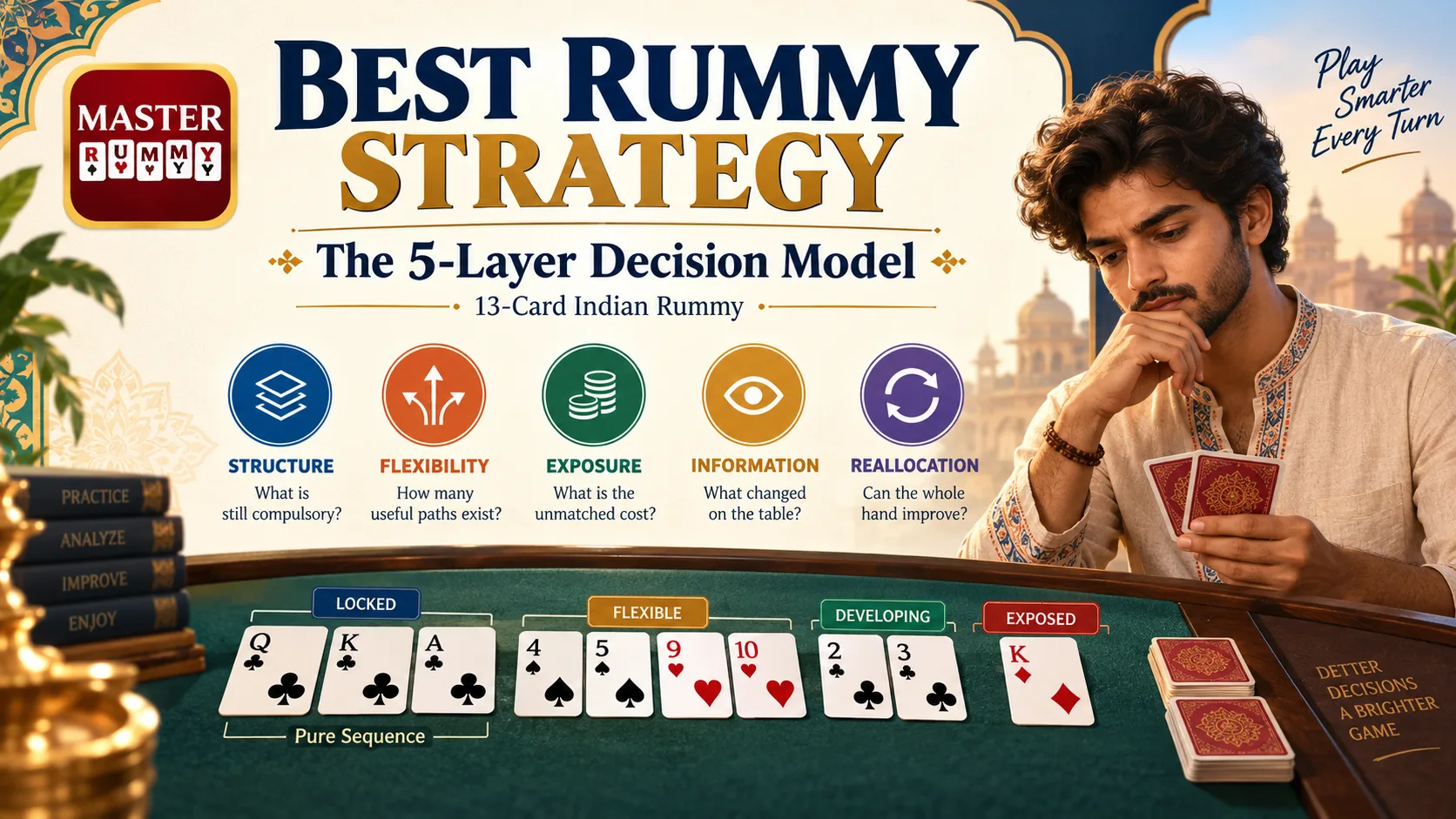
Three Useful Buckets: Locked, Flexible and Exposed
Instead of looking at thirteen individual cards, divide the hand mentally into three buckets.
LOCKED
Cards already performing a valid structural job.
Example:
Q♣ K♣ A♣
FLEXIBLE
Cards not yet complete, but with realistic development paths.
Example:
4♠ 5♠
EXPOSED
Cards with little current connection and meaningful point cost.
Example:
K♦
This quickly turns a messy 13-card hand into a decision map.
Layer 4: The Table Changes Card Value
The cards in your hand are not the only information available.
The open discard pile changes the environment.
Suppose you hold:
7♥ 8♥
Its immediate natural extensions are:
6♥
and:
9♥
Now imagine:
6♥ has already appeared in the discard pile.
Later, another player picks 9♥ from the open pile.
Your physical cards have not changed.
But the information surrounding the pair has changed.
That may affect how long you continue protecting it.
This is why a card does not have one permanent strategic value throughout a game.
Its value changes with new information.
Use Opponent Actions as Signals, Not Certainty
If another player picks:
8♣
you know they wanted that card.
You do not know exactly why.
They might want:
7♣ 8♣ 9♣
a set of eights,
or another structure involving a Joker.
So avoid pretending you can read another player's entire hand.
The discard pile is useful because it changes your assumptions.
It does not give perfect information.
Layer 5: Reallocation Can Improve a Hand Without Drawing Anything
Consider:
7♠ 8♠ 9♠ 10♠
plus:
7♥ 7♦
One arrangement is:
7♠ 8♠ 9♠ 10♠
and:
7♥ 7♦
The first group is a strong sequence.
The two sevens are incomplete.
Now move:
7♠
out of the sequence.
What remains?
8♠ 9♠ 10♠
Still a valid sequence.
The freed 7♠ joins:
7♥ 7♦
to create:
7♠ 7♥ 7♦
a set.
Nothing was drawn.
Nothing was discarded.
The same cards became more useful because the allocation changed.
This leads to one of the most valuable Rummy questions:
What survives after I move this card?
A Real 13-Card Strategy Lab
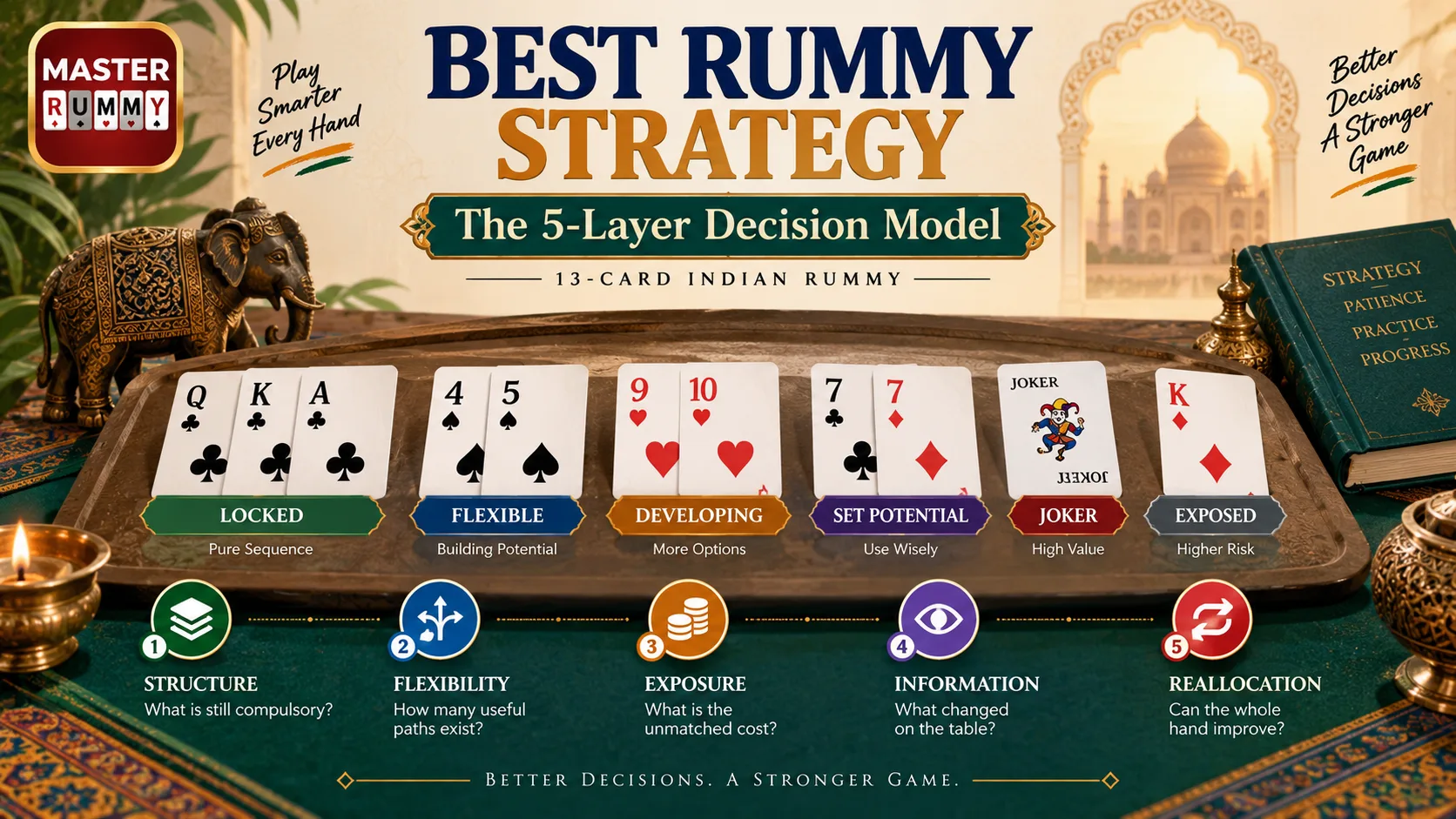
Now let us analyze one complete hand.
Suppose the hand is:
Q♣ K♣ A♣
4♠ 5♠
9♣ 10♣
2♥ 3♥
7♥ 7♦
Joker
K♦
Count:
3 + 2 + 2 + 2 + 2 + 1 + 1 = 13
Now apply the five layers.
Structure
Already completed:
Q♣ K♣ A♣
Pure Sequence ✓
The next structural goal is therefore the second sequence.
Flexibility
4♠ 5♠
Can immediately extend with:
3♠
or:
6♠
Extension Count:
2
9♣ 10♣
Can immediately extend with:
8♣
or:
J♣
Extension Count:
2
2♥ 3♥
Can immediately extend with:
A♥
or:
4♥
Extension Count:
2
7♥ 7♦
Can develop naturally with another valid seven, or potentially use a Joker according to the game rules.
K♦
Currently isolated.
Exposure
K♦ represents:
10 points
and currently has little structural utility.
That makes K♦ a much stronger discard candidate than:
4♠,
5♠,
9♣,
or 10♣,
even though some of those cards also carry points.
This is the difference between:
card value
and:
hand value.
Joker Utility
The Joker could potentially help several unfinished groups.
For example:
4♠ 5♠ Joker
or:
9♣ 10♣ Joker
or:
2♥ 3♥ Joker
or:
7♥ 7♦ Joker
So instead of asking:
Where can I use the Joker?
ask:
Which Joker placement removes the biggest structural problem?
We can call the number of realistic current placements:
Joker Utility Count
Again, this is not an official game statistic.
It is a decision tool.
In this example, the Joker has several possible jobs.
Using it immediately on the first available group could reduce future flexibility.
One Draw Can Change the Entire Strategy
Suppose K♦ is discarded.
Later, you draw:
6♠
Now:
4♠ 5♠ 6♠
becomes a completed second sequence.
The strategic hierarchy changes immediately.
Before 6♠:
Second sequence = major priority
After 6♠:
Second sequence = solved
Now the Joker may have greater value in another group such as:
7♥ 7♦ Joker
This is why a good strategy cannot be static.
The Strategy Update Loop
After an important draw, run this loop:
What changed?
↓
Which structural requirement is still missing?
↓
Which groups became more flexible?
↓
Which cards became more exposed?
↓
Can anything be reallocated?
↓
Which card now has the weakest job?
Then discard.
The best discard can change because of one new card.
Five Strategy Mistakes That Look Reasonable
Mistake 1: “Pure Sequence First” Forever
The pure sequence deserves high priority until it is complete.
After that, your problem changes.
Mistake 2: Discarding the Highest Card Automatically
An isolated K♦ and connected Q♣ K♣ are not strategically equal.
Mistake 3: Spending the Joker on the First Available Group
A Joker with four possible jobs may be more useful flexible than committed.
Mistake 4: Looking Only at the New Group
Moving a card into a set means nothing if the move destroys your only useful sequence.
Always check what remains behind.
Mistake 5: Refusing to Abandon an Old Plan
Keeping two cards for five turns does not make the missing third card more likely to help your current hand.
Judge the structure as it exists now.
A Simple 10-Second Rummy Strategy Check
Before discarding, ask:
STRUCTURE
What compulsory requirement is still missing?
FLEXIBILITY
Which card has the most useful paths?
EXPOSURE
Which unmatched card is costing the most?
INFORMATION
Did recent picks or discards change my assumptions?
REALLOCATION
Can I improve the same 13 cards without waiting for a new card?
If you can answer these questions consistently, you already have something more useful than a list of isolated tricks.
Frequently Asked Questions
What is the best Rummy strategy?
There is no single move that works for every hand. A practical strategy is to secure the compulsory sequence structure first, then compare card flexibility, point exposure, table information and possible reallocation.
What should I do first in 13-card Rummy?
Under common Indian Rummy rules, identifying and protecting a pure sequence is usually an important early priority because a valid declaration requires at least two sequences, including a pure sequence.
Should I always discard high cards first?
No.
An isolated high-value card may be a strong discard candidate, but connected high cards can still have useful sequence or set potential.
Compare point exposure with structural utility.
What does card flexibility mean in Rummy?
Card flexibility describes how many realistic combinations a card or group can still develop into.
For example:
7♠ 8♠
has two immediate natural sequence extensions:
6♠ or 9♠.
Should I use a Joker immediately?
Not necessarily.
If the Joker can solve several different incomplete groups, compare those uses before committing it.
Why is the discard pile important?
It provides information about which cards have appeared and which cards players choose to pick or release.
These are signals that can change how attractive your own incomplete groups are.
How many sequences are required in 13-card Indian Rummy?
Under common 13-card rules, at least two sequences are required, with at least one pure sequence.
Can strategy guarantee a win?
No.
The cards dealt and drawn involve chance.
Strategy improves the quality and consistency of your decisions; it cannot guarantee a particular outcome.
Final Takeaway
The best Rummy strategy is not:
“Always do this.”
It is a process for deciding:
Structure
What must be completed?
Flexibility
What has the most future value?
Exposure
What is currently costing the hand?
Information
What changed since the last turn?
Reallocation
Can the same cards work better somewhere else?
Then ask the same questions again after the next meaningful draw.
That is the difference between memorizing Rummy tips and actually developing a repeatable strategy.