
4 Common 13 Card Rummy Mistakes to Avoid
Avoid four common 13 Card Rummy mistakes involving pure sequences, Jokers, valid sets and card points, then use a 10-second declaration check.
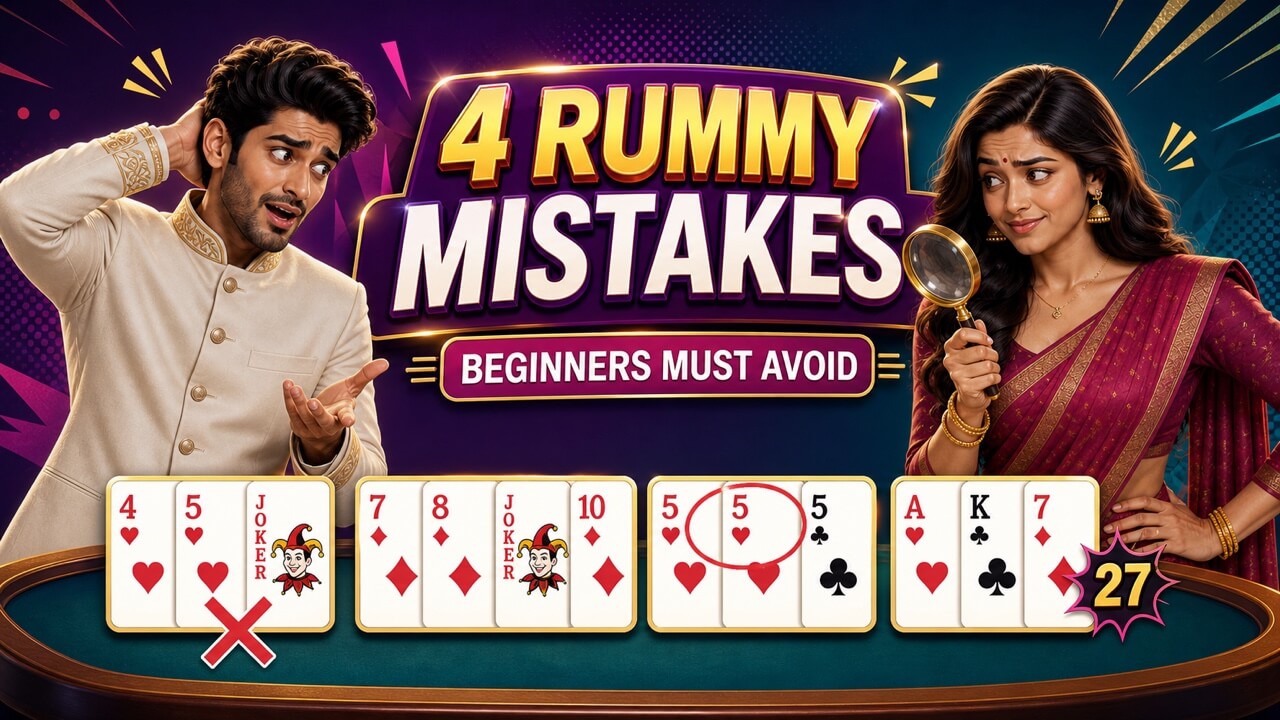
Before declaring, check the groups rather than how tidy the hand looks. A Joker substitution, a repeated suit in a set or one ungrouped card can make the declaration invalid. The examples below show what to look for.
In 13 Card Rummy, a hand can look almost complete and still fail. One sequence may not be pure, a Joker may be doing the wrong job, a set may repeat the same suit, or the points may have been counted incorrectly.
Here are four common 13 Card Rummy mistakes—and the quickest ways to spot and fix them.
The rule in 20 seconds: Arrange all 13 cards into valid sequences and sets. A valid declaration needs at least two sequences, including at least one pure sequence. A pure sequence must contain three or more consecutive cards of the same suit without a Joker.
1. Declaring Before Checking the Pure Sequence
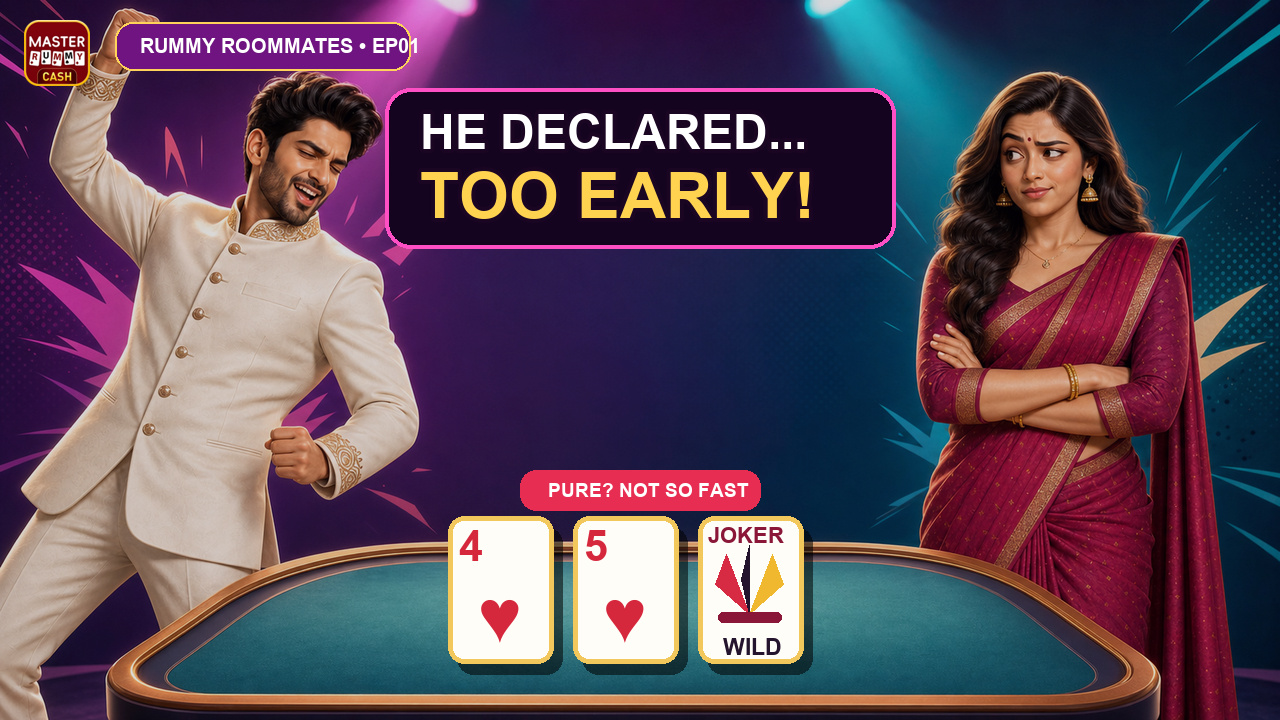
A pure sequence is a run of at least three consecutive cards of the same suit, formed without using a Joker as a substitute.
For example:
- 4♥–5♥–6♥
- 9♣–10♣–J♣–Q♣
Both groups are pure sequences because the cards are consecutive, belong to the same suit and contain no Joker.
The common mistake is seeing two natural cards plus a Joker and treating the group as pure. For example:
4♥–5♥–Joker
The Joker may represent 6♥, so this can form an impure sequence. However, it cannot become the required pure sequence because a Joker has been used.
You still need a separate, Joker-free sequence before the hand can become a valid declaration.
Quick Pure-Sequence Check
Before declaring, ask three questions:
- Are all the cards from the same suit?
- Are their ranks consecutive?
- Is the group completely free from printed and wild Jokers?
If the answer to any question is “no,” do not count the group as your pure sequence.
2. Using a Joker in the Wrong Place

A Joker is one of the most flexible cards in Rummy. It can replace a missing card in an impure sequence or help complete a valid set.
For example:
7♦–8♦–Joker–10♦
Here, the Joker can represent 9♦. The group therefore becomes a valid impure sequence.
The problem begins when every promising group in the hand depends on a Joker. A hand may contain several combinations that look complete and still fail because it does not have a natural pure sequence.
The safest approach is simple:
- Protect a genuine pure sequence first.
- Identify the second sequence.
- Use Jokers to complete the most difficult remaining groups.
- Never count a Joker-assisted sequence as the required pure sequence.
Think of the pure sequence as the foundation of your hand. Jokers can repair the other rooms, but they cannot replace the foundation.
After the wild Joker is revealed, take another look at the entire hand. A card that appeared ordinary may now work as a Joker, while another natural sequence may need to be protected from an impulsive discard.
3. Building an Invalid Same-Rank Set
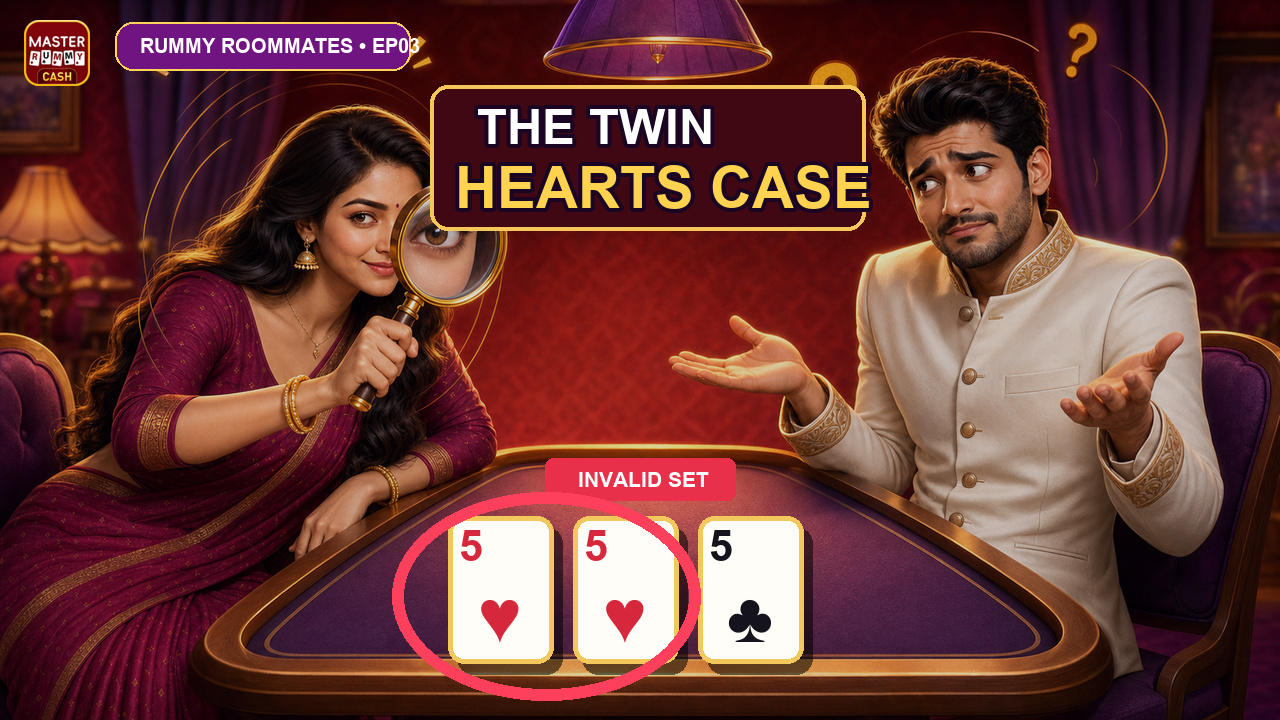
A valid Rummy set normally contains three or four cards of the same rank in different suits.
For example:
5♥–5♦–5♣
This is a valid natural set. All three cards have the same rank, and every card uses a different suit.
Now consider this group:
5♥–5♥–5♣
It may look like a set because every card has the same rank. However, the 5 of Hearts appears twice.
Because 13 Card Rummy may use more than one deck, two identical cards can appear in the same hand. That does not mean those identical cards can be placed together in one natural set.
Under standard 13 Card Indian Rummy rules, the natural cards in a set should have the same rank but different suits.
Quick Set Check
Before accepting a group as a set, confirm that:
- Every natural card has the same rank.
- Every natural card uses a different suit.
- No identical natural card has been repeated.
- Any Joker has been used according to the applicable table rules.
A Joker may help complete a set, but it does not make repeated identical natural cards valid.
4. Calculating Rummy Card Points Incorrectly
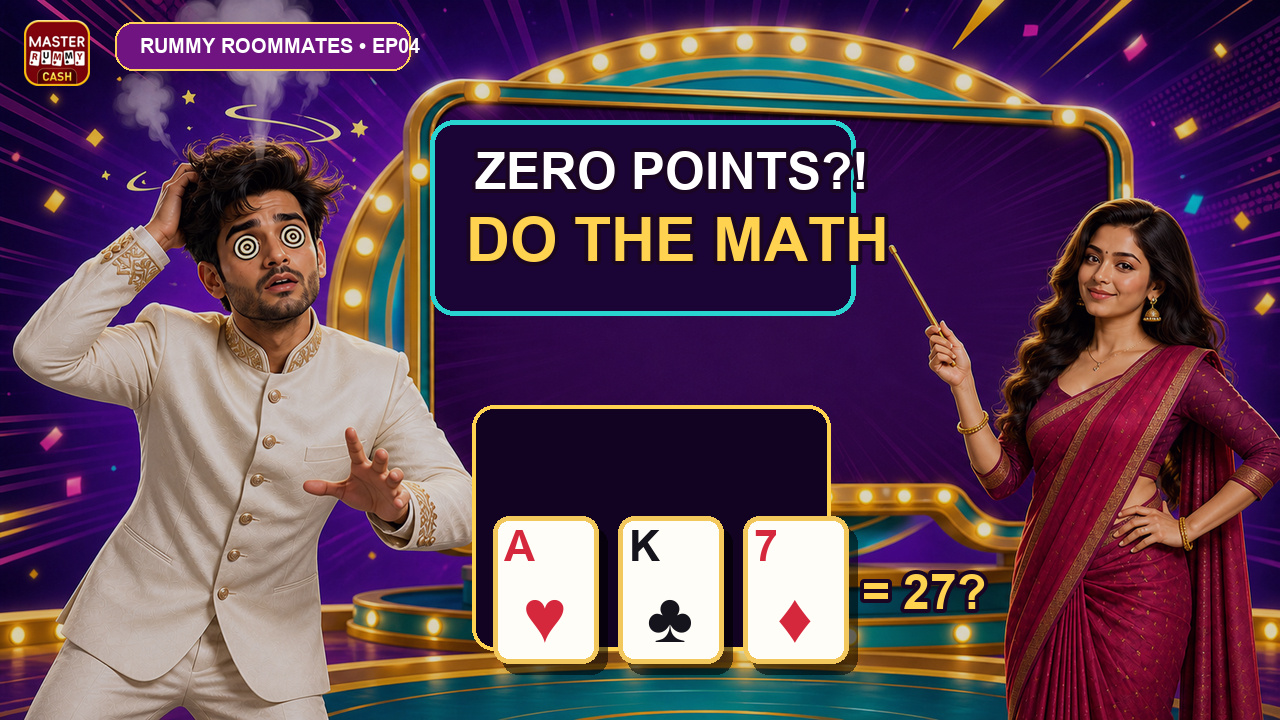
Card points become especially important when unmatched cards remain in the hand.
Beginners sometimes remember that Jokers are worth zero points and accidentally apply the same value to other cards they hope to group later.
The standard point values are:
- Ace: 10 points
- King: 10 points
- Queen: 10 points
- Jack: 10 points
- Number cards: Their face value
- Printed Joker: 0 points
- Wild Joker: 0 points
Consider these three unmatched cards:
A♥ + K♣ + 7♦
The correct calculation is:
10 + 10 + 7 = 27 points
The Ace and King are not worth zero. Only printed and wild Jokers carry zero points in this example.
High-value cards can quickly increase the points remaining in an unfinished hand. That does not mean every high card should be discarded immediately, but you should avoid holding several unmatched Aces and face cards without a realistic plan.
A 10-Second Checklist Before You Declare
A quick final check can prevent an invalid declaration.
1. Count All 13 Cards
Make sure every card belongs to a valid sequence or set. No card should be left ungrouped.
2. Find the Pure Sequence
Confirm that it contains consecutive cards of the same suit without a printed or wild Joker.
3. Confirm the Second Sequence
A valid declaration normally requires at least two sequences. The second sequence may be pure or impure.
4. Inspect Every Set
Check that the cards share the same rank while using different suits. Watch carefully for identical cards from multiple decks.
5. Review Every Joker
Make sure you have not mistakenly counted a Joker-assisted group as your required pure sequence.
6. Check the Points
Pay particular attention to unmatched Aces, Kings, Queens and Jacks because each carries 10 points.
This pause takes less time than a victory dance—and it is much more useful.
Frequently Asked Questions
How Many Pure Sequences Are Required in 13 Card Rummy?
A valid declaration normally requires at least two sequences, and at least one of them must be a pure sequence. The remaining cards may be arranged into valid sequences or sets.
Can a Joker Be Used in a Pure Sequence?
No. A pure sequence must be formed naturally without a printed Joker or wild Joker. A run completed with a Joker is an impure sequence.
Can Two Identical Cards Be Used in the Same Rummy Set?
Under standard 13 Card Indian Rummy rules, a natural set uses cards of the same rank in different suits. Two identical natural cards, such as two 5♥ cards, should not be grouped into the same set.
How Many Points Are Ace, King and Joker Worth?
Ace and King are worth 10 points each. Queen and Jack are also worth 10 points each. Printed and wild Jokers are worth zero points, while number cards carry their face value.
What Makes a Declaration Invalid in Rummy?
A declaration may be invalid when it has no pure sequence, does not contain the required number of sequences, includes an invalid set or sequence, or leaves one or more cards outside valid groups.
Learn the Rule, Then Spot the Mistake
The easiest way to remember Rummy rules is to see the wrong move and correct it immediately.
Before your next declaration, remember four things:
- Protect the pure sequence.
- Use Jokers in the right groups.
- Check every set for repeated suits.
- Calculate the points correctly.
Explore more MASTER RUMMY video guides for clear visual examples, visit our Rummy Learning Centre for step-by-step lessons, or check the Rummy FAQ whenever you need a quick answer.
Responsible play: This guide is provided for educational entertainment. 18+ only. Play responsibly and follow the rules that apply at your table and in your location.