
10 Rummy Tips and Tricks for Better Decisions
Use 10 practical Rummy tips to protect a pure sequence, manage high cards, place Jokers, read discards and check every group before declaring.
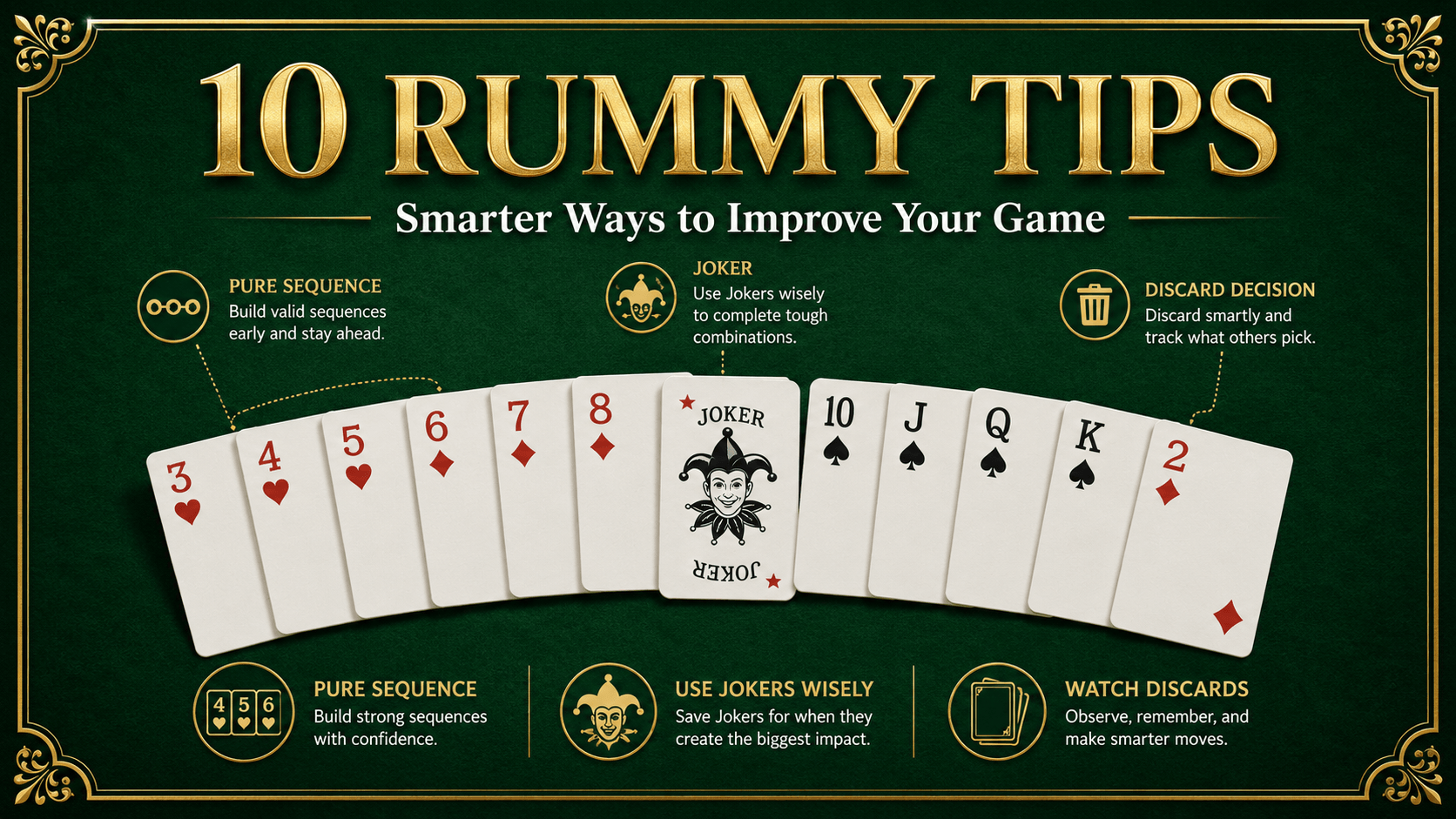
Each Rummy turn asks you to choose what to keep, what to discard and whether your current groups still make sense. These ten tips cover pure sequences, Jokers, unmatched points and declaration checks. No tactic guarantees the next card or the result of a hand.
1. Build a Pure Sequence Early
A pure sequence should usually be one of your first priorities.
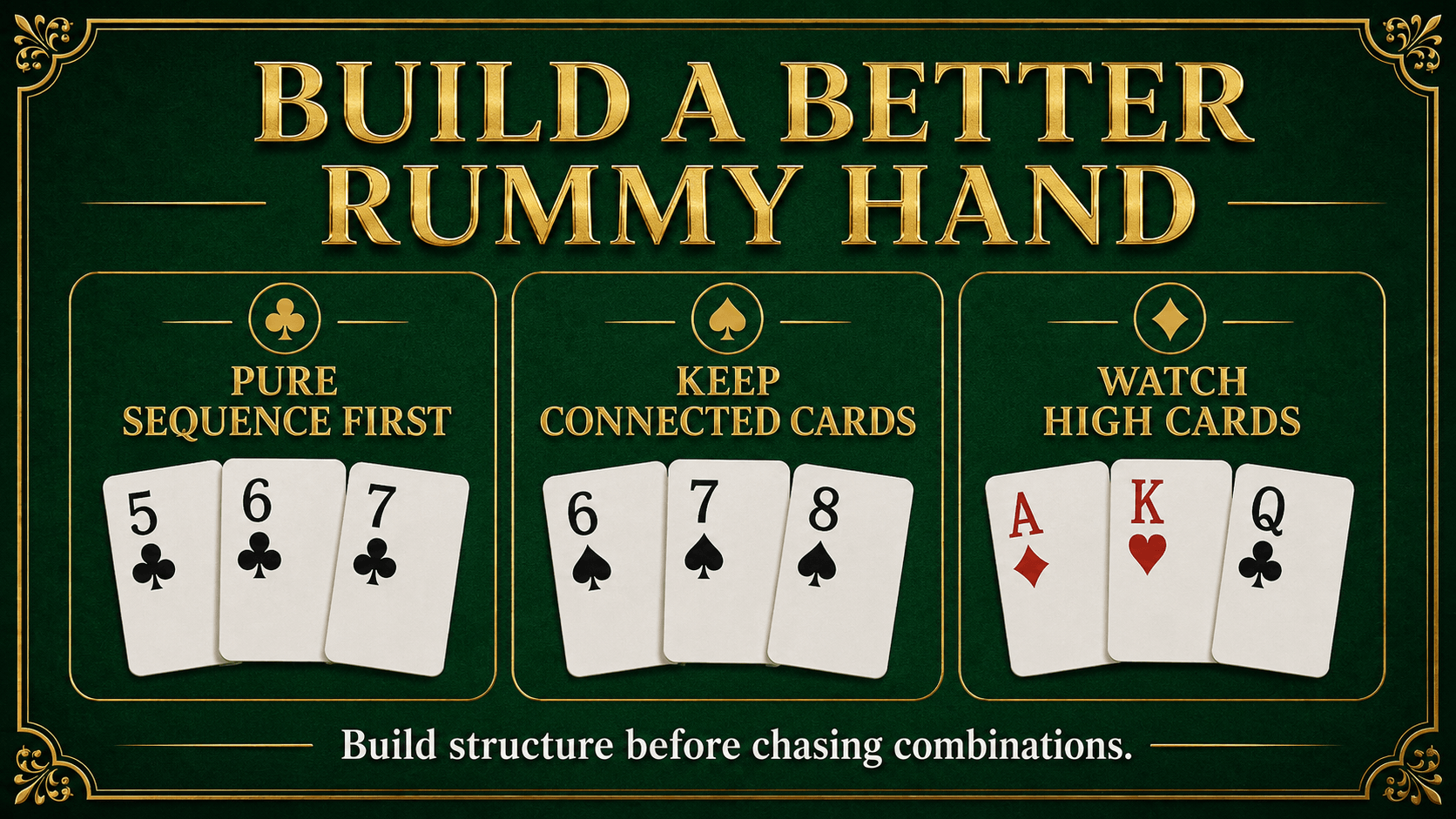
For example:
5♣ 6♣ 7♣
is already a complete pure sequence.
If you have:
5♣ 6♣
then cards such as 4♣ or 7♣ may help complete it.
Creating the pure sequence early makes the rest of the hand easier to organize.
2. Keep Connected Cards
Connected cards usually offer more possibilities than isolated cards.
For example:
6♠ 7♠
can potentially become:
5♠ 6♠ 7♠
or:
6♠ 7♠ 8♠
By comparison, two unrelated cards may have fewer useful combinations.
When deciding what to keep, look for cards that can work together in more than one way.
3. Do Not Hold High-Value Cards Without a Reason
Aces, Kings, Queens and Jacks can be useful when they are part of a sequence or set.
But isolated high-value cards may add more points if they remain unmatched.
For example:
J♦ Q♦ K♦
is a useful sequence.
But:
K♦
by itself may become less useful if it does not connect with the rest of your hand.
Do not discard every high card immediately.
Instead, ask:
Does this card have a realistic role in my hand?
4. Use Jokers Where They Help Most
Jokers are flexible, so avoid using them automatically.
Imagine you have:
7♥ 8♥ Joker
You could use the Joker as 9♥.
But if you also have:
Q♣ Q♦
the Joker may be more useful for completing that harder group.
The best position for a Joker can change as new cards appear.
A simple rule is:
Use Jokers to solve difficult gaps, not easy ones.
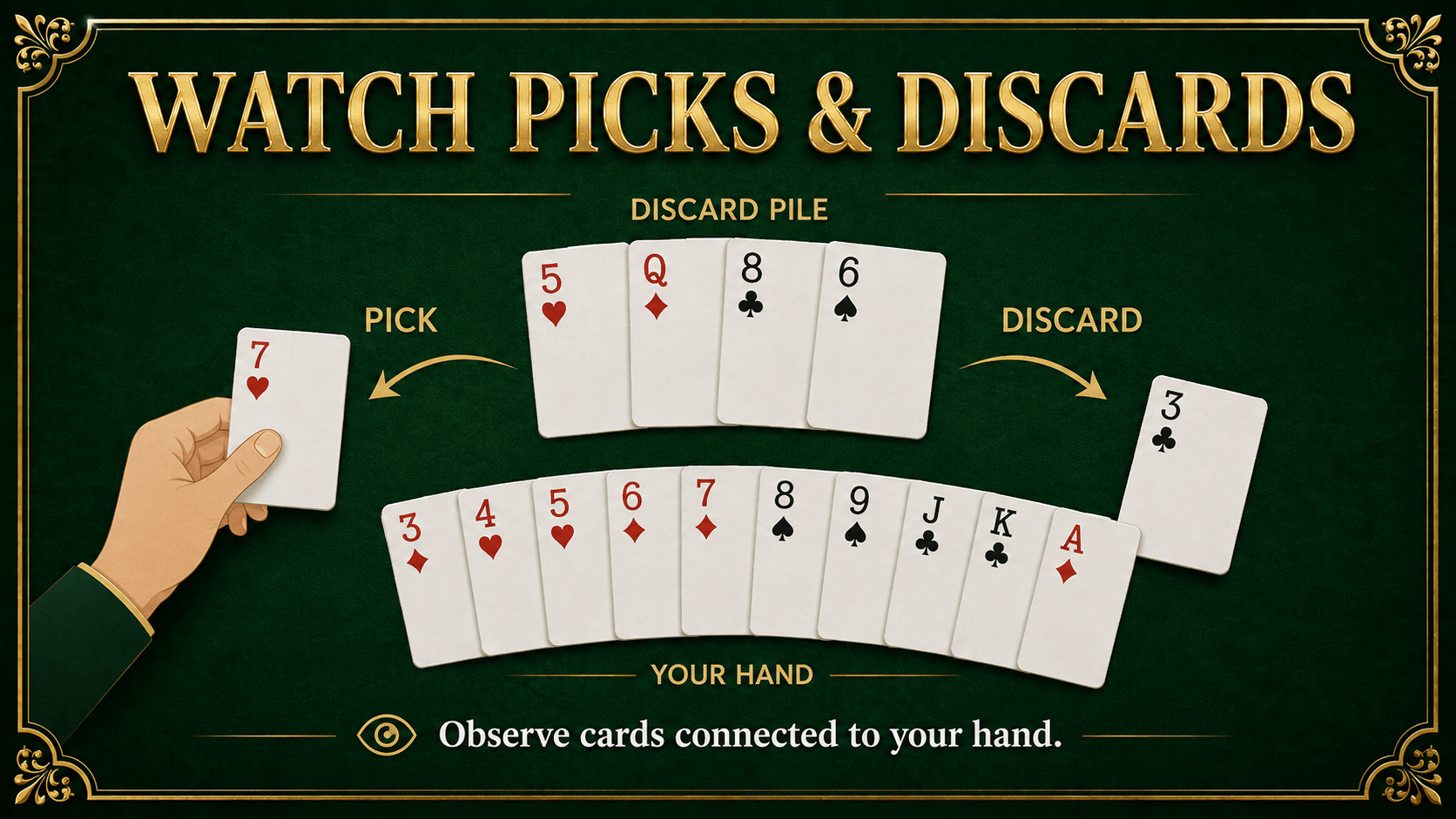
5. Watch the Discard Pile
The discard pile can provide useful information.
It tells you which cards have already appeared and which cards other players did not want.
You do not need to memorize every discarded card.
Start by watching cards connected to your own combinations.
For example, if you are building:
7♠ 8♠
then noticing whether 6♠ or 9♠ has already appeared can help you make better decisions.
6. Observe What Other Players Pick
The cards another player chooses can sometimes give clues about what they are building.
For example, if a player picks:
6♥
and later takes:
7♥
they may be working on a Heart sequence.
This does not tell you their entire hand.
But it may help you think twice before discarding:
5♥
or:
8♥
Observation is part of good Rummy decision-making.
7. Avoid Helping an Opponent
Your discard may be useful to another player.
Suppose another player has just picked:
8♣
If you then discard:
7♣
you may be giving them a card that fits naturally into a sequence.
This is why it is useful to combine two questions:
What do I no longer need?
and:
Could another player need this card?
You will not always know the answer, but paying attention can improve your decisions.
8. Rearrange Your Hand Often
One of the easiest mistakes is becoming attached to your first plan.
A new card can completely change the structure of your hand.
Try grouping cards into:
- Pure sequence
- Possible sequence
- Possible set
- Joker-supported group
- Unmatched cards
Then rearrange again after an important draw.
A flexible hand is usually easier to improve than a hand locked into one idea.
9. Do Not Wait Too Long for One Card
A nearly complete sequence can be tempting.
For example:
4♦ 5♦
looks promising if you are waiting for 3♦ or 6♦.
But if several turns pass and the hand develops in another direction, it may be better to change your plan.
Rummy rewards flexibility.
Sometimes the best decision is to stop chasing one combination and build a different one.
10. Check Every Group Before Declaring
A hand can look complete while still containing one mistake.
Before declaring, quickly check:
- Do I have a pure sequence?
- Do I have another valid sequence?
- Are all sets valid?
- Is every card included in a group?
- Is any Joker being used incorrectly?
This final check only takes a few seconds and can prevent an invalid declaration.
A Simple Priority for Beginners
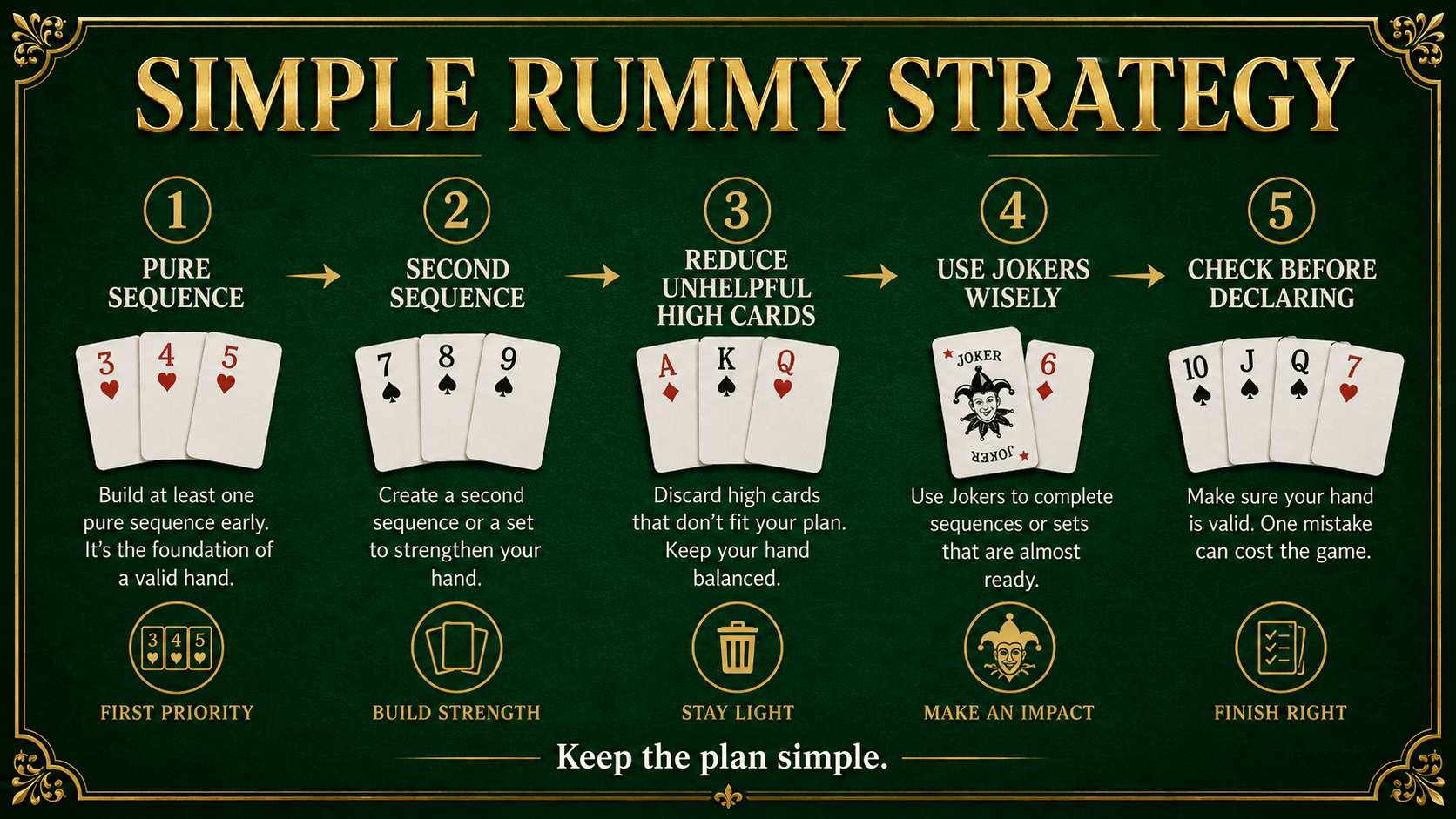
If 10 tips feel like too much to remember, reduce them to this:
Pure Sequence First
↓
Build Another Sequence
↓
Remove Difficult Unmatched Cards
↓
Use Jokers Carefully
↓
Complete the Hand
This basic structure is enough for most beginners.
You can add more advanced observation and discard strategy later.
Common Rummy Mistakes to Avoid
Holding Too Many Unconnected Cards
A hand full of isolated cards is harder to improve.
Using Jokers Too Quickly
A Joker may become more valuable in another combination.
Ignoring Other Players
Rummy is not only about your own cards.
Refusing to Change Strategy
A plan that looked good at the beginning may no longer be the best plan.
Declaring Too Fast
Always check the full hand once more.
Frequently Asked Questions
What is the best Rummy tip for beginners?
Build a pure sequence as early as possible and organize the rest of the hand around it.
Should I discard high cards first?
Not always. Keep a high card if it is useful in a realistic sequence or set. Otherwise, consider whether it is worth holding.
Should I use a Joker immediately?
Usually not. First check whether the Joker could solve a harder combination.
Is watching other players useful?
Yes. Their picks and discards may give clues about the cards they are trying to collect.
Should I keep waiting for one missing card?
Not forever. If the rest of your hand changes, be ready to reorganize.
Do Rummy tips guarantee a better result?
No strategy can guarantee the outcome of every hand. Good strategy is about making more informed decisions with the cards available.
Final Summary
Better Rummy play comes from simple habits:
Build the pure sequence early.
Keep useful connected cards.
Use Jokers carefully.
Watch picks and discards.
Stay flexible.
Check before declaring.
You do not need complicated tricks to improve.
Focus on making one better decision at a time.
Continue Learning
Read next:
- Rummy Rules Explained: Complete 13-Card Indian Rummy Guide
- How to Play Rummy Online: A Simple Step-by-Step Guide
- What Is the Role of Jokers in Indian Rummy?
- Why Is Rummy So Popular in India?