
13 Card Rummy with Real Players: A Beginner's Checklist
Choosing 13 card Rummy with real players? Compare table types, check the rules and practise a complete hand before deciding where to play.
Before joining a Rummy table, check whether you will play against other people, friends in a private room or a computer-controlled practice opponent. These options offer different experiences even when they use the same thirteen-card rules.
This guide helps you choose a suitable starting point, recognise the rules that matter and try one complete hand before moving on. It focuses on gameplay and learning, not cash-game recommendations.
Editorial note: this guide is published by the MASTER RUMMY team. The practice example below comes from our own website. It is not an independent ranking of competing apps, and our browser exercise is not a live multiplayer table.
First, choose the experience you actually want
“Online” tells you how a game is delivered. It does not, on its own, tell you who controls the other hands. A row of avatars is also not evidence that every opponent is a real person.
- Public multiplayer: look for a clear explanation of player matching, opponent types and the rules of the specific table. Do not assume that every mode in the same app works identically.
- A private table with friends: check whether there is an actual room invitation or friend-invite feature. Public matching is not the same as choosing who joins you.
- Solo practice: choose this when you want to understand card groups without waiting for other players. Some games use computer opponents; our browser practice uses fixed learning hands instead.
Rummy is also a family of games. A service offering classic Rummy or Gin Rummy may not use the same declaration requirements as 13-card Indian Rummy. Check the variant before comparing features.
Five checks before joining a real-player table
1. Can you identify the exact rules?
Find the rules for the selected mode, not just a general description of Rummy. For the 13-card practice used in this article, the hand must contain at least two sequences, including at least one pure sequence, and every card must belong to a legal group. For a full explanation, read our 13 card Indian Rummy rules.
2. Is the type of opponent explained?
Look for a specific description of live matching, private rooms or computer opponents. If this is unclear, ask support before relying on a “real players” claim. Animated faces, player names and fast responses do not establish who is controlling a hand.
3. What happens if you need more time?
Before starting, find out whether the mode uses a turn timer, what happens after a missed turn and how a disconnection is handled. These details matter more to a beginner than a large list of game modes. Never assume another platform will handle a timeout in the same way as the last one you tried.
4. Can you read and organise the cards on your phone?
Check whether suits and ranks are easy to distinguish, selected cards are clearly marked and a mistaken group can be corrected. An interface that looks impressive in a promotional image may feel different when thirteen cards share a small screen. Try basic selection and grouping before judging the experience.
5. Are the entry conditions clear?
Confirm whether you need an app, an account or a particular device. If a service advertises free play, check which mode is free and whether other modes have different conditions. Also check the operator's stated age and regional availability requirements. Do not treat a free download as proof that every table is free.
Before choosing a table, solve this one-hand check
Here is a more useful test than asking whether you remember every definition: can you account for all thirteen cards without using one card twice?
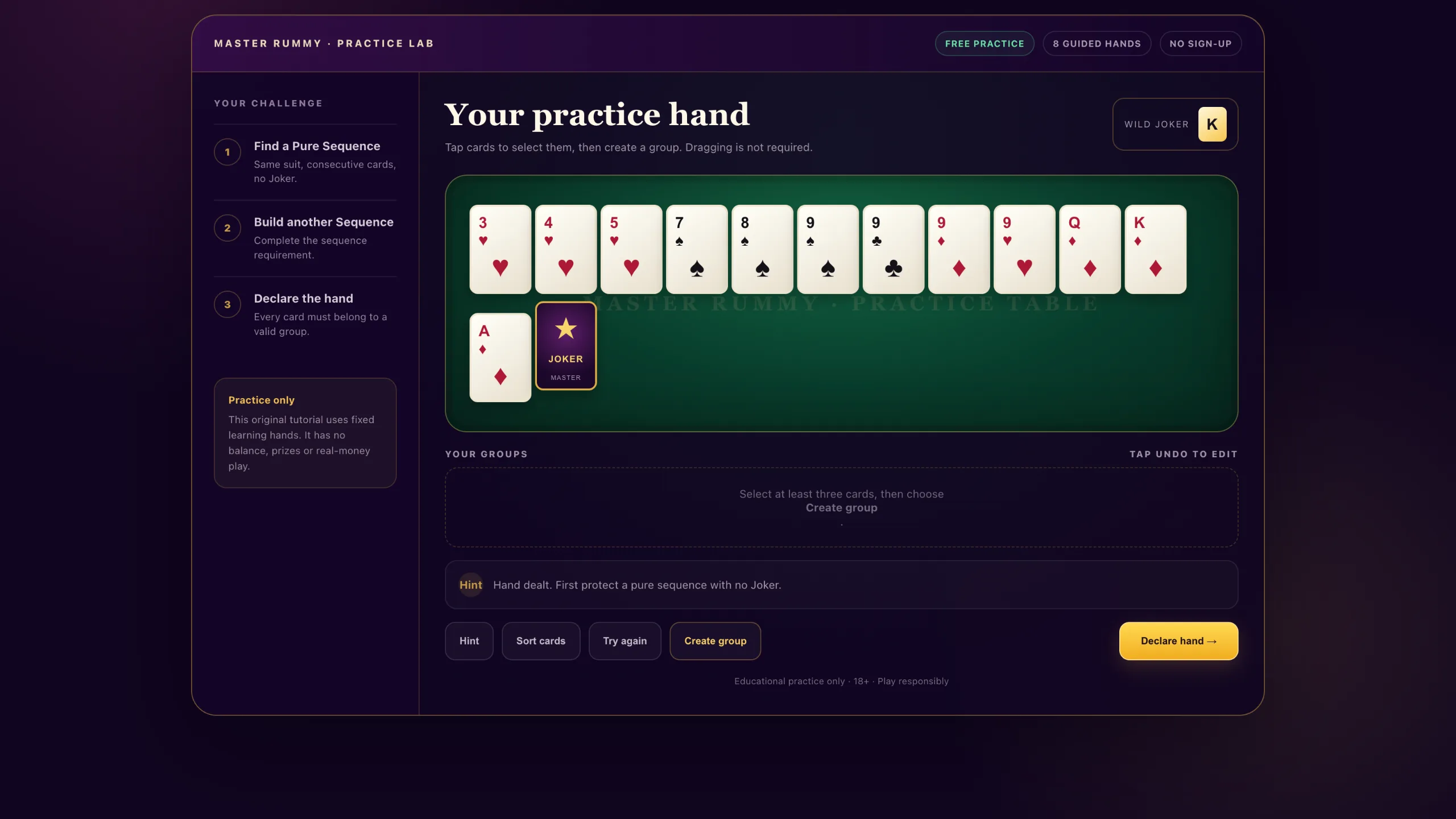
The first fixed hand in our practice lab contains:
3♥, 4♥, 5♥, 7♠, 8♠, 9♠, 9♣, 9♦, 9♥, Q♦, K♦, A♦ and a printed Joker. Kings are marked as wild Jokers in this exercise.
Before reading the arrangement below, ask yourself two questions: which cards already make consecutive runs, and which matching ranks can become a separate set?
Try the free 13-card practice hand →
Solo rules practice. No registration, live opponents, balance or prizes in this browser exercise.
One possible arrangement, explained
- 3♥–4♥–5♥: consecutive cards of the same suit form the first pure sequence.
- 7♠–8♠–9♠: another same-suit run forms the second pure sequence.
- 9♣–9♦–9♥: equal ranks in three different suits form a set. The 9♠ is already used in the previous group; it cannot also be counted here.
- Printed Joker–Q♦–K♦–A♦: the printed Joker can represent J♦, making an impure sequence. K♦ stays in its natural position between Q♦ and A♦, even though Kings are designated wild Jokers for the hand.
The count is 3 + 3 + 3 + 4 = 13. There are two pure sequences and no ungrouped cards. The useful lesson is not to memorise this one answer: it is to check each group, the sequence requirement and the entire hand separately.
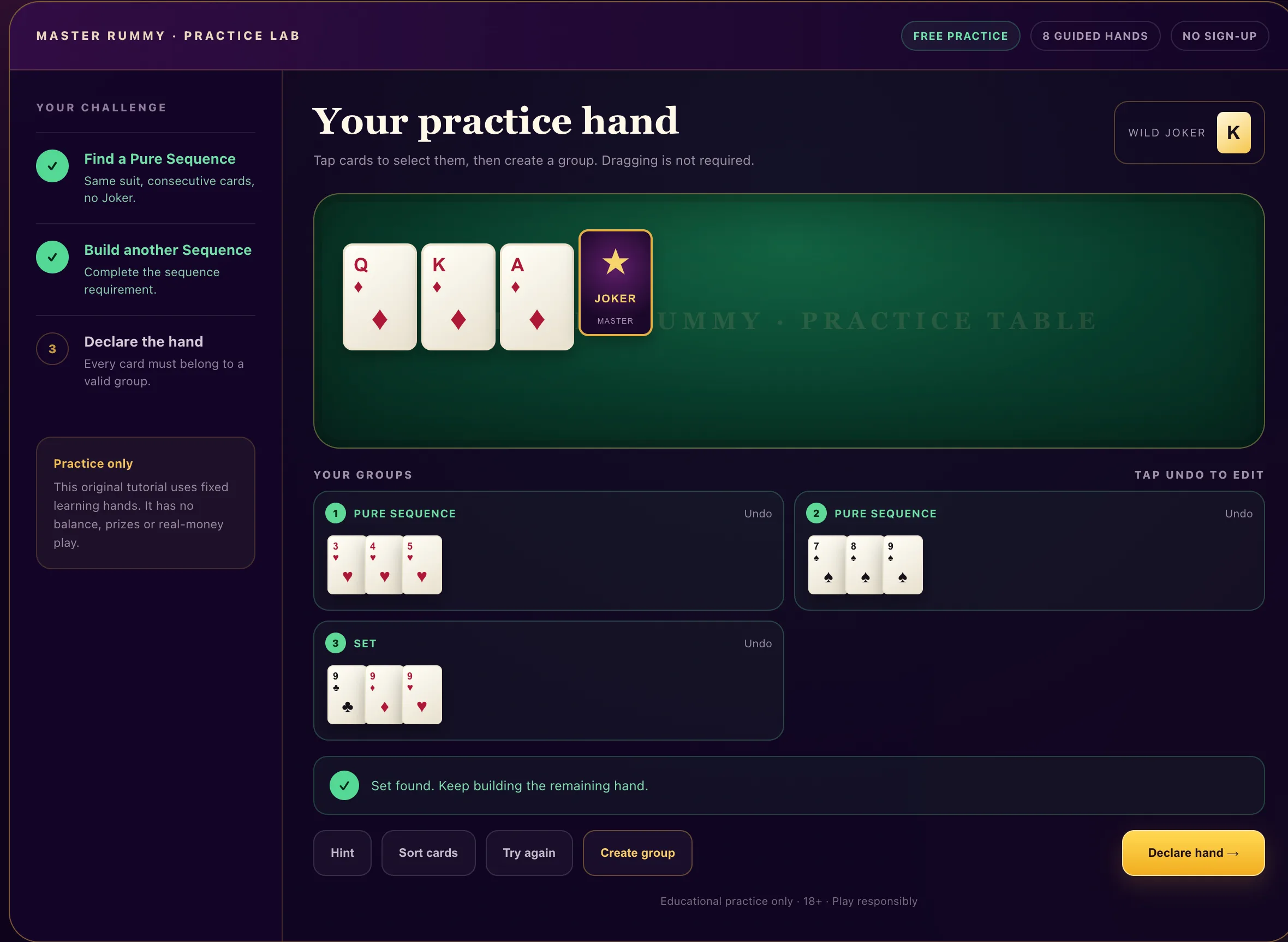
If the difference between the third and fourth groups is unclear, compare a sequence and a set, then revisit the Joker rules.
What we recommend for each starting point
If you are still learning to recognise groups
Start with a guided exercise, not a hurried live table. In the MASTER RUMMY practice lab, select the cards, choose Create group, and read the feedback. Use Undo to revise a group. Declare only when every card is grouped. Once the first arrangement makes sense, choose another fixed hand rather than repeatedly copying the same solution.
If you mainly want to play with friends
Prioritise a verified private-room feature and a ruleset everyone understands. Agree on the variant before the first round. A platform can have many public players and still be unsuitable for a small group that wants to stay together. Our browser practice does not provide friend rooms; use it to learn the grouping rules, not to host a multiplayer session.
If you already know the rules and want live matching
Prioritise transparent opponent information, clear turn controls and published explanations of disconnections and support. Choose a mode whose requirements you understand. A tutorial result is not a prediction of how you will perform against other players, where drawing, discarding and responding to a changing hand introduce additional decisions.
To explore MASTER RUMMY beyond the exercise, review the current game information and ask support about the particular mode you want. Do not infer live matching, private rooms or app registration requirements from the practice page.
Know when you are ready to move beyond the exercise
Before moving on, try explaining these three things in your own words:
- Which group is your pure sequence, and why is it pure?
- Does the entire hand meet the sequence requirement, not just one valid group?
- Where does each of the thirteen cards belong?
If you cannot answer one of them, the next useful step is another explanation or practice hand, not a more complicated table. Our valid declaration checklist works through the final hand check.
Questions beginners ask about multiplayer Rummy
Does “online Rummy” always mean playing with real people?
No. An online service may offer live opponents, computer opponents or solo exercises. Read the description of the selected mode rather than making an assumption from the word “online”.
Can I practise 13 card Rummy without downloading an app?
Yes. The MASTER RUMMY browser practice lets you arrange fixed hands and check declarations without downloading an app or registering. It does not include a live opponent or a full draw-and-discard round.
Can I play with friends in this website's practice module?
No. This module is an individual rules exercise. A friend session requires a separate multiplayer service with a confirmed private-table or invitation feature.
How do I choose a multiplayer Rummy game as a beginner?
First confirm the variant and opponent type. Then check the timer, card controls, connection rules and entry requirements. Choose the mode you can understand and use comfortably, rather than relying only on popularity or promotional claims.
Does completing practice mean I will win against real players?
No. It shows that you completed a particular learning task. It does not demonstrate the identity of opponents elsewhere or predict results in a multiplayer game.
Your next step: understand one hand, then choose your table
A suitable Rummy game should match your goal: learning the rules, playing privately with friends or joining a clearly described multiplayer mode. Check those distinctions before committing to an app or account.
If you are still learning, start with one free practice hand. Read the feedback, correct the groups and see whether you can explain the final declaration. That is a concrete first step, even before you choose where to play next.
For adults aged 18 and over. Follow the rules and availability requirements of any service you choose. Screenshots show the MASTER RUMMY solo practice interface captured on 7 September 2026.