
How to Play 13 Card Rummy: Your First Hand Step by Step
Learn how to play 13 Card Rummy through a complete first-hand walkthrough covering pure sequences, drawing, discarding, Jokers and declaration checks.
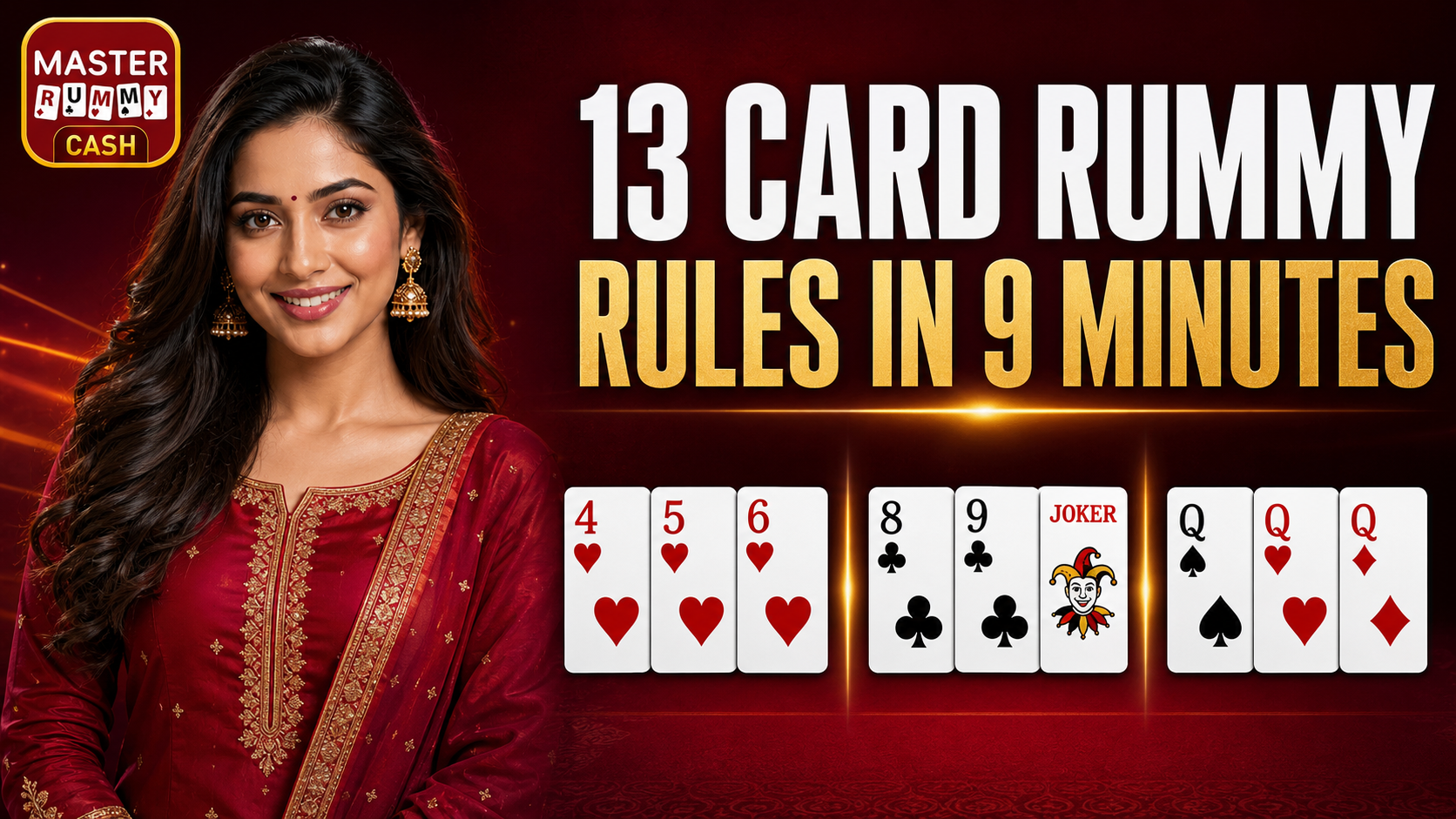
Learning how to play 13 Card Rummy becomes much easier when you stop trying to memorise every rule at once. For your first hand, focus on four decisions: protect a pure sequence, understand why you draw a card, discard with a purpose, and check every group before declaring.
This beginner walkthrough follows one complete hand from the initial sort to the final declaration. It is designed to complement our complete 13 Card Rummy rules guide, which explains the full rule set in more detail.
13 Card Rummy in one minute
Each player starts with 13 cards. The remaining cards form a closed deck, while a face-up card begins the open discard pile. On your turn, you take one card from either source and then discard one card, returning your hand to 13 cards.
Your goal is to organise every card into valid groups. A sequence uses consecutive cards of the same suit. A set uses cards of the same rank in different suits. A commonly used declaration rule requires at least two sequences, one of which must be pure—that means it is formed without using a Joker as a substitute.
Exact scoring, drop rules and table conditions can vary, so always read the rules displayed by the table or app you are using.
Before your first turn: sort the 13 cards
Do not begin by chasing every possible combination. First, arrange the cards by suit and rank. Put Hearts together, then Diamonds, Clubs and Spades. Move printed and wild Jokers to one side so you can see which natural cards are already close to forming a sequence.
Look for three types of starting groups:
- Ready groups: combinations such as 4♥-5♥-6♥ that already form a pure sequence.
- Near sequences: combinations such as 8♣-9♣ that need a 7♣ or 10♣.
- Same-rank cards: combinations such as Q♠-Q♥ that may become a set if another Queen arrives.
This first sort reduces mental clutter. If you are unsure whether a group is a sequence or a set, compare the examples in our Rummy sequence vs set guide.
Step 1: protect a pure sequence
The pure sequence is the foundation of a valid hand. If you already have three or more consecutive natural cards of the same suit, keep them together and avoid discarding from that group unless a better plan is obvious.
If the hand has 5♦-6♦, both 4♦ and 7♦ can complete a three-card pure sequence. If you hold 5♦-6♦-7♦, the group is already complete. A Joker used in place of a missing natural card creates an impure sequence, so it cannot satisfy the usual pure-sequence requirement.
Beginners often spend a Joker too early and then discover that they never completed a natural run. The safer starting rule is simple: build or protect the pure sequence first, then decide where a Joker creates the most value. See more examples in Pure Sequence in Rummy: Rules & Examples.
Step 2: draw a card for a specific reason
Every draw should answer a question. Are you completing a pure sequence, extending a useful run, forming a set, or replacing a risky unmatched card? If you cannot explain why the card helps, it may not deserve a place in the hand.
The open discard pile provides visible information: you know exactly which card you will receive, but taking it may also reveal part of your plan. The closed deck hides your intention, but the result is uncertain. Early in a learning game, choose the source that most clearly improves the structure of your hand rather than drawing automatically.
After drawing, pause and arrange all 14 cards before discarding. This short check prevents you from throwing away a card that connects two possible groups.
Step 3: discard cards that do the least work
An isolated card is a card with few realistic connections. For example, a lone 2♠ may be less useful than 7♥ beside 8♥, because the suited pair can accept either 6♥ or 9♥. High unmatched cards also deserve attention because Jacks, Queens, Kings and Aces commonly carry 10 points each when they remain outside valid groups.
That does not mean every high card should be discarded immediately. A pair such as K♣-K♦ may be close to a set, while Q♠-K♠ may be close to a sequence. Compare connection potential, point risk and the information available from the discard pile before choosing.
For more examples of weak decisions, read 4 Common 13 Card Rummy Mistakes Beginners Must Avoid.
Step 4: use Jokers after the natural structure is clear
A printed Joker or declared wild Joker can replace a missing card in an impure sequence or help complete a set under the table rules. Jokers are flexible, but they should support difficult groups rather than sit inside a combination that natural cards can already complete.
Suppose you have 8♣-9♣ and a Joker. That group can become an impure sequence while you protect a separate pure sequence. If you later draw 10♣, you can decide whether to keep the natural run and move the Joker to another incomplete group.
Always recheck the table's Joker and set rules, especially in games that use multiple decks. Duplicate cards require more care than a simple three-suit example.
A complete 13-card declaration example
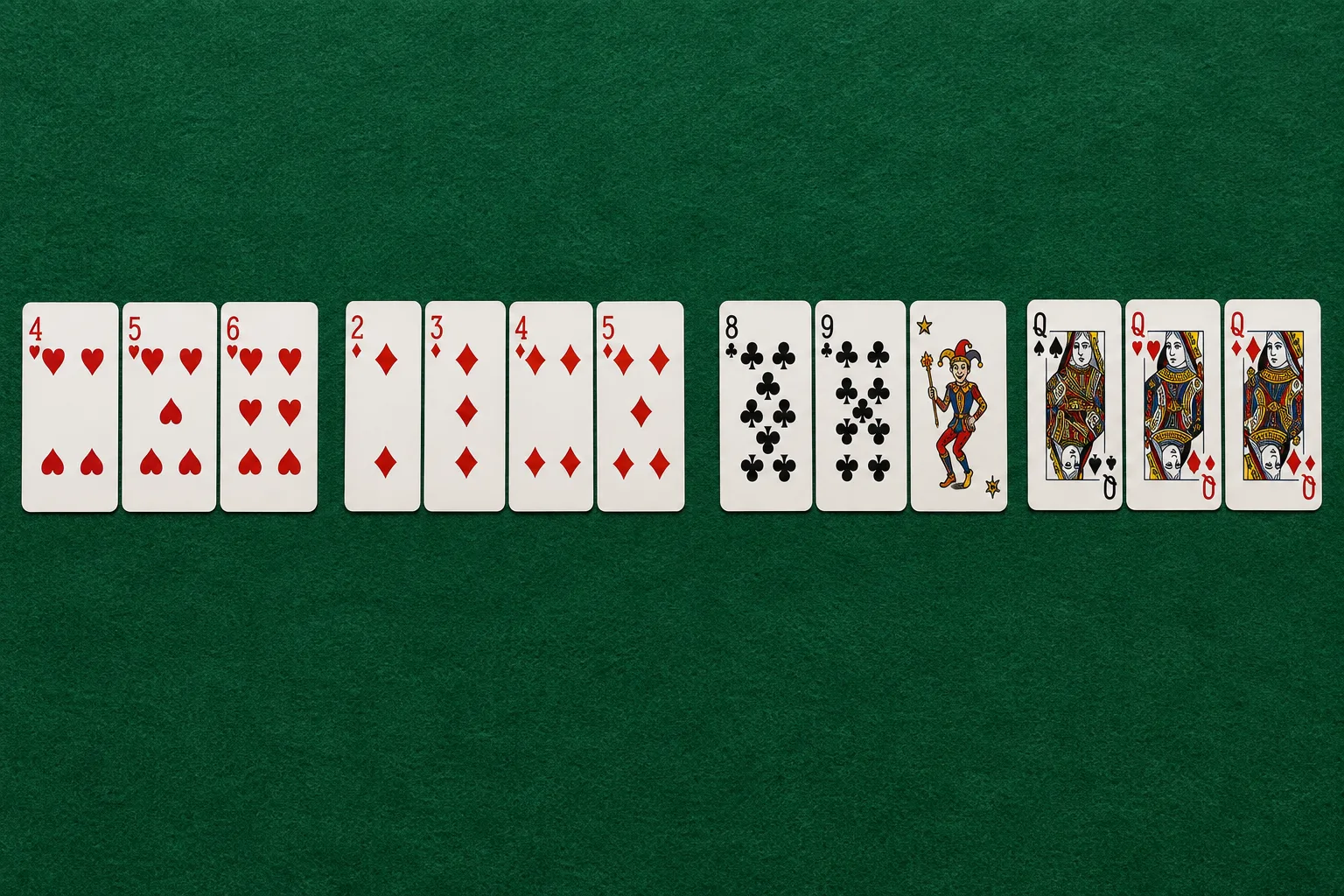
Consider this arranged hand:
- 4♥-5♥-6♥: pure sequence
- 2♦-3♦-4♦-5♦: second pure sequence
- 8♣-9♣-Joker: impure sequence
- Q♠-Q♥-Q♦: valid set
The groups contain all 13 cards. The hand has two sequences, including a pure sequence, and no card is left unmatched. Under common 13-card Indian Rummy rules, this structure is ready for a declaration.
Do not copy the shape without checking the cards. A sequence must keep the same suit, and a standard set should use the same rank in different suits. Review the valid declaration checklist before pressing Declare.
Step 5: perform a declaration check
Use this order before declaring:
- Confirm that at least one sequence is pure.
- Confirm that the hand contains the required second sequence.
- Check that every sequence uses consecutive ranks in one suit.
- Check that every set uses the same rank and permitted suits.
- Count all cards once and make sure no card sits outside a valid group.
- Check that a Joker has not been used inside the required pure sequence.
A slow five-second review is better than a fast invalid declaration. If the table shows a points total after the hand, use our 13 Card Rummy points calculation examples to understand how unmatched cards are counted.
Practise your first hand without rushing
The best way to remember the flow is to make the decisions yourself. Open the free 13 Card Rummy practice game, sort the hand, protect the pure sequence and test a declaration. The browser exercise uses fixed learning hands, so it is not a live multiplayer table and does not require payment.
You can also visit the Rummy video guides to watch short examples of sequences, Jokers and declaration checks. Once the basic pattern feels natural, return to the practice table and explain each draw and discard in one sentence.
Frequently asked beginner questions
How many cards does each player receive?
Each player normally receives 13 cards in this format. A turn adds one card and then removes one card, so the hand returns to 13.
Can a valid hand contain more than two sequences?
Yes. Two sequences are commonly the minimum requirement, not the maximum. Additional valid groups may be sequences or sets as long as every card is arranged correctly.
Can a Joker be used in a pure sequence?
A Joker used as a substitute makes the sequence impure. The required pure sequence must normally be formed with natural consecutive cards of the same suit.
Should beginners take every card from the open pile?
No. Take the open card when it clearly improves the hand. Otherwise, consider the closed deck and avoid revealing unnecessary information about the group you are building.
Your first-hand checklist
- Sort cards by suit and rank.
- Protect or build a pure sequence.
- Draw with a specific purpose.
- Discard the least connected or highest-risk card.
- Use Jokers after the natural structure is clear.
- Validate every group before declaring.
That is enough for a first session. Learn the structure, practise the decisions and check the exact rules shown at your table. Play responsibly and only where permitted; real-money play is for eligible adults aged 18 and above.