
Play Rummy Online for Free: A Beginner’s Guide
Play a free 13-card Rummy hand without registration or payment. Learn to draw, discard, use Jokers and check a declaration.
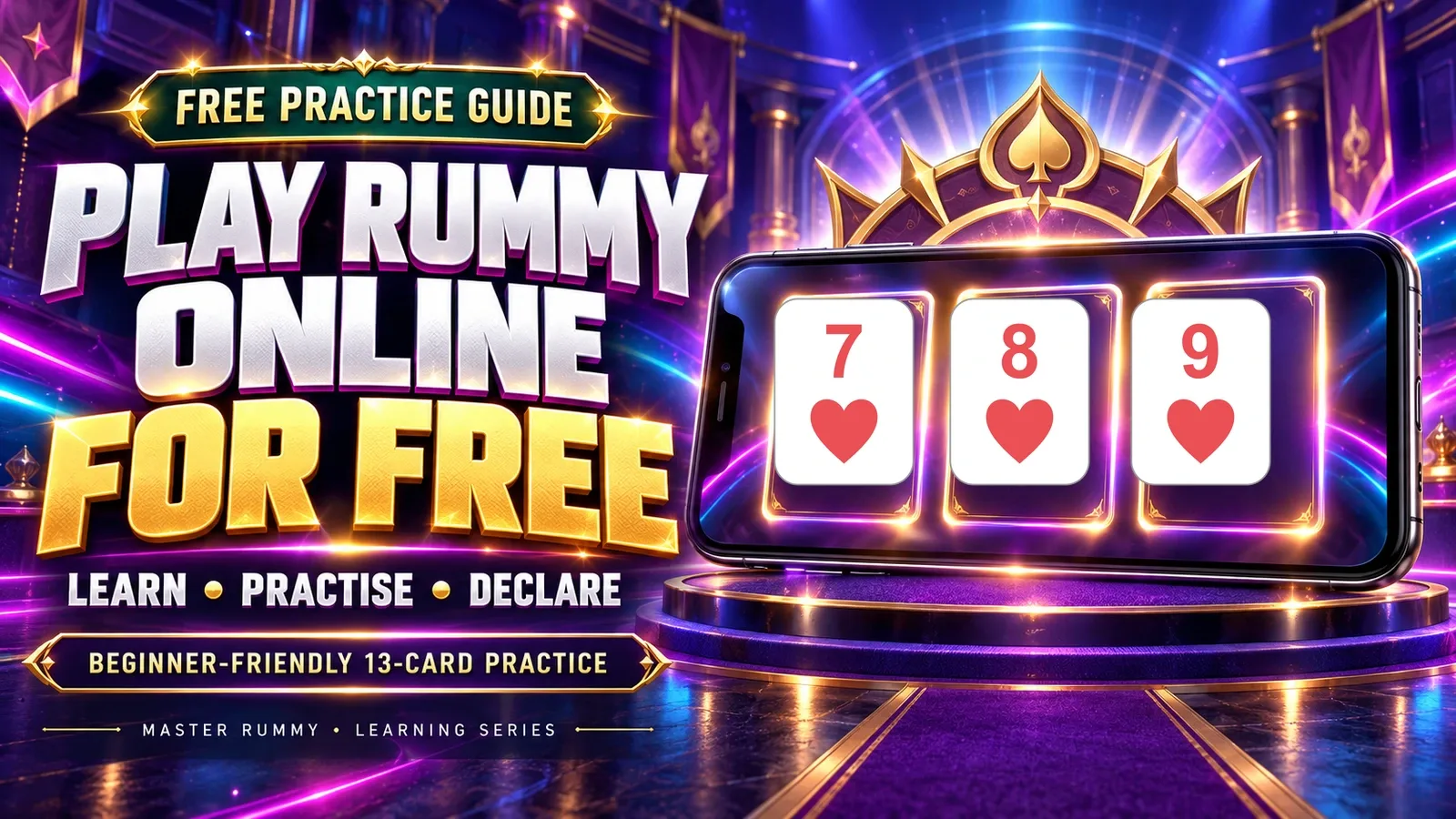
You can practise 13-card Indian Rummy in your browser without registration or payment. Start with a guided hand: draw a card, choose a discard and check your groups before declaring. The exercise is a learning simulation, not a live multiplayer table.
This guide explains how to play Rummy online for free in India, what to focus on during practice, and how to tell when you are ready for more challenging games. It is an educational guide for free and social play; no deposit or cash play is required.
What Does “Play Rummy Online for Free” Mean?
Free Rummy usually means a practice table that uses virtual points or play tokens with no cash value. You can learn the normal flow of a 13-card game without depositing money, purchasing an entry or withdrawing winnings.
A useful free-practice table should help you learn the same core decisions found in Indian Rummy:
- sorting a 13-card hand by suit or possible group;
- drawing one card from the closed deck or open discard pile;
- discarding one unwanted card at the end of each turn;
- forming sequences and sets;
- using printed and wild jokers;
- checking whether a declaration is valid.
Free practice is different from online money gaming. A free educational or social game has no stake and no cash prize. Always check the rules shown by the platform and follow the laws and age requirements that apply where you live.
Rummy Objective in One Minute
In a standard 13-card Indian Rummy round, your goal is to organise all 13 cards into valid sequences and sets. A valid declaration normally needs at least two sequences, and at least one of them must be a pure sequence made without a joker.
For example, 7♥-8♥-9♥ is a pure sequence because all three cards are consecutive and belong to the same suit. A set could be 6♠-6♥-6♣ because the cards share the same rank and use different suits.
If these terms are new, first read the 13-card Rummy learning guide and the Rummy glossary. Knowing the vocabulary makes every practice round easier to understand.
How to Start a Free Online Rummy Practice Game
1. Choose a Clearly Labelled Free Table
Open a free-practice or social-play table and confirm that no deposit, entry fee or cash prize is involved. Avoid any page that asks for payment before allowing you to learn the basic controls.
2. Learn the Table Controls
Most online tables include a closed deck, an open discard pile, your 13 cards and buttons for sorting or declaring. During each turn, draw one card and discard one card. Our online Rummy table-controls guide explains the interface and first-round flow in more detail.
3. Sort Your Hand Before Making a Plan
Group cards by suit first. Look for connected cards such as 4♣-5♣ or 10♠-J♠. Then separate pairs and same-rank cards that may become sets. Sorting reduces visual clutter and helps you avoid discarding a useful connector.
4. Build a Pure Sequence First
A pure sequence is the foundation of a valid declaration. If your opening hand contains two connected cards of the same suit, identify the missing card. For example, with 5♦ and 6♦, either 4♦ or 7♦ can extend the run.
Do not automatically chase every gap. A one-card gap such as 5♦-7♦ has only one exact natural card that completes it, while connected cards such as 5♦-6♦ have two open ends. Read pure sequence rules and examples before your first practice session.
5. Use Jokers to Support the Rest of the Hand
After protecting a natural pure sequence, use jokers to complete difficult impure sequences or sets. Do not place a joker inside your only pure sequence because that group will no longer satisfy the pure-sequence requirement.
Review the difference between a printed joker and a wild joker if the table shows both.
6. Declare Only After Checking All 13 Cards
Before pressing Declare, verify every group. Confirm that you have the required sequences, that one sequence is pure, and that no card is left outside a valid group. A fast declaration is not useful if it is invalid. Use the 13-card valid declaration checklist as a final check.
A 20-Minute Beginner Practice Routine
Randomly playing many rounds is less effective than practising one skill at a time. Try this short routine:
- Minutes 1-3 — Read the hand: sort by suit and mark every natural run, pair and isolated high card.
- Minutes 4-8 — Protect a pure sequence: choose the strongest natural run and avoid breaking it without a clear reason.
- Minutes 9-13 — Watch the discard pile: note which ranks and suits other players pick or ignore.
- Minutes 14-17 — Reduce deadwood: release isolated high cards when they are not helping a realistic sequence or set.
- Minutes 18-20 — Review: after the round, identify one useful draw, one weak discard and one group you held for too long.
Repeat this routine across several free rounds. The goal is not to “win every game.” The goal is to make fewer avoidable mistakes and recognise valid groups faster.
Five Skills to Practise for Free
Fast Hand Arrangement
Try to organise a new hand into meaningful groups within the first few turns. Do not rely only on an automatic sort button; manually checking the hand can reveal alternate sequences.
Discard-Pile Observation
The open pile contains public information. If a player takes a specific card, be cautious about discarding nearby cards of the same suit or another card of the same rank. Observation is useful, but it is not certainty: one pickup never reveals a complete hand.
Flexible Grouping
A card may fit more than one plan. The 8♥ in 7♥-8♥-9♥ may also appear useful beside two other eights, but one physical card cannot be used in two groups at the same time. Compare the complete hand before committing it.
High-Card Control
Unmatched aces and face cards may increase your points if another player declares first. Keep them when they have a realistic path to a sequence or set; otherwise consider discarding them early. See our guide to reducing high-card points in a bad hand.
Declaration Accuracy
During free practice, deliberately slow down before declaring. Read every group from left to right. Accuracy should become automatic before speed does.
Common Free-Practice Mistakes
- Playing too quickly: a countdown can create pressure, but beginners learn more by using the available time.
- Ignoring the pure sequence: attractive sets cannot replace the mandatory natural sequence.
- Keeping every high card: K, Q, J and A are not automatically valuable when they remain isolated.
- Using jokers too early: wait until you understand which natural cards should be protected.
- Copying a single fixed strategy: every 13-card hand has different probabilities and grouping options.
- Treating virtual points as proof of future results: free practice teaches rules and decisions; it does not guarantee outcomes in any other format.
How to Tell Whether Your Rummy Practice Is Working
Track decisions rather than only wins. After ten free rounds, ask:
- Can I identify my best pure-sequence option quickly?
- Do I understand why each group is valid?
- Am I discarding fewer useful connectors by mistake?
- Can I explain when a joker helps an impure sequence?
- Do I check all 13 cards before declaring?
- Can I recognise when an isolated high card has become risky?
If most answers are yes, move to stronger free opponents or a different free format. You can compare Points, Pool and Deals Rummy while continuing to practise without money.
Free Online Rummy FAQ
Can I learn Rummy online without depositing money?
Yes. Choose a clearly labelled free-practice or social table that uses points or tokens with no cash value. You should not need a deposit to learn basic rules, table controls or declarations.
Is free Rummy suitable for complete beginners?
Yes. Start by learning sequences, sets, jokers and the valid-declaration requirement. Use several low-pressure practice rounds to become familiar with drawing and discarding.
Does free practice guarantee that I will win?
No. Rummy contains uncertain draws and decisions made by other players. Practice can improve rule knowledge and reduce mistakes, but it cannot guarantee a result.
What should I practise first?
Practise identifying and protecting a pure sequence. Then work on hand arrangement, joker use, discard observation and declaration checking.
Can children play online Rummy?
Platforms may set age limits, and local rules can vary. Parents and users should follow the platform terms and applicable law. Any service restricted to adults should not be used by minors.
Start with Rules, Then Build Better Decisions
The best reason to play Rummy online for free is simple: it gives you space to learn. Begin with the pure-sequence requirement, organise every hand carefully, observe the open pile and review your decisions after each round. A short, focused practice routine is more valuable than rushing through many games.
When you are ready, open the MASTER RUMMY home page to explore the available free practice experience, or continue with our five-layer Rummy strategy guide.
Editorial note: This article is for education and free/social play. It does not promise winnings and is not legal or financial advice. Platform availability and local requirements may change, so verify current terms before playing.